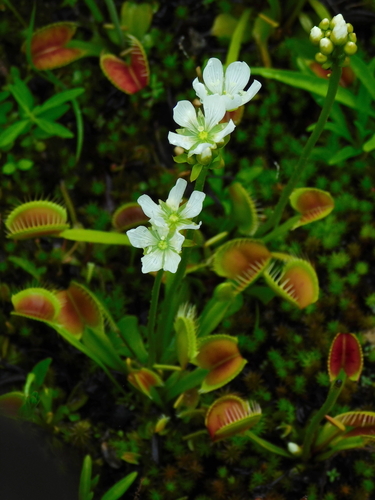
How to care for Venus flytrap
Watering
Venus flytraps grow in boggy, nutrient-poor soil in their native coastal Carolinas wetlands, so they need constantly moist soil and water that is free of minerals. Use distilled, deionized or rainwater only, because tap water and fertilizer salts build up and kill the roots. Keep the soil damp like a wrung-out sponge, never soggy-standing and never dried out. A pot with drainage holes sitting in a tray with 1 to 2 cm of water works well in spring and summer. Empty the tray in winter so the soil does not stay waterlogged while the plant rests.
Does it need water today?
Press a finger 2 cm into the soil. If it feels dry, water now. If it feels damp and cool, wait. A pot that feels light when lifted is also a sign it needs water.
Water from below by filling the tray, and let the soil soak it up over an hour. Top up the tray whenever it is empty.
Overwatering
Venus flytraps come from wet bogs, but their roots still need air to breathe. Soil that stays waterlogged, especially in winter when the plant is dormant, can lead to root rot, which is hard to reverse.
Symptoms: Black or mushy roots and stems at the base, yellowing leaves and traps, a sour or rotten smell from the soil, and sudden collapse of the plant.
Solutions: Stop watering and empty the tray. If the base is mushy, gently remove the plant, cut away black roots with clean scissors, and repot into fresh, moist sphagnum peat mixed with coarse sand in a pot with drainage holes. Keep it in bright light and avoid watering until the top layer is just starting to dry.
Underwatering
The roots of a Venus flytrap are short and shallow, so the soil dries out quickly. Without steady moisture, the plant cannot grow new traps and the roots die back.
Symptoms: Dry, crispy soil pulling away from the pot edges, blackened or dead traps, and a plant that looks pale and stalled.
Solutions: Stand the pot in a tray of distilled water right away so the soil can soak up moisture from below. Dead traps will not recover, so trim them off at the base once they are fully dark. Keep the pot in a tray with 1 cm of water for a few weeks until the plant shows fresh growth.
Sunlight
Venus flytraps need intense light to make the sugars that feed their traps and to keep their colour. Indoors, a bright south- or west-facing window is usually best. Rotate the pot every week or two so the plant grows evenly and does not lean toward the glass. Moving it outdoors into full sun in late spring gives the strongest growth.
- Ideal: Full sun · At least 4 to 6 hours of direct sun per day, and 8 or more hours is better for strong, red-tinged traps
- Tolerates: Full sun, Partial sun
- Best spot in a room: At the window
- Artificial light: If there is not enough natural light, use a full-spectrum LED grow light about 15 to 30 cm above the plant for 12 to 14 hours a day. Keep the light on a timer so the plant gets a steady day-length in spring and summer.
Too little light
In dim light, a Venus flytrap cannot make enough energy to build strong traps, and it grows long, weak stalks as it reaches for light. The traps then lose their trigger sensitivity and cannot feed.
Symptoms: Pale green or yellowing traps, long thin leaf stalks that lean toward the window, traps that stay open or do not close, and slow or no new growth.
Solutions: Move the plant to the brightest window you have or outdoors into full sun for several hours a day, introducing it slowly over a week to avoid scorch. Add a full-spectrum LED grow light if daylight is weak. Trim off the weak growth once new traps come in strong.
Too much sun
Venus flytraps are sun-loving, but they are used to open bogs, so a sudden jump from low indoor light to harsh midday sun can scorch the leaves. Very hot glass windows can also dry out the soil and stress the plant.
Symptoms: Bleached, white or brown patches on the traps, dry crispy leaf edges, and traps that turn fully red or black before they have caught anything.
Solutions: Shade the plant with a sheer curtain or move it a little away from the glass during the hottest hours of the day. Check the soil more often in hot weather, since it dries faster in strong sun. Trim scorched traps at the base once they are dark, and new growth will come back in good conditions.
Temperature
Venus flytraps need a cold winner dormancy period of roughly 3 to 4 months at about 0 to 10°C to stay healthy and grow vigorously the following year. Warm summers around 20 to 30°C with plenty of direct sun drive strong growth and trap production.
- Ideal: 5–30 °C
- Tolerates: -10–40 °C
- Hardiness zones: 7-9
Fertilizing
Venus flytraps grow in nutrient-poor bog soil and cannot absorb nutrients through their roots the way most plants do. Fertilizer, especially regular salts, burns their roots and kills them. Never use standard garden fertilizer, potting soil with added fertilizer, or tap water with high minerals. Feeding traps with live insects is optional and should be done sparingly.
- Slow-release fertilizer: not needed
- Ideally none; Venus flytraps get nutrients from insects they catch, Insect-based or fish-based fertilizer diluted to a quarter strength, only if needed, Pure distilled or rainwater for watering
Soil
Dionaea muscipula evolved in nutrient-poor, acidic bogs of the Carolinas in the USA, so it needs a mineral-free, acidic, moisture-holding mix. Ordinary potting soil, compost, or fertilizer will kill it. Use only rainwater or distilled water for both soil and watering.
- Sphagnum peat mix: Sphagnum peat moss with perlite or coarse silica sand, about 1:1, which holds moisture while staying airy.
- Carnivorous plant mix: Commercial mix made for carnivorous plants, based on sphagnum peat with added silica sand, without fertilizer or lime.
- Pure sphagnum moss: Live or dried sphagnum moss, suitable for top dressing or for growing in a shallow, humid pot, but drains more slowly than a peat and sand mix.
- pH 3.5–4.5
Repotting
Dionaea muscipula has a small, fragile root system and grows in very nutrient-poor soil. Repot gently, keep roots intact, and never fertilize the new mix. Use only rainwater or distilled water, never tap water with minerals.
- How often: Every 1-2 years, or when the pot is filled with mineral-poor peat and the soil has collapsed or stayed waterlogged
- New pot: A pot 1-2 cm wider than the root ball, with drainage holes; plastic or glazed pots are preferred because they hold moisture steadily. Avoid large pots, since excess wet soil around Dionaea muscipula roots causes rot.
- Repotting season: Spring
How to repot
- Water the plant lightly the day before, so the root ball slides out more easily without tearing.
- Gently loosen the old soil with your fingers or a wooden chopstick, working from the outside in. Do not use metal tools near the roots.
- Remove dead, black, or mushy roots and any dead leaves or traps, using clean scissors.
- Hold the plant at the same depth it was growing before, with the rhizome (the thick, horizontal base) sitting at or just above the soil surface.
- Fill around the roots with the moistened peat mix, tapping the pot gently to remove large air pockets but without compacting the soil.
- Water thoroughly from the top with distilled or rainwater until it drains from the holes, then set the pot in a tray with a few centimetres of water.
- Keep the plant out of direct harsh sun for about a week while it settles in, then return it to bright light.
Pruning
Use only clean, sharp tools, and cut close to the base of the leaf stalk without damaging the rhizome. Trim only what is dead or clearly spent, because each trap is a leaf the plant relies on for nutrition.
Pruning season: Spring, Summer, Autumn
How to prune
- In late spring, as the flower stalk begins to form, cut it off at the base before the flower opens, which helps the plant keep its energy for traps.
- Remove any trap that is fully black and dry by cutting its petiole near the base of the plant, leaving the green parts intact.
- Trim away dead leaves or dried tissue at the crown, but never pull on the traps or the rhizome, which can damage the roots.
- Remove dead material during the growing season, from spring to early autumn, and avoid heavy pruning in the weeks before winter dormancy.
- After each cut, wipe the blade and check the plant for signs of rot, such as soft, dark, or foul-smelling tissue, and remove any affected parts right away.
Propagation
Division of clumps · Spring
- In early spring, when new growth starts, lift the plant from its pot and gently shake off the loose peat-based substrate.
- Pull the rosette apart at the rhizome into sections, each with at least three or four healthy traps and roots attached.
- Repot each division into a pot filled with a mix of sphagnum peat and perlite, keeping the crown just above the soil surface.
- Stand the pots in a tray of rainwater or distilled water so the soil stays wet from below, and place them in bright light.
Leaf-pullings from rhizome · Spring, Summer
- Choose a healthy outer trap that is fully developed and has a short, thick petiole, then gently twist it away from the base so a small piece of rhizome comes with it.
- Let the cut end dry in the air for an hour so it forms a callus.
- Insert the base into moist sphagnum and perlite, keeping the trap upright and the top above the surface.
- Keep the pot in a humid, bright spot and do not feed it; new plantlets may appear over several months.
Seed sowing · Autumn, Winter
- Collect black seeds from the seed pod after it turns brown and splits, usually a few weeks after flowering in late spring.
- Store the seeds in a paper envelope in a dry, cool place until late autumn.
- Sow them on the surface of moist sphagnum peat and perlite, without covering them, since they need light to germinate.
- Cover the tray with clear plastic, keep it near a bright window, and expect seedlings after several weeks to months. Seedlings are slow and may need two or more years before they form traps.
Division is the quickest and most reliable way to get new plants of the Venus flytrap, while seed-grown plants take years to mature. Dividing in spring and keeping the pot in a tray of distilled water usually gives the best results.
About Venus flytrap
Also known as: Venus's flytrap, Venus fly-trap, Venus flytrap plant
- Plant type: carnivorous herb, rosette perennial
- Lifespan: perennial
- Distribution: Native to a small area of the coastal plain of North and South Carolina in the eastern United States.
- Mature height: 5-15 cm
- Bloom time: Late spring
Pets · People
Pets: Safe · People: Safe. Not known to be toxic to cats, dogs, or humans according to ASPCA; the traps can close on fingers but are harmless. Eating traps is not dangerous but is not a food source.
Common problems
- Blackening traps: Traps turn black after closing several times or from tap water, mineral buildup, or dormancy; normal aging is fine, but blackening of new growth signals water or nutrient problems.
- Rotting roots: Overwatering or waterlogged soil without drainage causes root rot; use a well-draining peat and sand mix and allow the top to drain.
- Mineral burn: Tap water, fertiliser or compost cause leaf and root damage; use only pure water and never feed the soil.
- Insufficient light: Weak growth, thin leaves and failure to form traps in low light; move to a bright, sunny spot or add a grow light.
- Dormancy failure: Plants kept warm all year weaken and may die; a cool winter rest of several months at 0-10 °C supports healthy growth.
Uses
Ornamental and horticultural: widely grown as a houseplant and collectible carnivorous plant. It also serves as a pest-control curiosity and an educational plant in classrooms and botanic gardens.
Is it edible?
Not edible for humans; the plant is grown for its insect-trapping leaves and has no culinary use.
History & legends
Dionaea muscipula was first described by Joseph Ellis in 1768 and was brought to European attention shortly after, when it fascinated naturalists. Charles Darwin studied it in the 1870s, and his work on insectivorous plants helped establish carnivorous plants as a serious field of botany. Its common name is linked to Venus, the Roman goddess of love and beauty, a reference to its striking appearance.
Did you know?
Each trap can count how many times its trigger hairs are touched and typically closes only after two touches within about 20 seconds, which helps it avoid wasting energy on raindrops or debris. A trap can only close around 5 to 7 times before it dies and turns black.
Frequently asked questions
How often should I water Venus flytrap?
every 3 days. Venus flytraps grow in boggy, nutrient-poor soil in their native coastal Carolinas wetlands, so they need constantly moist soil and water that is free of minerals. Use distilled, deionized or rainwater only, because tap water and fertilizer salts build up and kill the roots. Keep the soil damp like a wrung-out sponge, never soggy-standing and never dried out. A pot with drainage holes sitting in a tray with 1 to 2 cm of water works well in spring and summer. Empty the tray in winter so the soil does not stay waterlogged while the plant rests. Press a finger 2 cm into the soil. If it feels dry, water now. If it feels damp and cool, wait. A pot that feels light when lifted is also a sign it needs water.
How much light does Venus flytrap need?
Full sun (At least 4 to 6 hours of direct sun per day, and 8 or more hours is better for strong, red-tinged traps). Venus flytraps need intense light to make the sugars that feed their traps and to keep their colour. Indoors, a bright south- or west-facing window is usually best. Rotate the pot every week or two so the plant grows evenly and does not lean toward the glass. Moving it outdoors into full sun in late spring gives the strongest growth.
What temperature does Venus flytrap like?
5–30 °C. Venus flytraps need a cold winner dormancy period of roughly 3 to 4 months at about 0 to 10°C to stay healthy and grow vigorously the following year. Warm summers around 20 to 30°C with plenty of direct sun drive strong growth and trap production.
Is Venus flytrap toxic to cats and dogs?
It is safe for cats and dogs. Not known to be toxic to cats, dogs, or humans according to ASPCA; the traps can close on fingers but are harmless. Eating traps is not dangerous but is not a food source.
What are the most common problems of Venus flytrap?
Blackening traps: Traps turn black after closing several times or from tap water, mineral buildup, or dormancy; normal aging is fine, but blackening of new growth signals water or nutrient problems. Rotting roots: Overwatering or waterlogged soil without drainage causes root rot; use a well-draining peat and sand mix and allow the top to drain. Mineral burn: Tap water, fertiliser or compost cause leaf and root damage; use only pure water and never feed the soil. Insufficient light: Weak growth, thin leaves and failure to form traps in low light; move to a bright, sunny spot or add a grow light. Dormancy failure: Plants kept warm all year weaken and may die; a cool winter rest of several months at 0-10 °C supports healthy growth.
When should I repot Venus flytrap?
Every 1-2 years, or when the pot is filled with mineral-poor peat and the soil has collapsed or stayed waterlogged. Dionaea muscipula has a small, fragile root system and grows in very nutrient-poor soil. Repot gently, keep roots intact, and never fertilize the new mix. Use only rainwater or distilled water, never tap water with minerals.
How do I propagate Venus flytrap?
Division of clumps, Leaf-pullings from rhizome, Seed sowing. In early spring, when new growth starts, lift the plant from its pot and gently shake off the loose peat-based substrate. Pull the rosette apart at the rhizome into sections, each with at least three or four healthy traps and roots attached. Repot each division into a pot filled with a mix of sphagnum peat and perlite, keeping the crown just above the soil surface. Stand the pots in a tray of rainwater or distilled water so the soil stays wet from below, and place them in bright light.
How this guide was written
Verdiss writes each guide with AI from botanical references and checks the species against iNaturalist and Plants of the World Online (Kew). Readers can rate every guide in the app.
Sources
Verdiss's information is for general guidance. Never eat or use a plant as medicine based on an app: ask a professional.