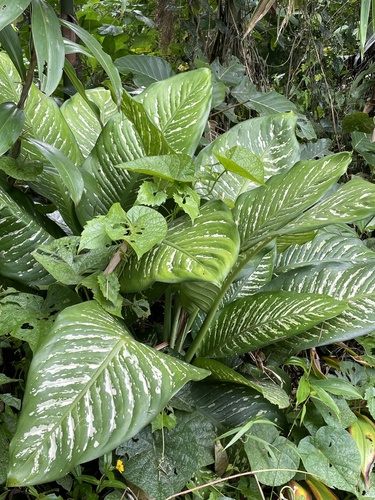
How to care for tuftroot
Watering
Dieffenbachia seguine, the tuftroot, likes its soil to dry out slightly between drinks but never to dry out completely. Its thick stems and fleshy roots store some water, so it copes better with a little dryness than with soggy feet. Water thoroughly until it runs out of the drainage holes, then empty the saucer. Use a pot with drainage and a peat-and-perlite mix that holds moisture without becoming wet.
Does it need water today?
Push a finger about 3 cm (1 inch) into the soil. If it feels dry, water today. If it still feels damp, wait a few days. You can also lift the pot: a dry pot feels noticeably lighter than one that was just watered.
Water less in winter, when growth slows and the soil stays wet longer. Lukewarm water at room temperature prevents cold shock to the roots.
Overwatering
Dieffenbachia seguine has thick, fleshy roots that rot quickly in waterlogged soil, because they need air as well as moisture. Constantly wet soil also invites bacterial stem rot, which the tuftroot is prone to.
Symptoms: Yellowing lower leaves, a soft or mushy stem base, black or brown mushy roots, a sour smell from the soil, and fungus gnats hovering around the pot.
Solutions: Stop watering and let the soil dry out. Remove the plant, cut away any black or mushy roots with clean scissors, and repot into fresh, well-draining mix in a pot with drainage holes. If the stem base is rotting, cut above the damage and try to root the healthy top section.
Underwatering
Dieffenbachia seguine uses its stored water to keep leaves firm and upright. When the soil dries out for too long, the plant quickly loses turgor, and the leaves droop to conserve moisture.
Symptoms: Drooping, limp leaves, crispy brown leaf edges, dry soil pulling away from the pot sides, and slowed growth.
Solutions: Water thoroughly using the bottom-watering method so the root ball rehydrates evenly. Mist the leaves lightly if the air is very dry. Leaves that have turned crispy won't recover, but new growth should be healthy once watering is regular.
Sunlight
Dieffenbachia seguine grows best in bright, indirect light, similar to the dappled light under a tall tree in its native tropical forest. It tolerates lower light but grows slowly and becomes leggy. Direct midday sun can scorch its broad leaves, leaving pale or brown patches.
- Ideal: Bright, indirect light · 6-8 hours of bright, filtered light per day
- Tolerates: Partial sun, Bright, indirect light
- Best spot in a room: Near the window
- Artificial light: A full-spectrum LED grow light placed 30-45 cm (12-18 inches) above the plant for 10-12 hours a day works well in dark rooms or winter months. Use a timer to keep the schedule consistent.
Too little light
Dieffenbachia seguine is a forest understory plant adapted to filtered light. In low light, it cannot make enough energy to keep its large leaves healthy, so it stretches and loses its color.
Symptoms: Leggy growth with long gaps between leaves, small new leaves, dull or faded variegation, and older leaves yellowing and dropping.
Solutions: Move the plant closer to a bright window, ideally an east or north-facing one, or supplement with a grow light. Rotate the pot a quarter turn each week so it grows evenly.
Too much sun
Dieffenbachia seguine has thin, soft leaves that are not built for strong sun. Intense direct light, especially through glass, heats the leaf tissue and destroys chlorophyll.
Symptoms: Bleached or pale yellow patches, brown crispy scorch marks on the leaves facing the window, and leaves that curl or wilt during the hottest part of the day.
Solutions: Move the plant a metre or two back from a south or west window, or add a sheer curtain. Damaged leaves won't recover, but removing them lets the plant focus on healthy growth.
Temperature
Dieffenbachia seguine, commonly called tuftroot, is a tropical aroid from the Caribbean and northern South America. Keep it warm and steady, away from cold drafts, and never let it sit below about 10°C for long.
- Ideal: 18–29 °C
- Tolerates: 10–35 °C
- Hardiness zones: 10-12
Fertilizing
Tuftroot is a fast-growing foliage plant that uses nutrients mainly to build large leaves and stems. Feed it during its active growing season from spring to early autumn, and give little or none in winter when growth slows.
- Slow-release fertilizer: Once a year in early spring, mix a small amount of slow-release fertilizer into the top layer of potting mix. Skip this step if the plant was repotted with fresh mix that already contains fertilizer.
- Balanced liquid houseplant fertilizer (such as 20-20-20) diluted to half strength, Foliage-focused fertilizer with moderate nitrogen, Slow-release granular fertilizer for indoor plants
Soil
Tuftroot needs a well-draining but moisture-holding medium rich in organic matter. Its fleshy roots rot quickly in dense, waterlogged soil, so air pockets around the roots matter as much as nutrients.
- Chunky aroid mix: Two parts peat-free potting mix, one part perlite, one part orchid bark, and a small handful of horticultural charcoal
- Peat-based houseplant mix with added perlite: Three parts standard peat-free potting compost mixed with one part perlite and a little coarse sand
- Outdoor garden bed mix for tropical shade: Two parts well-rotted leaf mould or compost, one part garden loam, and one part coarse grit or perlite
- pH 5.5–6.5
Repotting
Tuftroot (Dieffenbachia seguine) has fleshy, brittle roots that break easily and sulk if disturbed too hard, so handle the root ball gently and repot during active spring or early summer growth.
- How often: Every 2-3 years, or when roots fill the pot and emerge from drainage holes
- New pot: Move up only 2-5 cm in pot diameter at each repot; tuftroot dislikes wet soil in oversized containers
- Repotting season: Spring, Summer
How to repot
- Slide the plant out by tipping the pot on its side and gently squeezing the sides
- Loosen the outer roots with your fingers; trim any mushy, dark brown roots with clean scissors
- Place a 2-3 cm layer of fresh mix in the bottom of the new pot
- Set the plant so the base of the stems sits about 2 cm below the pot rim, then fill in around the roots
- Firm the mix lightly with your hands, leaving a small gap at the top for watering
- Water thoroughly until it drains, then empty the saucer
Pruning
Prune tuftroot in spring or early summer, when it is actively growing. Avoid heavy pruning in autumn and winter, when growth slows and cut stems heal and regrow more slowly. Always wear gloves, since the sap irritates skin and is toxic if swallowed.
Pruning season: Spring, Summer
How to prune
- Remove any yellow, brown, or damaged leaves first by cutting their stalks close to the main stem.
- To make the plant bushier, cut the top of a leggy stem about 2 to 3 cm above a healthy node.
- To renew a very bare plant, cut the tall canes back to a stub of 15 to 30 cm. Cut cleanly, just above a node.
- Expect new shoots to form from the nodes left on the stub over the next few weeks. Keep the plant warm and bright during this time.
- Save the removed stem tips and segments for propagation, as described in the propagation section.
- Wipe away sap with a damp cloth and wash your hands and tools when you finish. Do not let the sap touch your eyes or mouth.
Propagation
Stem tip cutting · Spring, Summer
- Choose a healthy, firm stem tip about 10 to 15 cm long with at least two or three leaves and one node, the slightly bumpy ring where a leaf meets the stem.
- Wear gloves and cut just below a node with a clean, sharp knife or pruners. The sap of tuftroot irritates skin and mouth, so wash your hands and tools afterward.
- Remove the lowest leaf so the bottom node is bare, and cut the remaining large leaves in half to reduce water loss.
- Let the cut end dry for about an hour so it forms a callus. Dip it in rooting hormone if you like, though it is not required.
- Insert the cutting about 3 cm deep into a pot of moist perlite, or a mix of perlite and peat. Keep it bright but out of direct sun.
- Keep the mix damp, and cover the pot loosely with a clear bag to hold humidity. Roots usually form in 3 to 6 weeks at 21 to 27°C. Pot it up once you feel resistance when you gently tug it.
Cane segment cutting · Spring, Summer
- Use a leggy plant with a bare, woody cane. Cut the cane into 5 to 8 cm pieces, making sure each piece has at least one dormant bud or node.
- Wear gloves and let the cut ends dry for a few hours, since the sap can ooze and slow rooting.
- Lay each piece flat or stand it upright in moist perlite or peat mix, with the node facing up. Bury the piece just enough to hold it in place.
- Keep the medium evenly moist and the air warm, around 24°C. Shoots usually appear from the node within several weeks, and roots follow.
- Once the new shoot has several leaves and roots are established, move the young plant into a small pot with regular potting mix.
Air layering · Spring, Summer
- Pick a healthy, mature stem with good leaves. Choose a spot about 30 to 45 cm below the crown.
- Wear gloves and make a clean upward cut about one third of the way through the stem, just below a node. Keep the cut open with a small wood chip or a matchstick.
- Dust the wound with rooting hormone if you have it, then pack damp sphagnum moss around the cut.
- Wrap the moss in clear plastic and tie both ends with twine so moisture stays in. Check every few weeks and mist the moss if it dries out.
- When white roots show through the plastic, usually after 4 to 8 weeks, cut the stem below the new root ball and pot it up in fresh potting mix. Keep it warm and humid for the first few weeks.
Tuftroot roots more reliably from stem tips with at least one node than from leaves alone. Keep the cuttings warm and bright, but never in direct midday sun, and resist overwatering, which causes stem rot before roots form.
About tuftroot
Also known as: Tuftroot, Dumb cane, Seguine dieffenbachia
- Plant type: herb, aroid, houseplant
- Lifespan: perennial
- Distribution: Native to the Caribbean islands and northern South America, including Venezuela and the Guianas.
- Mature height: 1-2 m indoors, taller in the tropics
- Bloom time: Rarely blooms indoors; occasionally in warm months
Pets · People
Pets: Toxic · People: Toxic. All parts contain insoluble calcium oxalate raphides that cause intense burning, swelling of the mouth and throat, drooling and difficulty swallowing if chewed; sap can irritate skin and eyes. Contact a vet or poison control if ingested, and wear gloves when pruning.
Common problems
- Brown leaf edges: Usually caused by low humidity, dry air or irregular watering; raise humidity and water more consistently.
- Yellowing lower leaves: Normal aging of older leaves, but excessive yellowing can indicate overwatering or root rot.
- Root rot: Soggy soil and poor drainage lead to rotting roots and collapsing stems; use a well-draining mix.
- Spider mites: Fine webbing and stippled leaves in dry conditions; wipe leaves and increase humidity.
- Leggy growth: Stretching toward low light results in long gaps between leaves; move to brighter indirect light.
Uses
Grown worldwide as a popular ornamental houseplant and in interior landscaping for its bold, variegated foliage. In tropical regions it is used in gardens and shade plantings, and it has been used in folk medicine in the Caribbean, though its toxicity limits safe use.
Is it edible?
not edible
History & legends
Dieffenbachia was named in honor of the gardener Joseph Dieffenbach at the Schönbrunn Palace gardens in Vienna, and the species was described in the 19th century from Caribbean specimens. Its sap's painful effect on the tongue led to the name 'dumb cane', and in the Caribbean it was once used in folk practices and as a remedy for skin ailments, though such uses are unsafe.
Did you know?
The genus is named after Joseph Dieffenbach, a 19th-century German gardener, and its common name 'dumb cane' comes from the mouth-numbing effect of its sap.
Frequently asked questions
How often should I water tuftroot?
every 7 days. Dieffenbachia seguine, the tuftroot, likes its soil to dry out slightly between drinks but never to dry out completely. Its thick stems and fleshy roots store some water, so it copes better with a little dryness than with soggy feet. Water thoroughly until it runs out of the drainage holes, then empty the saucer. Use a pot with drainage and a peat-and-perlite mix that holds moisture without becoming wet. Push a finger about 3 cm (1 inch) into the soil. If it feels dry, water today. If it still feels damp, wait a few days. You can also lift the pot: a dry pot feels noticeably lighter than one that was just watered.
How much light does tuftroot need?
Bright, indirect light (6-8 hours of bright, filtered light per day). Dieffenbachia seguine grows best in bright, indirect light, similar to the dappled light under a tall tree in its native tropical forest. It tolerates lower light but grows slowly and becomes leggy. Direct midday sun can scorch its broad leaves, leaving pale or brown patches.
What temperature does tuftroot like?
18–29 °C. Dieffenbachia seguine, commonly called tuftroot, is a tropical aroid from the Caribbean and northern South America. Keep it warm and steady, away from cold drafts, and never let it sit below about 10°C for long.
Is tuftroot toxic to cats and dogs?
It is toxic to cats and dogs: keep it out of their reach. All parts contain insoluble calcium oxalate raphides that cause intense burning, swelling of the mouth and throat, drooling and difficulty swallowing if chewed; sap can irritate skin and eyes. Contact a vet or poison control if ingested, and wear gloves when pruning.
What are the most common problems of tuftroot?
Brown leaf edges: Usually caused by low humidity, dry air or irregular watering; raise humidity and water more consistently. Yellowing lower leaves: Normal aging of older leaves, but excessive yellowing can indicate overwatering or root rot. Root rot: Soggy soil and poor drainage lead to rotting roots and collapsing stems; use a well-draining mix. Spider mites: Fine webbing and stippled leaves in dry conditions; wipe leaves and increase humidity. Leggy growth: Stretching toward low light results in long gaps between leaves; move to brighter indirect light.
When should I repot tuftroot?
Every 2-3 years, or when roots fill the pot and emerge from drainage holes. Tuftroot (Dieffenbachia seguine) has fleshy, brittle roots that break easily and sulk if disturbed too hard, so handle the root ball gently and repot during active spring or early summer growth.
How do I propagate tuftroot?
Stem tip cutting, Cane segment cutting, Air layering. Choose a healthy, firm stem tip about 10 to 15 cm long with at least two or three leaves and one node, the slightly bumpy ring where a leaf meets the stem. Wear gloves and cut just below a node with a clean, sharp knife or pruners. The sap of tuftroot irritates skin and mouth, so wash your hands and tools afterward. Remove the lowest leaf so the bottom node is bare, and cut the remaining large leaves in half to reduce water loss. Let the cut end dry for about an hour so it forms a callus. Dip it in rooting hormone if you like, though it is not required. Insert the cutting about 3 cm deep into a pot of moist perlite, or a mix of perlite and peat. Keep it bright but out of direct sun. Keep the mix damp, and cover the pot loosely with a clear bag to hold humidity. Roots usually form in 3 to 6 weeks at 21 to 27°C. Pot it up once you feel resistance when you gently tug it.
How this guide was written
Verdiss writes each guide with AI from botanical references and checks the species against iNaturalist and Plants of the World Online (Kew). Readers can rate every guide in the app.
Sources
Verdiss's information is for general guidance. Never eat or use a plant as medicine based on an app: ask a professional.