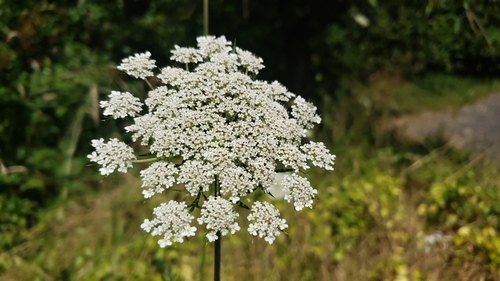
How to care for wild carrot
Watering
Wild carrot (Daucus carota), also called Queen Anne's lace, is a deep-rooted meadow plant that tolerates dry spells once established. Water young plants and container plants regularly, then ease off as they mature. Keep the soil lightly moist but never soggy, since its taproot rots in waterlogged ground.
Does it need water today?
Push a finger 2-3 cm into the soil. If it feels dry, water the plant. For pots, lift the container: a light pot needs water, while a heavy, damp pot can wait.
Wild carrot grown indoors is usually a short-lived plant, so give it steady moisture while it grows and avoid letting it wilt between waterings.
Overwatering
Wild carrot grows a single fleshy taproot that needs air in the soil to stay healthy. Wet, compacted soil quickly leads to root rot, and the plant cannot recover once the root is damaged.
Symptoms: Yellowing lower leaves, a limp or mushy base, a sour smell from the soil, and fungus gnats hovering around the pot.
Solutions: Stop watering and let the top 5 cm of soil dry out. Improve drainage by mixing in grit or perlite, and make sure the pot has drainage holes. In severe cases, unpot the plant, trim any soft brown roots, and repot in fresh, gritty mix.
Underwatering
Although wild carrot is fairly drought-tolerant in the ground, container plants dry out quickly. Its feathery leaves lose water fast in warm, bright conditions.
Symptoms: Wilting ferny foliage that stays limp after the morning, crisp brown leaf edges, and soil pulling away from the pot sides.
Solutions: Water thoroughly until it drains freely, then check again in a day or two. If the soil is hydrophobic, stand the pot in a tub of water for 30 minutes. Mulch outdoor plants with straw to slow evaporation.
Sunlight
Wild carrot is a sun-loving plant of open fields and roadsides. It produces the strongest, sturdiest growth and its lacy white flower heads when it gets full sun. In partial shade it grows taller and floppier with fewer flowers.
- Ideal: Full sun · 6-8 hours of direct sun a day
- Tolerates: Full sun, Partial sun
- Best spot in a room: At the window
- Artificial light: Use a full-spectrum grow light for 12-14 hours a day, placed 20-30 cm above the foliage. Bring the light closer or add it during short winter days.
Too little light
Wild carrot stretches toward light when it does not get enough sun, because it is adapted to open ground with few competing plants. Weak light produces thin stems and reduced flowering.
Symptoms: Long, leggy stems that lean toward the window, pale green leaves, small leaf divisions, and few or no flower heads.
Solutions: Move the plant to the sunniest spot available, ideally a south-facing window. Rotate the pot every week so it grows evenly, and supplement with a grow light in winter.
Too much sun
In very hot, reflective sites, intense midday sun can scorch the delicate, fern-like foliage of wild carrot, especially in containers that heat up quickly.
Symptoms: Bleached or brown patches on leaves, crisp edges, and wilting during the hottest hours even when the soil is moist.
Solutions: Move the plant to a spot with light afternoon shade, or use a sheer curtain. Keep the soil moist during heatwaves and mulch outdoor plants to keep roots cool.
Temperature
Wild carrot (Daucus carota) is a hardy biennial that grows happily in cool to mild weather. It forms its first-year rosette and taproot in spring and summer, then flowers in its second year. Full sun and well-drained soil matter more than precise temperature. Plants tolerate frost well but bolt quickly when hot, dry weather arrives.
- Ideal: 13–24 °C
- Tolerates: -30–38 °C
- Hardiness zones: 3-9
Fertilizing
Wild carrot is a tough, low-input plant that thrives in poor, sandy or gravelly soil. Its taproot is adapted to find nutrients deep down, so heavy feeding is unnecessary. Its main needs are good drainage and enough light. Too much nitrogen gives leafy growth at the expense of roots.
- Slow-release fertilizer: Not needed in most gardens. A light top-dressing of compost once a year in early spring is enough.
- Well-rotted compost, Balanced organic fertilizer with low nitrogen, such as a 3-4-6 blend, Bone meal for phosphorus, Seaweed-based liquid feed at half strength
Soil
Daucus carota needs loose, well-drained soil that is deep enough for its taproot to grow straight. Heavy clay or soil with stones will cause forked, stunted roots, so loosen the ground before sowing.
- Sandy loam: About 50 percent sandy loam garden soil, 30 percent coarse sand or perlite, and 20 percent compost.
- Light potting mix: Commercial potting mix blended with an equal part of coarse sand or perlite to improve drainage.
- Garden bed soil: Native soil dug to a depth of at least 30 cm, with stones and clods removed and a small amount of compost worked in.
- pH 6–7.5
Repotting
Daucus carota forms a long, straight taproot that resents disturbance. Choose a deep container with a drainage hole, and move seedlings gently so the root is not broken.
- How often: Every year for container-grown plants, since the taproot needs room to develop; garden-grown wild carrot is rarely repotted.
- New pot: A deep pot at least 30 cm tall and 20 cm wide for a single plant, because the taproot grows downward quickly. Shallow trays and short planters will stunt or fork the root.
- Repotting season: Spring
How to repot
- Tip the pot on its side and ease the root ball out gently, supporting the crown of the plant with one hand.
- Loosen the outer soil with your fingers and check the taproot for rot or damage.
- Set the plant in the new pot so the crown sits just below the soil surface, then fill around the root with fresh mix.
- Press the soil lightly with your fingers to remove large air pockets, then water thoroughly until it drains from the base.
- Place the pot in bright, indirect light for a week before moving it to full sun.
Pruning
Wild carrot produces large, flat clusters of white flowers in summer of its second year, and each flower head can hold hundreds of seeds. Removing flower heads before they set seed is the main way to control it.
Pruning season: Summer, Autumn
How to prune
- Wear gloves and use clean, sharp secateurs or scissors.
- Check flower heads every week from mid-summer onward.
- Cut each flower stalk at its base once the flower head begins to close or turn brown at the edges, before the seeds ripen and drop.
- Bag cut stalks and seed heads and put them in household waste, not compost, to stop seeds from spreading.
- Remove the entire plant, including the taproot, when you want to clear an area. Pull it out by the base when the soil is moist.
- Clean your tools and wash your hands after handling the plant.
Propagation
Autumn direct sowing · Autumn
- Choose a sunny spot with loose, well-drained soil, since wild carrot grows best in open ground.
- Rake the soil surface to a fine tilth and remove grass and weeds.
- Scatter the seeds thinly over the bed in late August to October, when the soil is still around 10 to 20 °C.
- Cover the seeds with no more than 0.5 cm of soil and press gently to make contact.
- Water lightly with a fine spray so the seeds do not wash away, and keep the soil moist until seedlings appear in one to three weeks.
- Thin seedlings to about 15 cm apart once they have a few true leaves.
Early spring direct sowing · Spring
- Wait until the soil can be worked and has warmed to about 10 °C, usually March or April in most of the Northern Hemisphere.
- Loosen the top 15 cm of soil and remove stones and old roots, because the taproot grows straight down.
- Sow seeds thinly in shallow rows, covering them with a thin layer of fine soil or compost.
- Keep the soil evenly moist, but not waterlogged, until germination.
- Thin the seedlings to about 15 cm apart and water only during dry spells.
Check local rules before sowing. In parts of North America and Australia, wild carrot is considered a weed, and its seeds spread easily. Sow only where you can keep it contained.
About wild carrot
Also known as: Queen Anne's lace, bird's nest, wild parsnip, bishop's lace
- Plant type: herb, biennial forb
- Lifespan: biennial
- Distribution: Native to Europe, temperate Asia and North Africa, and widely introduced elsewhere.
- Mature height: 0.3 to 1.2 m
- Bloom time: Late spring to early autumn in its second year
Pets · People
Pets: Toxic · People: Toxic. Wild carrot resembles poison hemlock (Conium maculatum) and other toxic umbellifers; the carrot-like smell of Daucus carota distinguishes it, and the foliage can cause skin irritation after sun exposure. Do not let pets or children chew the stems or leaves.
Common problems
- Carrot rust fly: Larvae tunnel into the taproot, leaving rusty brown trails; cover with fine insect mesh and avoid thinning in the evening.
- Aster yellows: A phytoplasma spread by leafhoppers that causes yellowed, distorted leaves and stunted roots.
- Powdery mildew: White powder on leaves in humid, crowded conditions; improve air flow and avoid wetting foliage.
- Forked or hairy roots: Caused by compacted or stony soil and excess nitrogen; loosen the soil and keep feeding light.
- Invasive self-seeding: Plants set large numbers of seeds that spread into lawns and pastures; deadhead before seed set in gardens.
Uses
Wild carrot is grown as an ornamental for its lacy umbels in meadow and cottage gardens and cut flower arrangements. Its close relative, the cultivated carrot Daucus carota subsp. sativus, was bred from it in Afghanistan for its roots, and seeds of the wild form have been used in traditional medicine as a diuretic and to support digestion.
Is it edible?
The young taproot of the first year is edible but tough and woody when older, and the seeds are used as a spice. Leaves are edible in small amounts but resemble toxic species, so do not harvest them for eating unless identification is certain.
History & legends
The plant has been known since ancient times, and Greek and Roman writers described its medicinal uses. Its common name Queen Anne's lace comes from a legend that the Queen of England pricked her finger while making lace and left a single drop of blood on the flower's dark central floret.
Did you know?
Wild carrot's flower head curls into a cup-shaped nest after pollination, which is why it is called bird's nest in parts of its range.
Frequently asked questions
How often should I water wild carrot?
every 7 days. Wild carrot (Daucus carota), also called Queen Anne's lace, is a deep-rooted meadow plant that tolerates dry spells once established. Water young plants and container plants regularly, then ease off as they mature. Keep the soil lightly moist but never soggy, since its taproot rots in waterlogged ground. Push a finger 2-3 cm into the soil. If it feels dry, water the plant. For pots, lift the container: a light pot needs water, while a heavy, damp pot can wait.
How much light does wild carrot need?
Full sun (6-8 hours of direct sun a day). Wild carrot is a sun-loving plant of open fields and roadsides. It produces the strongest, sturdiest growth and its lacy white flower heads when it gets full sun. In partial shade it grows taller and floppier with fewer flowers.
What temperature does wild carrot like?
13–24 °C. Wild carrot (Daucus carota) is a hardy biennial that grows happily in cool to mild weather. It forms its first-year rosette and taproot in spring and summer, then flowers in its second year. Full sun and well-drained soil matter more than precise temperature. Plants tolerate frost well but bolt quickly when hot, dry weather arrives.
Is wild carrot toxic to cats and dogs?
It is toxic to cats and dogs: keep it out of their reach. Wild carrot resembles poison hemlock (Conium maculatum) and other toxic umbellifers; the carrot-like smell of Daucus carota distinguishes it, and the foliage can cause skin irritation after sun exposure. Do not let pets or children chew the stems or leaves.
What are the most common problems of wild carrot?
Carrot rust fly: Larvae tunnel into the taproot, leaving rusty brown trails; cover with fine insect mesh and avoid thinning in the evening. Aster yellows: A phytoplasma spread by leafhoppers that causes yellowed, distorted leaves and stunted roots. Powdery mildew: White powder on leaves in humid, crowded conditions; improve air flow and avoid wetting foliage. Forked or hairy roots: Caused by compacted or stony soil and excess nitrogen; loosen the soil and keep feeding light. Invasive self-seeding: Plants set large numbers of seeds that spread into lawns and pastures; deadhead before seed set in gardens.
When should I repot wild carrot?
Every year for container-grown plants, since the taproot needs room to develop; garden-grown wild carrot is rarely repotted.. Daucus carota forms a long, straight taproot that resents disturbance. Choose a deep container with a drainage hole, and move seedlings gently so the root is not broken.
How do I propagate wild carrot?
Autumn direct sowing, Early spring direct sowing. Choose a sunny spot with loose, well-drained soil, since wild carrot grows best in open ground. Rake the soil surface to a fine tilth and remove grass and weeds. Scatter the seeds thinly over the bed in late August to October, when the soil is still around 10 to 20 °C. Cover the seeds with no more than 0.5 cm of soil and press gently to make contact. Water lightly with a fine spray so the seeds do not wash away, and keep the soil moist until seedlings appear in one to three weeks. Thin seedlings to about 15 cm apart once they have a few true leaves.
How this guide was written
Verdiss writes each guide with AI from botanical references and checks the species against iNaturalist and Plants of the World Online (Kew). Readers can rate every guide in the app.
Sources
Verdiss's information is for general guidance. Never eat or use a plant as medicine based on an app: ask a professional.