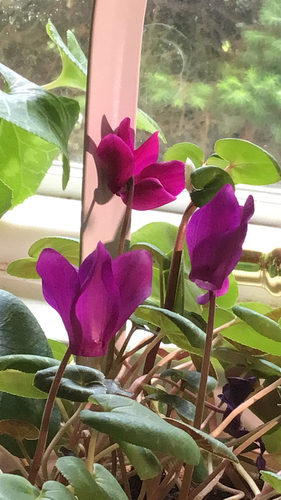
How to care for Persian Cyclamen
Watering
Persian Cyclamen (Cyclamen persicum) grows from a flattened corm that rots easily when kept wet. Water when the top layer of compost is dry, and keep the corm itself dry. Water less in winter when the plant is resting between flowerings, and more during active flowering in cool winter conditions. Use room-temperature water and avoid leaving the pot standing in water.
Does it need water today?
Push a finger about 2 cm into the compost. If it feels dry, water. If it is still damp, wait a day or two. You can also lift the pot: a light pot needs water, a heavy one does not. Check that the corm, the bulb-like swelling at soil level, is not sitting in wet compost.
Water around the edge of the pot, not over the corm and leaves. Water on the crown can cause rot. Empty the saucer within 30 minutes so the roots do not sit in water.
Overwatering
Persian Cyclamen has a fleshy corm that stores water, and its fine roots need air. Constantly wet compost deprives the roots of oxygen and invites Pythium and Botrytis fungi, which attack the corm in the cool, damp conditions this species prefers.
Symptoms: Yellowing leaves that go limp, a soft or mushy corm, a sour smell from the compost, grey fuzzy mould on the corm or leaf bases, and flower buds that turn brown and drop.
Solutions: Stop watering and let the compost dry to a depth of 2 cm. Remove any mushy or dark tissue from the corm with a clean knife and let the cut dry. Repot into fresh, fast-draining compost in a pot with holes, and make sure the corm sits at or just above the soil surface. If the corm is badly rotten, it may not recover.
Underwatering
Persian Cyclamen has thin, fleshy leaves and a corm that holds only modest reserves. In warm, dry rooms it loses water quickly, and the plant responds by collapsing its leaves and flowers to save moisture.
Symptoms: Drooping leaves and flower stalks that bend over, leaf edges turning brown and crisp, and compost that pulls away from the pot edges and feels dry and light.
Solutions: Water thoroughly using the bottom-watering method until the compost is evenly moist. Leaves and flowers often recover within a few hours to a day. Afterwards, check the moisture every few days, especially when the plant is near a heater or in a sunny window. Remove any badly damaged leaves at the base.
Sunlight
Persian Cyclamen grows in the bright, cool understorey of its native Middle Eastern mountain woodlands. It needs strong light to flower well, but direct midday sun scorches its leaves and hot light shortens flowering. Bright indirect light from a north, east or sheltered west window suits it best. In winter, a cool, bright room is ideal. Keep it away from heaters and hot radiators.
- Ideal: Bright, indirect light · 4-6 hours of bright, indirect light daily, with cooler conditions in winter
- Tolerates: Partial sun, Bright, indirect light
- Best spot in a room: Near the window
- Artificial light: A full-spectrum LED grow light or a bright LED panel placed about 30 cm above the plant, run for 10 to 12 hours a day, can keep it flowering in a room with little natural light.
Too little light
Persian Cyclamen flowers on long, slender stalks that reach toward light. Without enough brightness it cannot build the energy needed to produce buds, so the plant stretches and stops flowering.
Symptoms: Long, weak flower stalks and leaf stalks that lean toward the window, pale small leaves, few or no new flower buds, and leaves that stay flat instead of forming a neat rosette.
Solutions: Move the plant closer to a bright window, ideally an east or north-facing one, or give it a few hours of artificial light each day. Turn the pot a quarter turn each week so growth stays even. Avoid moving it into direct afternoon sun.
Too much sun
The thin, soft leaves of Persian Cyclamen are not adapted to direct sun. Strong light heats the leaves and dries the compost quickly, and it can bleach or scorch the leaf tissue.
Symptoms: Pale, bleached patches or brown scorched edges on leaves, leaves curling upward or drooping in the afternoon, and flowers that fade quickly.
Solutions: Move the plant out of direct sun, or pull back a sheer curtain on the window. Water a little more often, since the compost dries faster in strong light. Once the leaves are damaged, remove them at the base; new growth will come from the corm.
Temperature
Persian Cyclamen (Cyclamen persicum) is a tuberous perennial from the eastern Mediterranean and the Middle East that grows best in cool rooms. It thrives at 10 to 18°C, and flowers last longest when nights stay cool. Above about 20°C the plant slows down, drops buds and flowers, and yellows, so keep it away from hot radiators and sunny windows that overheat.
- Ideal: 10–18 °C
- Tolerates: 5–24 °C
- Hardiness zones: 9-11
Fertilizing
Persian Cyclamen feeds only through its roots and is sensitive to salt build-up in the soil. Feed it lightly during active growth and flowering, and stop during summer dormancy. Always water first, so the roots are not burned by dry fertilizer.
- Slow-release fertilizer: Once a year in early autumn, when new growth starts, or not needed if you repot into fresh potting mix each year.
- Balanced liquid houseplant fertilizer diluted to half strength, Low-nitrogen flowering plant fertilizer such as a tomato-style feed with higher potassium, Slow-release granular fertilizer for flowering houseplants
Soil
Persian Cyclamen needs a loose, well-drained medium that stays evenly moist but never soggy, because water sitting around the corm is the most common cause of failure. Use fresh mix each autumn, avoid heavy garden soil, and make sure the drainage holes are clear.
- Peat-free loam-based potting mix: Mix of good-quality peat-free compost, a little loam, and coarse perlite or horticultural grit at roughly 3:1:1 by volume
- Leaf mould and grit blend: Two parts leaf mould or composted bark, one part coarse sand or grit, and one part fine bark; suits growers who want a more natural, well-aerated mix
- Orchid-style bark mix: Fine bark, perlite, and a small amount of peat-free compost, which drains quickly and reduces the risk of corm rot in overwatered pots
- pH 5.5–6.5
Repotting
Persian Cyclamen grows from a flattened tuber (corm) that must stay at soil level, with the top shoulders just visible above the compost. Repot after the summer dormancy, when new leaves begin to emerge, and never bury the corm deeper than it was before.
- How often: Every 2-3 years, or when the corm has crowded the pot or sits high out of the soil
- New pot: Choose a pot only 2-4 cm wider than the corm, since Persian Cyclamen flowers best when slightly root-bound and rots in oversized pots; a 12-15 cm pot suits most corms
- Repotting season: Autumn
How to repot
- Gently tip the plant out and loosen the compost from the roots with your fingers, keeping the corm intact
- Brush away old, dark, or mushy roots and cut away any rotted parts of the corm with sterile tools, dusting cuts with sulphur powder if available
- Set the corm on the new mix with its top at or just above soil level, so the crown is exposed and the growing point is not covered
- Fill around the sides with fresh compost, firm lightly, and leave a gap of about 1 cm at the rim for watering
- Water from the base or pour carefully around the edge until moisture reaches the roots, avoiding the corm and the crown
- Place the pot in bright, indirect light at about 12-18 °C and keep it out of draughts
Pruning
Persian cyclamen should be pruned by removing, not cutting, its stems and leaves. Its flower and leaf stalks grow directly from the corm, and a cut stalk can leave an open wound that invites rot. Always remove faded flowers and old leaves at their base with a gentle twist and pull.
Pruning season: Autumn, Winter, Spring
How to prune
- Hold the base of the flower or leaf stalk close to the corm between your thumb and forefinger.
- Give the stalk a gentle twist and pull it away from the corm in one smooth motion, so it snaps off cleanly at its base.
- Do not use scissors or a knife, because cut stalks leave stubs that rot easily.
- Remove spent flowers as soon as their petals drop and the stalk begins to curl.
- Pull out yellow or dead leaves in the same way, working around the outer edge of the plant first.
- Check the corm surface after pruning. Dust any small wound with sulphur powder and let it dry in the air.
- Water from below or at the edge of the pot, keeping water off the corm, after each pruning session.
Propagation
Seed sowing · Summer, Autumn
- Buy fresh seed of Cyclamen persicum from a reputable supplier, because Persian cyclamen seed loses viability within a year or two.
- Soak the seeds in lukewarm water for 12 to 24 hours to soften the seed coat.
- Fill a shallow seed tray with a light, peat-free seed compost and water it well before sowing.
- Press the seeds lightly onto the surface and cover them with only a thin layer of compost, since they need some darkness to germinate.
- Keep the tray at about 15 to 18 °C in a dark, warm spot, such as a cupboard, and keep the compost evenly moist but never soggy.
- Germination is slow and can take several weeks to a few months. Check the tray regularly and remove the cover once shoots appear.
- Move the seedlings into bright, indirect light at around 12 to 16 °C once they have emerged. Keep them away from direct midday sun.
- When seedlings have two or three true leaves and a small corm has formed, pot them individually into small pots using a loose, well-draining potting mix.
Corm division · Summer
- Wait until the plant has entered its summer rest, when most leaves have yellowed and died back and the tuber is dry on top.
- Lift the corm carefully from the pot and gently brush away the old compost from the roots.
- Only attempt this on a large, healthy, mature corm with clearly separate growing points. Cut it into sections with a clean, sharp knife, making sure each piece has at least one bud or growing point.
- Dust the cut surfaces with sulphur or charcoal powder and let the pieces dry in the shade for a day or two.
- Pot each section in fresh, lightly moist compost, with the top of the corm just above the soil surface, and keep it cool and shaded until new leaves appear.
Persian cyclamen seed germinates best in the dark, so keep the tray covered and warm until shoots appear. Do not let the corm sit in water, and do not bury the top of a corm, as this is a common cause of rot.
About Persian Cyclamen
Also known as: Persian cyclamen, Florist's cyclamen, Alpine violet
- Plant type: herb, tuberous perennial
- Lifespan: perennial
- Distribution: Native to the eastern Mediterranean region, from southern Turkey through Lebanon, Syria, Israel and Cyprus.
- Mature height: 10-25 cm
- Bloom time: Late autumn to early spring
Pets · People
Pets: Toxic · People: Toxic. Saponins and other compounds in the tuber and leaves cause vomiting, drooling and diarrhoea if eaten; the tuber is the most concentrated part, so keep it away from curious pets and children.
Common problems
- Corm rot: Caused by overwatering or water sitting in the crown, leading to soft, collapsing tissue and wilting.
- Spider mites: Fine webbing and stippled, bronzed leaves, especially in warm, dry indoor air.
- Aphids: Cluster on flower buds and young leaves, causing distortion and sticky honeydew.
- Botrytis grey mould: Fuzzy grey mould on flowers and leaves in cool, damp, poorly ventilated conditions.
- Yellowing and dormancy: Leaves yellow in summer as the plant rests naturally; this is normal and not a sign of death if the corm is firm.
Uses
Grown worldwide as a flowering pot plant, especially as a winter gift and in florist trade, and bred into many cultivars with frilled or fragrant flowers.
Is it edible?
not edible
History & legends
Cyclamen have been cultivated for centuries in the Mediterranean and Middle East, and were described in classical writings as a remedy and a plant of love. Persian cyclamen became popular in Europe in the 1600s and was bred into the florist's plant grown today.
Did you know?
Cyclamen persicum flowers have their petals swept backward, and the flower stalk coils downward as the seed develops so the seed capsule ripens near the soil surface.
Frequently asked questions
How often should I water Persian Cyclamen?
every 10 days. Persian Cyclamen (Cyclamen persicum) grows from a flattened corm that rots easily when kept wet. Water when the top layer of compost is dry, and keep the corm itself dry. Water less in winter when the plant is resting between flowerings, and more during active flowering in cool winter conditions. Use room-temperature water and avoid leaving the pot standing in water. Push a finger about 2 cm into the compost. If it feels dry, water. If it is still damp, wait a day or two. You can also lift the pot: a light pot needs water, a heavy one does not. Check that the corm, the bulb-like swelling at soil level, is not sitting in wet compost.
How much light does Persian Cyclamen need?
Bright, indirect light (4-6 hours of bright, indirect light daily, with cooler conditions in winter). Persian Cyclamen grows in the bright, cool understorey of its native Middle Eastern mountain woodlands. It needs strong light to flower well, but direct midday sun scorches its leaves and hot light shortens flowering. Bright indirect light from a north, east or sheltered west window suits it best. In winter, a cool, bright room is ideal. Keep it away from heaters and hot radiators.
What temperature does Persian Cyclamen like?
10–18 °C. Persian Cyclamen (Cyclamen persicum) is a tuberous perennial from the eastern Mediterranean and the Middle East that grows best in cool rooms. It thrives at 10 to 18°C, and flowers last longest when nights stay cool. Above about 20°C the plant slows down, drops buds and flowers, and yellows, so keep it away from hot radiators and sunny windows that overheat.
Is Persian Cyclamen toxic to cats and dogs?
It is toxic to cats and dogs: keep it out of their reach. Saponins and other compounds in the tuber and leaves cause vomiting, drooling and diarrhoea if eaten; the tuber is the most concentrated part, so keep it away from curious pets and children.
What are the most common problems of Persian Cyclamen?
Corm rot: Caused by overwatering or water sitting in the crown, leading to soft, collapsing tissue and wilting. Spider mites: Fine webbing and stippled, bronzed leaves, especially in warm, dry indoor air. Aphids: Cluster on flower buds and young leaves, causing distortion and sticky honeydew. Botrytis grey mould: Fuzzy grey mould on flowers and leaves in cool, damp, poorly ventilated conditions. Yellowing and dormancy: Leaves yellow in summer as the plant rests naturally; this is normal and not a sign of death if the corm is firm.
When should I repot Persian Cyclamen?
Every 2-3 years, or when the corm has crowded the pot or sits high out of the soil. Persian Cyclamen grows from a flattened tuber (corm) that must stay at soil level, with the top shoulders just visible above the compost. Repot after the summer dormancy, when new leaves begin to emerge, and never bury the corm deeper than it was before.
How do I propagate Persian Cyclamen?
Seed sowing, Corm division. Buy fresh seed of Cyclamen persicum from a reputable supplier, because Persian cyclamen seed loses viability within a year or two. Soak the seeds in lukewarm water for 12 to 24 hours to soften the seed coat. Fill a shallow seed tray with a light, peat-free seed compost and water it well before sowing. Press the seeds lightly onto the surface and cover them with only a thin layer of compost, since they need some darkness to germinate. Keep the tray at about 15 to 18 °C in a dark, warm spot, such as a cupboard, and keep the compost evenly moist but never soggy. Germination is slow and can take several weeks to a few months. Check the tray regularly and remove the cover once shoots appear. Move the seedlings into bright, indirect light at around 12 to 16 °C once they have emerged. Keep them away from direct midday sun. When seedlings have two or three true leaves and a small corm has formed, pot them individually into small pots using a loose, well-draining potting mix.
How this guide was written
Verdiss writes each guide with AI from botanical references and checks the species against iNaturalist and Plants of the World Online (Kew). Readers can rate every guide in the app.
Sources
Verdiss's information is for general guidance. Never eat or use a plant as medicine based on an app: ask a professional.