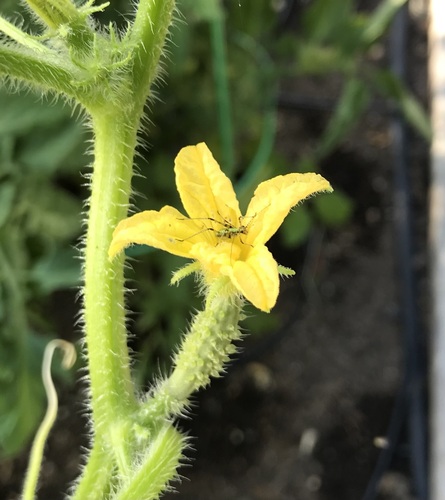
How to care for Cucumber
Watering
Cucumber (Cucumis sativus) is roughly 95% water and grows fast, so it needs steady, consistent moisture at the root zone. Keep the soil evenly damp, never soggy and never bone dry. Irregular watering causes bitter fruit, misshapen cucumbers and blossom drop. Water deeply at the base of the plant, ideally in the morning, so leaves dry quickly and mildew has less chance to start. Once fruit sets and during hot weather, plants may need water every day.
Does it need water today?
Push a finger 2-3 cm (about an inch) into the soil near the base of the plant. If it feels dry, water now. If it feels cool and moist, wait. Lifting the pot is also useful: a light pot means it is thirsty. Wilting leaves in the afternoon heat are a warning sign, but healthy plants recover by evening; if they stay limp in the morning, water immediately.
Mulch around the plants with straw or shredded leaves to keep the root zone cool and moist. This reduces watering frequency and keeps soil from splashing onto leaves, which helps prevent disease.
Overwatering
Cucumber roots need oxygen as well as water. Soggy, waterlogged soil quickly suffocates roots and encourages root rot and fungal diseases such as Pythium, which cucumbers are particularly prone to. Their large, thin leaves also lose water fast, so they depend on a balance of moisture that is easy to upset in heavy or poorly draining soil.
Symptoms: Yellowing lower leaves, wilting even when the soil is wet, brown or mushy roots and stems, stunted growth, and a sour smell from the soil.
Solutions: Stop watering and let the top few centimetres dry out before watering again. Improve drainage by adding compost or perlite and by using containers with drainage holes. Remove badly rotted leaves and stems, and make sure pots never sit in standing water.
Underwatering
Cucumbers have shallow roots and very large leaves that transpire heavily, especially in summer heat. Without a steady supply of water, they wilt quickly, stop flowering, and produce small or bitter fruit. Drought stress is one of the most common causes of poor cucumber harvests.
Symptoms: Drooping leaves that do not recover in the evening, dry crispy leaf edges, yellowing leaves, flowers dropping without setting fruit, and small, curved or bitter cucumbers.
Solutions: Water deeply and thoroughly, then check again in a day or two. Add mulch to slow evaporation. In containers, water until liquid drains from the bottom and consider a larger pot, since small containers dry out in hours during hot weather.
Sunlight
Cucumbers are warm-season plants that need strong, direct sunlight to grow vigorously and set plenty of fruit. Less than 6 hours of sun usually means fewer flowers, slower growth and a higher risk of mildew. Partial shade still allows a crop in very hot climates, where afternoon shade helps prevent leaf scorch. Cucumbers also need warmth, with soil ideally above 18°C for planting, and air temperatures between 18°C and 30°C for best growth.
- Ideal: Full sun · 6-8 hours of direct sun per day
- Tolerates: Full sun, Partial sun
- Best spot in a room: At the window
- Artificial light: Indoor cucumbers need a very bright, south-facing window or a full-spectrum grow light running 14-16 hours a day, placed 15-30 cm above the plant. Rotate the pot weekly so the plant grows evenly. Indoor growing is best limited to compact or dwarf varieties.
Too little light
Cucumber plants rely on strong sunlight to make the sugars needed for flowers and fruit. In low light they stretch toward the light, grow weak stems and produce few female flowers, so the harvest is poor even if the plant looks green and healthy.
Symptoms: Tall, leggy stems with long gaps between leaves, pale leaves, few or no flowers, male flowers only, and fruit that stays small or fails to develop.
Solutions: Move the plant to the sunniest spot available, ideally outdoors in full sun. Indoors, use a grow light for 14-16 hours a day. Thin nearby plants or remove overhanging branches that cast shade.
Too much sun
In full sun and high heat, cucumber leaves can lose more water than the roots can supply. Cucumbers are sensitive to intense afternoon sun in very hot climates, especially when young plants are moved outdoors without hardening off.
Symptoms: Bleached or papery white patches on leaves, crispy brown leaf edges, wilting at midday, and bitter fruit or sunburnt cucumbers.
Solutions: Provide light afternoon shade with shade cloth (about 30%) during heatwaves above 32°C. Water deeply in the morning, and mulch the soil. Harden off seedlings gradually over 7-10 days before planting them into full sun.
Temperature
Cucumber (Cucumis sativus) is a warm-season annual that grows fastest between 18 and 30°C. Plant seeds or transplants only after all frost danger has passed and the soil has warmed to at least 16°C. Keep it out of frost and avoid prolonged temperatures above 35°C.
- Ideal: 18–30 °C
- Tolerates: 10–35 °C
- Hardiness zones: grown as an annual; frost-tender, zones 2-11
Fertilizing
Cucumbers are heavy feeders that need steady nutrition, especially during flowering and fruiting. Feed them lightly and often rather than heavily all at once. Choose fertilizers with moderate nitrogen so the plant produces fruit instead of only leafy growth.
- Slow-release fertilizer: Mix a balanced slow-release granular fertilizer into the soil once at planting time in spring. Do not repeat it during the season unless the plant is grown in containers.
- Balanced liquid fertilizer such as 10-10-10 or 20-20-20 for general growth, Tomato or vegetable fertilizer with a moderate nitrogen level, Well-rotted compost or aged manure as a soil amendment, Fish emulsion or seaweed extract as a gentle liquid feed
Soil
Cucumber needs loose, fertile, well-draining soil rich in organic matter, which holds moisture for its shallow roots without waterlogging. Soil should be warmed to at least 15°C before planting out, because cold soil slows root growth and stunts plants.
- Loam: Roughly 40% sand, 40% silt, 20% clay, with added organic matter; the ideal base for cucumbers
- Sandy loam: Mostly sand with some silt and clay plus compost; good for early crops but needs regular feeding and watering
- Compost-rich potting mix: Peat-free or peat-based potting compost blended with 20-30% well-rotted compost and some perlite for drainage; suited to containers
- pH 6–7
Repotting
Cucumber roots are shallow, fine, and easily damaged, so handle the root ball gently and avoid disturbing it. Move seedlings only after the last frost, when night temperatures stay above 10°C.
- How often: Usually once per plant. Cucumber (Cucumis sativus) is a fast annual, so it is moved only from seed tray to its final spot or container, and not repotted again.
- New pot: Final container at least 30-40 cm wide and 30-40 cm deep for one bush or trailing cucumber plant, or 50 cm or more for a vining variety that needs support.
- Repotting season: Spring, Summer
How to repot
- Dig a planting hole about twice the width of the root ball and as deep as the root ball.
- Slide the seedling out of its tray by gently pressing the base of the cell, supporting the root ball with your fingers.
- Set the root ball in the hole so the top of the soil sits level with the surrounding ground or slightly below the container rim.
- Backfill around the root ball, firm the soil lightly, and avoid burying the stem.
- Water deeply until the soil is evenly moist and the root zone is settled.
- Space plants 60-90 cm apart in the garden, or one plant per container of the size listed above, to give the vines room to climb.
Pruning
Prune cucumbers lightly and regularly, focusing on removing side shoots and damaged or diseased leaves rather than cutting the main stem. Always use clean, sharp pruners and disinfect them between plants.
Pruning season: Summer
How to prune
- Pinch off the first few side shoots near the base of the plant to reduce crowding at the bottom.
- Once the main vine reaches the top of the trellis, pinch out the growing tip to encourage side branches.
- Remove any yellowing, damaged, or diseased leaves, cutting them at the base of the stem.
- Trim side shoots back to one or two leaves beyond a developing fruit to keep the vine focused on production.
- Remove any flowers or small fruits from the first 30 to 40 cm of the main stem to help the plant establish strong roots and growth.
- Stop pruning about two to three weeks before the end of the season so the plant can focus on ripening remaining fruit.
Propagation
Direct seeding in warm soil · Spring, Summer
- Wait until nighttime temperatures stay above 10°C and the soil reaches about 16°C or warmer, usually late spring.
- Sow two or three seeds per spot, 1.5 cm deep, spacing hills about 90 cm apart or rows 90 cm apart with seeds 30 cm apart.
- Keep the soil evenly moist but not waterlogged until seedlings appear, usually within 5 to 10 days.
- Thin to the strongest seedling per spot once it has two or three true leaves.
Starting seeds indoors · Spring
- Sow seeds indoors about 3 to 4 weeks before your last expected frost, using 7 to 10 cm pots because cucumber roots dislike disturbance.
- Place pots in a spot kept at 21 to 27°C until germination, which usually takes 3 to 6 days.
- Move seedlings to bright light for 12 to 16 hours a day, and keep them at 18 to 24°C.
- Harden off seedlings over 7 to 10 days before planting outdoors, and transplant them when they are 2 to 3 weeks old and the weather is reliably warm.
Rooting stem cuttings · Summer
- Take a 10 to 15 cm cutting from a healthy, non-flowering side shoot of a vigorous plant in early summer.
- Remove the lower leaves and place the cut end in a glass of clean water kept in bright, indirect light.
- Change the water every two days and wait for white roots to reach about 2.5 cm, usually 7 to 14 days.
- Pot the rooted cutting in moist potting mix and keep it warm and humid for a week while it establishes.
Cucumber seeds are best sown directly in the garden or in deep pots because the roots are fragile and resent transplanting. If you start seeds indoors, use biodegradable pots so you can plant the whole pot without disturbing the roots.
About Cucumber
Also known as: Garden cucumber, Common cucumber, Slicing cucumber, Salad cucumber
- Plant type: annual vine, climber, herb
- Lifespan: annual
- Distribution: Native to the Himalayan foothills of South Asia, likely northern India.
- Mature height: 1-3 m when climbing; trailing to 1 m on the ground
- Bloom time: Summer, roughly June to September in the Northern Hemisphere
Pets · People
Pets: Safe · People: Safe. Cucumber fruit is non-toxic per the ASPCA. Bitter-tasting fruit contains cucurbitacins, which can cause stomach upset in people and animals; discard any bitter cucumber rather than eating it.
Common problems
- Powdery mildew: White powdery patches on leaves caused by fungi, most common in humid conditions and late summer; improve airflow and treat early with a sulfur or potassium bicarbonate spray.
- Cucumber mosaic virus: Spread by aphids, causing mottled, distorted leaves and misshapen fruit; remove infected plants and control aphids.
- Spider mites: Tiny pests that cause stippled, bronzed leaves in hot, dry conditions; spray with water and use insecticidal soap.
- Bitter fruit: Cucumbers turn bitter from drought, heat or irregular watering; keep soil moist and harvest regularly.
- Root rot and damping off: Fungal rot from cold, waterlogged soil, especially in seedlings; use well-drained soil and avoid overwatering.
Uses
Cucumbers are grown mainly as a salad and pickling vegetable worldwide, eaten raw, sliced into salads, or fermented into pickles. They are also used in skin care and cosmetics, and in traditional cooling remedies for eyes and skin, while the seeds yield a small amount of oil.
Is it edible?
The fruit is edible raw or cooked, with the skin and seeds usually eaten; leaves and stems are not eaten. Bitter fruit should be discarded.
History & legends
Cucumbers were domesticated in South Asia and spread early along trade routes to China, the Mediterranean and Europe. The Romans were known to grow them under glass or in cloches to extend the season, and they were a favorite vegetable of Emperor Tiberius, who reportedly had them grown in frames.
Did you know?
Cucumbers are about 95 percent water, and the bitter compounds called cucurbitacins that wild and stressed plants produce are the same family of chemicals found in some drugs being studied for cancer.
Frequently asked questions
How often should I water Cucumber?
every 2 days. Cucumber (Cucumis sativus) is roughly 95% water and grows fast, so it needs steady, consistent moisture at the root zone. Keep the soil evenly damp, never soggy and never bone dry. Irregular watering causes bitter fruit, misshapen cucumbers and blossom drop. Water deeply at the base of the plant, ideally in the morning, so leaves dry quickly and mildew has less chance to start. Once fruit sets and during hot weather, plants may need water every day. Push a finger 2-3 cm (about an inch) into the soil near the base of the plant. If it feels dry, water now. If it feels cool and moist, wait. Lifting the pot is also useful: a light pot means it is thirsty. Wilting leaves in the afternoon heat are a warning sign, but healthy plants recover by evening; if they stay limp in the morning, water immediately.
How much light does Cucumber need?
Full sun (6-8 hours of direct sun per day). Cucumbers are warm-season plants that need strong, direct sunlight to grow vigorously and set plenty of fruit. Less than 6 hours of sun usually means fewer flowers, slower growth and a higher risk of mildew. Partial shade still allows a crop in very hot climates, where afternoon shade helps prevent leaf scorch. Cucumbers also need warmth, with soil ideally above 18°C for planting, and air temperatures between 18°C and 30°C for best growth.
What temperature does Cucumber like?
18–30 °C. Cucumber (Cucumis sativus) is a warm-season annual that grows fastest between 18 and 30°C. Plant seeds or transplants only after all frost danger has passed and the soil has warmed to at least 16°C. Keep it out of frost and avoid prolonged temperatures above 35°C.
Is Cucumber toxic to cats and dogs?
It is safe for cats and dogs. Cucumber fruit is non-toxic per the ASPCA. Bitter-tasting fruit contains cucurbitacins, which can cause stomach upset in people and animals; discard any bitter cucumber rather than eating it.
What are the most common problems of Cucumber?
Powdery mildew: White powdery patches on leaves caused by fungi, most common in humid conditions and late summer; improve airflow and treat early with a sulfur or potassium bicarbonate spray. Cucumber mosaic virus: Spread by aphids, causing mottled, distorted leaves and misshapen fruit; remove infected plants and control aphids. Spider mites: Tiny pests that cause stippled, bronzed leaves in hot, dry conditions; spray with water and use insecticidal soap. Bitter fruit: Cucumbers turn bitter from drought, heat or irregular watering; keep soil moist and harvest regularly. Root rot and damping off: Fungal rot from cold, waterlogged soil, especially in seedlings; use well-drained soil and avoid overwatering.
When should I repot Cucumber?
Usually once per plant. Cucumber (Cucumis sativus) is a fast annual, so it is moved only from seed tray to its final spot or container, and not repotted again.. Cucumber roots are shallow, fine, and easily damaged, so handle the root ball gently and avoid disturbing it. Move seedlings only after the last frost, when night temperatures stay above 10°C.
How do I propagate Cucumber?
Direct seeding in warm soil, Starting seeds indoors, Rooting stem cuttings. Wait until nighttime temperatures stay above 10°C and the soil reaches about 16°C or warmer, usually late spring. Sow two or three seeds per spot, 1.5 cm deep, spacing hills about 90 cm apart or rows 90 cm apart with seeds 30 cm apart. Keep the soil evenly moist but not waterlogged until seedlings appear, usually within 5 to 10 days. Thin to the strongest seedling per spot once it has two or three true leaves.
How this guide was written
Verdiss writes each guide with AI from botanical references and checks the species against iNaturalist and Plants of the World Online (Kew). Readers can rate every guide in the app.
Sources
Verdiss's information is for general guidance. Never eat or use a plant as medicine based on an app: ask a professional.