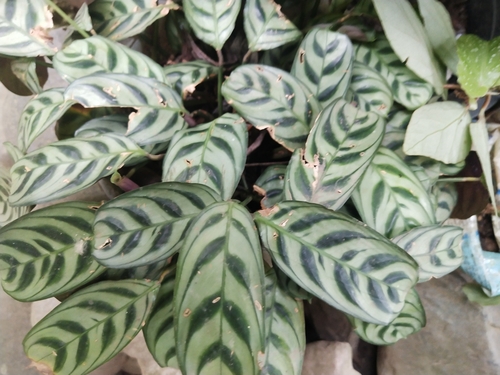
How to care for Ctenanthe burle-marxii
Watering
Ctenanthe burle-marxii, known as Never Never Plant or Burle Marx's ctenanthe, has thin, delicate roots that dislike sitting in wet soil. Keep the potting mix evenly lightly moist during spring and summer, letting roughly the top 2-3 cm dry out between waterings. Reduce watering noticeably in winter, when growth slows. Use water at room temperature, and avoid hard tap water or heavy fertilizer salts, which can cause brown leaf edges. Good drainage through the pot and a chunky, peat-based mix that holds some moisture but drains freely are key. Humidity also matters: this plant loses water fast through its leaves, so it needs regular moisture in the air.
Does it need water today?
Push a finger about 2-3 cm into the soil. If it feels dry, water now. If it feels damp, wait a few days and check again. You can also lift the pot: a pot that feels light and dry needs water, while a heavy pot can wait. Look at the leaves too. Slight curling in the morning often means thirst, but leaves that stay curled and turn crisp mean the plant is dry. Leaves that are soft, yellowing and droopy usually mean too much water.
Water slowly until a little drains from the bottom, then empty the saucer after 15 minutes so the roots never sit in water. Pair watering with misting or a pebble tray to keep the leaves from drying out.
Overwatering
Ctenanthe burle-marxii has shallow, fine roots that rot quickly in soggy, poorly aerated soil. In its native Brazilian Atlantic forest understory, it grows in rich but well-draining conditions, so constantly wet compost is a serious risk.
Symptoms: Yellowing lower leaves, soft or mushy stems near the soil, a sour smell from the pot, and leaves that droop even though the soil is wet.
Solutions: Stop watering and let the soil dry to the top few centimetres. Remove the plant from its pot, trim any black or mushy roots with clean scissors, and repot into fresh, well-draining mix in a pot with drainage holes. Empty saucers after watering and water less often in winter.
Underwatering
Because its leaves are thin and transpire heavily, Ctenanthe burle-marxii shows thirst quickly. It needs steady moisture at the root zone to keep its leaves flat and its patterned foliage vivid.
Symptoms: Leaves curl tightly and stay curled, edges turn brown and crisp, new leaves are small, and the soil pulls away from the pot wall.
Solutions: Water thoroughly until it drains from the bottom, then soak the pot in a basin for 20 minutes if the mix has become dry and hydrophobic. Increase humidity with a pebble tray or grouping plants together, and keep the plant away from heating vents, which speed up moisture loss.
Sunlight
Ctenanthe burle-marxii is native to the shaded understory of Brazil's Atlantic forest, where tall trees filter the sun. Bright, indirect light brings out the silver and dark green patterning on its leaves. Direct midday sun scorches the foliage, leaving bleached or brown patches, while deep shade causes leggy growth and dull, faded coloration. Morning sun for an hour or two is usually fine, as long as the afternoon sun is blocked by a sheer curtain or distance from the glass.
- Ideal: Bright, indirect light · 6-8 hours of bright, filtered light per day
- Tolerates: Partial sun, Shade
- Best spot in a room: Near the window
- Artificial light: If natural light is weak, use a full-spectrum LED grow light about 30-45 cm above the foliage for 10 to 12 hours a day. Keep the light on a timer so the plant gets a consistent day length, and raise the light as the plant grows.
Too little light
Ctenanthe burle-marxii relies on bright filtered light to power its large, patterned leaves. In low light, it cannot make enough energy to maintain its foliage, so it stretches and loses colour.
Symptoms: Leaves become smaller and darker green with faded patterning, stems grow long and weak, new growth is sparse, and the plant leans toward the nearest light source.
Solutions: Move the plant closer to an east- or north-facing window, or to a bright spot a few feet from a south-facing window with a sheer curtain. Rotate the pot a quarter turn each week for even growth and add a grow light if needed.
Too much sun
The thin, shade-adapted leaves of Ctenanthe burle-marxii are easily damaged by strong direct sun. Intense light dries the tissue and bleaches the silver markings, which the plant cannot recover from quickly.
Symptoms: Pale, bleached or whitish patches on the leaves, crispy brown scorched edges, curling leaves during the day, and faded colour across the whole plant.
Solutions: Move the plant out of direct sun to a spot with filtered light, or add a sheer curtain to a south or west window. Trim badly scorched leaves at the base with clean scissors. New leaves will grow in with normal patterning once the light is gentler.
Temperature
Ctenanthe burle-marxii, commonly called Never Never Plant or Burle Marx's ctenanthe, is a tropical understory plant from the Brazilian Atlantic forest. It grows best in steady warmth between 18 and 26°C, away from drafts and sudden swings. Keep it indoors year-round in most climates, and bring it inside before nights drop toward 12°C.
- Ideal: 18–26 °C
- Tolerates: 12–32 °C
- Hardiness zones: 11-12
Fertilizing
Ctenanthe burle-marxii is a light feeder with thin, sensitive roots that burn easily. Feed only while it is actively growing in spring and summer, and always water the soil before applying fertilizer. Pause feeding in winter when growth slows.
- Slow-release fertilizer: Once a year in early spring, if the plant is in a pot with fresh soil; not needed if you repot annually with new potting mix.
- Balanced liquid houseplant fertilizer, such as 10-10-10 or 20-20-20, diluted to half strength, Liquid fertilizer for foliage plants with a moderate nitrogen content, Slow-release granular houseplant fertilizer with micronutrients
Soil
Ctenanthe burle-marxii needs a soil that stays evenly moist yet drains freely, because its fine roots rot quickly in dense or soggy mix. Its native habitat is the humid understory of Brazilian forests, where leaf litter keeps the ground loose and acidic.
- Peat-based potting mix: Sphagnum peat with perlite or coarse sand, roughly 3 parts peat to 1 part perlite
- Aroid-style mix: Peat or coco coir, orchid bark, and perlite in roughly equal parts
- Humus-rich African violet mix: Peat, perlite, and a little vermiculite, with no heavy garden soil
- pH 5.5–6.5
Repotting
Ctenanthe burle-marxii, commonly called Never Never Plant or Burle Marx prayer plant, has fine, shallow roots and dislikes being left in waterlogged soil. Repot gently and keep the pot only slightly larger than the root ball.
- How often: Every 2 years, or when roots fill the pot
- New pot: Move up only 2-5 cm in diameter at a time, using a pot with drainage holes
- Repotting season: Spring, Summer
How to repot
- Gently tip the pot on its side and ease the plant out, supporting the stems at the base
- Loosen the outer roots with your fingers. Trim away any black, mushy roots with clean scissors
- Place a 2-3 cm layer of fresh mix in the new pot and set the plant so the top of the root ball sits about 2 cm below the rim
- Fill around the roots with mix, firming lightly with your fingertips to remove large air pockets
- Water thoroughly until it drains from the holes, then empty the saucer
- Keep the pot out of direct sun and avoid fertilizing for about 4-6 weeks
Pruning
Use clean, sharp scissors and cut leaf stalks at the base, close to the soil line, without leaving stubs. Only remove leaves that are fully yellow, badly torn, or heavily browned. Never remove more than about a third of the plant's foliage at one time, because Burle Marx's ctenanthe needs its leaves to make energy for the rhizomes.
Pruning season: Spring, Summer
How to prune
- Look over the whole plant and identify leaves that are yellow, crispy, or split beyond repair.
- Follow each leaf stalk down to the soil and make a clean cut close to the base.
- Remove any dead or dried flower stalks in the same way.
- Wipe the cut tools with rubbing alcohol before moving to the next leaf.
- Rinse the leaves you removed away from the pot and dispose of them so pests or disease do not spread.
- Water lightly afterward, and move the plant away from draughts while it recovers.
Propagation
Division at repotting · Spring
- Wait until the plant is root-bound, with roots circling the pot or pushing out of the drainage holes, which usually happens every two to three years.
- Slide the plant out of its pot and gently shake off loose soil so you can see the rhizome clumps.
- Pull or cut the clump into sections, making sure each piece has several upright shoots and a healthy set of roots.
- Pot each section in a container only slightly larger than its root ball, using a chunky, well-draining aroid mix with peat-free compost, perlite, and bark.
- Water lightly, then keep the pots out of direct sun in bright, indirect light at 18 to 24 °C until new growth appears.
Stem cuttings in water · Spring, Summer
- Choose a healthy stem with at least two or three leaves and a visible node, the small bump where a leaf meets the stem.
- Cut just below a node with clean, sharp scissors or a knife.
- Place the cutting in a glass of room-temperature water so the lowest node is submerged, and remove any leaves that would sit below the waterline.
- Set the glass in bright, indirect light and change the water every few days to prevent rot.
- Once roots are two to three centimetres long, pot the cutting in a well-draining mix and keep the soil lightly moist.
Be patient: Burle Marx's ctenanthe often takes several weeks to root and can sulk for a while after division. Keep humidity high, around 50 to 60 percent, and cover new divisions loosely with a plastic bag for the first two weeks if your air is dry.
About Ctenanthe burle-marxii
Also known as: Burle Marx ctenanthe, Never never plant, Brazilian ctenanthe
- Plant type: herb, rhizomatous perennial
- Lifespan: perennial
- Distribution: Native to the Atlantic Forest understory of southeastern Brazil.
- Mature height: 30-60 cm indoors
- Bloom time: Rarely flowers indoors; flowers are small and white when they do appear.
Pets · People
Pets: Safe · People: Safe. Listed as non-toxic to cats, dogs and horses by the ASPCA; no significant toxic effects are reported for people.
Common problems
- Brown leaf edges: Usually caused by low humidity or dry air; raise humidity and water more evenly.
- Yellowing leaves: Often from overwatering or soggy soil leading to root rot; let the soil dry more between waterings.
- Curling leaves: Commonly a sign of underwatering or cold drafts; check soil moisture and move away from vents.
- Spider mites: Fine webbing and speckled leaves in dry conditions; wipe leaves and raise humidity.
- Faded pattern: Too much direct sun or too little light can dull the silver markings; move to brighter indirect light.
Uses
Grown almost entirely as an indoor ornamental for its patterned foliage, and used in interior design and botanical collections. It has no notable culinary, medicinal or industrial uses.
Is it edible?
not edible
History & legends
Ctenanthe burle-marxii was named in honour of Roberto Burle Marx, the Brazilian landscape architect who championed native tropical plants in gardens. It was introduced to horticulture in the twentieth century and has since become a popular houseplant in Europe and North America.
Did you know?
Its leaves fold upward at night in a movement called nyctinasty, a habit shared with many plants of the prayer plant family.
Frequently asked questions
How often should I water Ctenanthe burle-marxii?
every 7 days. Ctenanthe burle-marxii, known as Never Never Plant or Burle Marx's ctenanthe, has thin, delicate roots that dislike sitting in wet soil. Keep the potting mix evenly lightly moist during spring and summer, letting roughly the top 2-3 cm dry out between waterings. Reduce watering noticeably in winter, when growth slows. Use water at room temperature, and avoid hard tap water or heavy fertilizer salts, which can cause brown leaf edges. Good drainage through the pot and a chunky, peat-based mix that holds some moisture but drains freely are key. Humidity also matters: this plant loses water fast through its leaves, so it needs regular moisture in the air. Push a finger about 2-3 cm into the soil. If it feels dry, water now. If it feels damp, wait a few days and check again. You can also lift the pot: a pot that feels light and dry needs water, while a heavy pot can wait. Look at the leaves too. Slight curling in the morning often means thirst, but leaves that stay curled and turn crisp mean the plant is dry. Leaves that are soft, yellowing and droopy usually mean too much water.
How much light does Ctenanthe burle-marxii need?
Bright, indirect light (6-8 hours of bright, filtered light per day). Ctenanthe burle-marxii is native to the shaded understory of Brazil's Atlantic forest, where tall trees filter the sun. Bright, indirect light brings out the silver and dark green patterning on its leaves. Direct midday sun scorches the foliage, leaving bleached or brown patches, while deep shade causes leggy growth and dull, faded coloration. Morning sun for an hour or two is usually fine, as long as the afternoon sun is blocked by a sheer curtain or distance from the glass.
What temperature does Ctenanthe burle-marxii like?
18–26 °C. Ctenanthe burle-marxii, commonly called Never Never Plant or Burle Marx's ctenanthe, is a tropical understory plant from the Brazilian Atlantic forest. It grows best in steady warmth between 18 and 26°C, away from drafts and sudden swings. Keep it indoors year-round in most climates, and bring it inside before nights drop toward 12°C.
Is Ctenanthe burle-marxii toxic to cats and dogs?
It is safe for cats and dogs. Listed as non-toxic to cats, dogs and horses by the ASPCA; no significant toxic effects are reported for people.
What are the most common problems of Ctenanthe burle-marxii?
Brown leaf edges: Usually caused by low humidity or dry air; raise humidity and water more evenly. Yellowing leaves: Often from overwatering or soggy soil leading to root rot; let the soil dry more between waterings. Curling leaves: Commonly a sign of underwatering or cold drafts; check soil moisture and move away from vents. Spider mites: Fine webbing and speckled leaves in dry conditions; wipe leaves and raise humidity. Faded pattern: Too much direct sun or too little light can dull the silver markings; move to brighter indirect light.
When should I repot Ctenanthe burle-marxii?
Every 2 years, or when roots fill the pot. Ctenanthe burle-marxii, commonly called Never Never Plant or Burle Marx prayer plant, has fine, shallow roots and dislikes being left in waterlogged soil. Repot gently and keep the pot only slightly larger than the root ball.
How do I propagate Ctenanthe burle-marxii?
Division at repotting, Stem cuttings in water. Wait until the plant is root-bound, with roots circling the pot or pushing out of the drainage holes, which usually happens every two to three years. Slide the plant out of its pot and gently shake off loose soil so you can see the rhizome clumps. Pull or cut the clump into sections, making sure each piece has several upright shoots and a healthy set of roots. Pot each section in a container only slightly larger than its root ball, using a chunky, well-draining aroid mix with peat-free compost, perlite, and bark. Water lightly, then keep the pots out of direct sun in bright, indirect light at 18 to 24 °C until new growth appears.
How this guide was written
Verdiss writes each guide with AI from botanical references and checks the species against iNaturalist and Plants of the World Online (Kew). Readers can rate every guide in the app.
Sources
Verdiss's information is for general guidance. Never eat or use a plant as medicine based on an app: ask a professional.