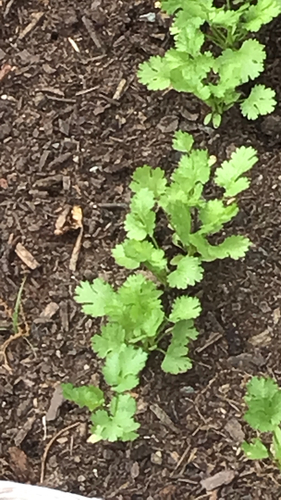
How to care for coriander
Watering
Coriander (Coriandrum sativum) is a fast-growing annual herb that wants evenly moist soil and does not tolerate drying out. Keep the compost lightly damp at all times, especially while seedlings are establishing and when the plant is forming leaves. Once it begins to flower, it can tolerate slightly drier conditions, but leaf quality drops quickly if it wilts. Water at the base of the plant in the morning so foliage dries before evening.
Does it need water today?
Push a finger 2 cm into the soil. If it feels dry at that depth, water now. If it feels cool and slightly damp, wait a day. Lifting the pot is also useful: a light pot means it is thirsty, a heavy pot means it has enough water.
Coriander bolts (runs to seed) quickly when stressed by heat or drought. Consistent watering keeps the leaves tender and delays flowering, so you get more harvests.
Overwatering
Coriander has delicate, shallow roots that rot quickly in waterlogged soil. Its taproot is prone to damping-off in seedlings and root rot in pots with poor drainage, so too much water can kill it faster than too little.
Symptoms: Yellowing lower leaves, stems that turn soft and translucent near the soil line, a sour smell from the soil, fungus gnats, and seedlings that collapse at the base.
Solutions: Let the top 2 cm of soil dry before watering again. Make sure the pot has drainage holes and never leave it standing in water. Improve the mix with perlite or sand, and move the plant somewhere with more airflow. Remove badly affected plants, since the roots cannot recover.
Underwatering
Coriander has shallow roots and large, soft leaves that lose water quickly in warm or windy conditions. Dry soil makes it wilt rapidly and triggers early flowering, which makes the leaves bitter.
Symptoms: Drooping, limp leaves, browning leaf edges, dry compost pulling away from the pot sides, and stems that begin to flower early with a sharp, soapy taste.
Solutions: Water thoroughly until moisture drains from the base, then check again the next day. For container plants, soak the pot in a tray for 20 minutes if the compost has shrunk away from the sides. Mulch outdoor beds with compost or straw to hold moisture, and provide light shade in hot weather.
Sunlight
Coriander grows best with bright light for most of the day but benefits from some afternoon shade when temperatures climb above about 25°C. Full sun in spring and autumn produces lush leaves, while strong summer sun in hot climates encourages bolting. Coriander prefers cool conditions, and growth slows sharply below about 7°C.
- Ideal: Partial sun · 4-6 hours of direct sun in cool weather, with light afternoon shade in hot weather
- Tolerates: Full sun, Partial sun, Bright, indirect light
- Best spot in a room: At the window
- Artificial light: A full-spectrum LED grow light set 15 to 30 cm above the plants for 12 to 14 hours a day will keep indoor coriander growing well through winter. Use the light on a timer to avoid long, weak stems.
Too little light
Coriander needs strong light to build its leafy growth. In dim conditions the stems stretch and the plant produces thin, pale leaves with weak flavour, because it cannot make enough energy to support new leaves.
Symptoms: Leggy, pale stems that lean toward the light, small leaves spaced far apart, slow growth, and very mild flavour.
Solutions: Move the plant to the sunniest window, ideally south or west facing in the Northern Hemisphere. Add a grow light for 12 to 14 hours a day. Rotate the pot every few days so growth stays even.
Too much sun
Coriander is a cool-season herb with delicate leaves. Intense midday sun, especially above about 30°C, scorches the foliage and speeds up flowering, which makes the leaves bitter and short-lived.
Symptoms: Bleached or crispy leaf edges, wilting in the afternoon even when the soil is moist, pale yellow or white patches on the leaves, and early flower stalks.
Solutions: Provide light shade from about midday to late afternoon using a shade cloth or by positioning the plant behind taller plants. Water in the morning to help the plant cope with heat. Sow new batches every 3 to 4 weeks so you always have young, tender plants.
Temperature
Coriander (Coriandrum sativum) is a cool-season annual herb that grows best between 10 and 24°C. It bolts (flowers and goes bitter) quickly once temperatures stay above about 25°C or days get long, so plan sowings for spring and autumn.
- Ideal: 10–24 °C
- Tolerates: -5–35 °C
- Hardiness zones: 2-11 (grown as an annual)
Fertilizing
Coriander is a light feeder grown mainly for its leaves, so too much nitrogen produces lush foliage with weak flavor and encourages early bolting. Feed lightly and keep the soil moist, rich in organic matter, and well drained.
- Slow-release fertilizer: Not needed for most gardens. If your soil is poor, mix a small handful of slow-release granules into the bed once in early spring before sowing.
- Balanced liquid fertilizer such as 10-10-10 or a fish emulsion, Compost or well-rotted manure worked into the soil before sowing, Slow-release granular fertilizer with a balanced formula
Soil
Coriandrum sativum grows best in fertile, well-drained soil that stays evenly moist but never waterlogged. Its taproot needs loose soil to a depth of at least 20 cm.
- Light loam-based potting mix: Peat-free compost blended with about 25 percent perlite or coarse sand.
- Garden loam with added compost: Two parts well-drained garden loam, one part well-rotted compost, and one part sharp sand.
- Sandy loam for open ground: Sandy loam with compost worked in to a depth of 20-30 cm before sowing.
- pH 6.2–7
Repotting
Coriander has a deep taproot that resents disturbance, so transplant only when seedlings are small and handle the roots gently.
- How often: Every year or two for container plants, since coriander is an annual that bolts quickly and is usually sown fresh rather than repotted.
- New pot: Use a pot 15-20 cm deep with good drainage, because the long taproot of Coriandrum sativum needs depth more than width.
- Repotting season: Spring, Summer
How to repot
- Tip the pot on its side and gently ease the root ball out, supporting the stem at the base.
- Loosen the outer roots with your fingers, keeping the central taproot intact wherever possible.
- Place a layer of mix in the new pot so the top of the root ball sits about 2 cm below the rim.
- Set the plant in the centre, fill around it with mix, and press lightly to remove large air pockets.
- Water thoroughly until it drains from the holes, then keep the plant in partial shade for a few days.
Pruning
Coriander is an annual herb, so pruning is about harvesting leaves and removing flower stalks, not shaping woody growth. Cut stems above a leaf node and never remove more than about one third of the plant at once.
Pruning season: Spring, Summer
How to prune
- Harvest the outer leaves first, cutting individual stems at the base or just above a leaf node.
- Pinch out flower buds as soon as you see them forming at the stem tips to slow bolting.
- If a plant has started to bolt, cut back the tall flower stalks to encourage side shoots, though leaf flavour will become stronger and more bitter.
- Remove any yellowed or damaged leaves at the base to improve airflow and reduce fungal problems.
- Stop pruning when flowering is well underway and let the plant finish, if you want seeds.
Propagation
Direct seeding · Spring, Autumn
- Sow coriander seeds directly into the bed or container, since coriander dislikes having its taproot disturbed.
- Sow seeds about 1 cm deep and 15 cm apart in rows, or scatter them and thin later.
- Keep the soil evenly moist until seedlings appear, usually within 7 to 14 days at about 15 to 20 °C.
- Thin seedlings to about 15 cm apart once they have two or three true leaves.
Succession sowing · Spring, Summer, Autumn
- Sow a small batch of seeds every 2 to 3 weeks rather than all at once.
- Stop sowing once daytime temperatures stay above about 25 °C, because the plants will bolt quickly in heat.
- Choose slow-bolting varieties if you want leaves through summer.
Saving seed · Summer, Autumn
- Leave a few healthy plants to flower and set seed rather than harvesting them all for leaves.
- When the seed heads turn brown and dry, cut the stems and hang them upside down in a paper bag.
- Rub the dried seeds from the heads, remove chaff, and store them in a cool, dry, sealed jar.
Crush the seeds lightly before sowing or soak them overnight in water to speed germination. Sow where the plants will grow to maturity, and avoid moving seedlings once they are established.
About coriander
Also known as: cilantro, Chinese parsley, dhania
- Plant type: herb, annual
- Lifespan: annual
- Distribution: Native to the eastern Mediterranean, southwestern Asia and the Caucasus region.
- Mature height: 30-70 cm
- Bloom time: Late spring to summer
Pets · People
Pets: Safe · People: Safe. Coriandrum sativum is listed as non-toxic to cats and dogs by the ASPCA, and its leaves and seeds are used as food; however, large amounts of the fresh leaves may upset a pet's stomach, and the ASPCA lists related plants in the same family that are toxic, so identify the species carefully.
Common problems
- Bolting: Heat and long days trigger early flowering, making leaves bitter; sow in cool seasons and choose slow-bolt varieties.
- Aphids: Colonies cluster on tender new growth and flower stalks; rinse with water or use insecticidal soap.
- Powdery mildew: White powdery patches appear in humid, crowded conditions; improve airflow and water at the base.
- Root rot: Waterlogged soil causes taproot decay and wilting; use well-draining soil and deep, drained containers.
- Leaf miners and caterpillars: Larvae tunnel into leaves or feed on foliage; hand-pick pests and use row covers.
Uses
Leaves are used fresh in salsas, chutneys, curries, and salads across Asian, Latin American, and Middle Eastern cuisines, while the dried seeds are a core spice in garam masala, pickling blends, and baked goods. Coriander seed oil is used in perfumery, liqueurs, and soaps, and the plant has traditional digestive and antimicrobial applications.
Is it edible?
Leaves, stems and seeds are edible; leaves are used fresh, while seeds are dried or ground and used whole or powdered. Roots are also eaten in Thai cooking.
History & legends
Coriander seeds have been found in ancient Egyptian tombs, including that of Tutankhamun, and the plant is mentioned in Sanskrit texts and the Hebrew Bible. Ancient Greeks and Romans used it as a flavoring and medicine, and it spread across Europe and Asia through trade and cultivation.
Did you know?
Fresh coriander leaves and dried seeds come from the same plant yet taste so different that many people think they are unrelated; the aroma of the leaves comes largely from compounds that are reduced when the plant matures into seed.
Frequently asked questions
How often should I water coriander?
every 3 days. Coriander (Coriandrum sativum) is a fast-growing annual herb that wants evenly moist soil and does not tolerate drying out. Keep the compost lightly damp at all times, especially while seedlings are establishing and when the plant is forming leaves. Once it begins to flower, it can tolerate slightly drier conditions, but leaf quality drops quickly if it wilts. Water at the base of the plant in the morning so foliage dries before evening. Push a finger 2 cm into the soil. If it feels dry at that depth, water now. If it feels cool and slightly damp, wait a day. Lifting the pot is also useful: a light pot means it is thirsty, a heavy pot means it has enough water.
How much light does coriander need?
Partial sun (4-6 hours of direct sun in cool weather, with light afternoon shade in hot weather). Coriander grows best with bright light for most of the day but benefits from some afternoon shade when temperatures climb above about 25°C. Full sun in spring and autumn produces lush leaves, while strong summer sun in hot climates encourages bolting. Coriander prefers cool conditions, and growth slows sharply below about 7°C.
What temperature does coriander like?
10–24 °C. Coriander (Coriandrum sativum) is a cool-season annual herb that grows best between 10 and 24°C. It bolts (flowers and goes bitter) quickly once temperatures stay above about 25°C or days get long, so plan sowings for spring and autumn.
Is coriander toxic to cats and dogs?
It is safe for cats and dogs. Coriandrum sativum is listed as non-toxic to cats and dogs by the ASPCA, and its leaves and seeds are used as food; however, large amounts of the fresh leaves may upset a pet's stomach, and the ASPCA lists related plants in the same family that are toxic, so identify the species carefully.
What are the most common problems of coriander?
Bolting: Heat and long days trigger early flowering, making leaves bitter; sow in cool seasons and choose slow-bolt varieties. Aphids: Colonies cluster on tender new growth and flower stalks; rinse with water or use insecticidal soap. Powdery mildew: White powdery patches appear in humid, crowded conditions; improve airflow and water at the base. Root rot: Waterlogged soil causes taproot decay and wilting; use well-draining soil and deep, drained containers. Leaf miners and caterpillars: Larvae tunnel into leaves or feed on foliage; hand-pick pests and use row covers.
When should I repot coriander?
Every year or two for container plants, since coriander is an annual that bolts quickly and is usually sown fresh rather than repotted.. Coriander has a deep taproot that resents disturbance, so transplant only when seedlings are small and handle the roots gently.
How do I propagate coriander?
Direct seeding, Succession sowing, Saving seed. Sow coriander seeds directly into the bed or container, since coriander dislikes having its taproot disturbed. Sow seeds about 1 cm deep and 15 cm apart in rows, or scatter them and thin later. Keep the soil evenly moist until seedlings appear, usually within 7 to 14 days at about 15 to 20 °C. Thin seedlings to about 15 cm apart once they have two or three true leaves.
How this guide was written
Verdiss writes each guide with AI from botanical references and checks the species against iNaturalist and Plants of the World Online (Kew). Readers can rate every guide in the app.
Sources
Verdiss's information is for general guidance. Never eat or use a plant as medicine based on an app: ask a professional.