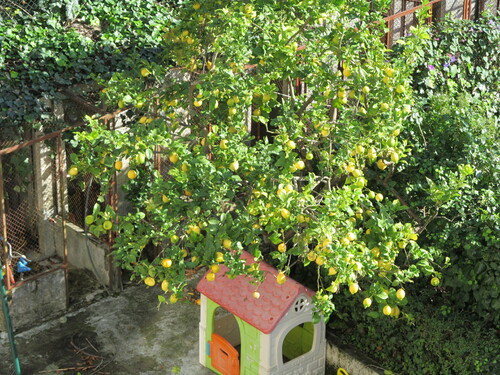
How to care for Citrus limon
Watering
Lemon trees (Citrus limon) like evenly moist soil that is never waterlogged. Let the top few centimetres dry out between waterings, then water thoroughly until it drains from the pot's base. Use a pot with drainage holes and a well-draining citrus or potting mix. Reduce watering in winter, when growth slows and roots take up less water. Lemon leaves that curl, yellow, or drop often signal a watering problem, so check the soil before changing your routine.
Does it need water today?
Push a finger 3-4 cm into the soil near the trunk. If it feels dry, water now. If it feels damp, wait a few days. Also lift the pot: a light pot means the soil is dry, while a heavy pot means it still holds water.
Water slowly so the soil absorbs it evenly rather than running straight down the sides. Empty the saucer within 30 minutes so the roots do not sit in water.
Overwatering
Lemon trees are sensitive to soggy roots because Citrus limon grows in well-drained soil and its fine roots need oxygen. When soil stays wet, the roots rot and cannot move water up to the leaves, even though the soil seems full of moisture.
Symptoms: Yellowing leaves that drop, especially older leaves; a sour or musty smell from the soil; fungus gnats; soft, dark, or mushy roots; wilting even though the soil is wet.
Solutions: Stop watering and let the soil dry out for several days. Make sure the pot drains freely and empty any saucer. If the roots are brown and mushy, repot into fresh, dry citrus mix, trimming off rotten roots with clean scissors. Move the tree to a bright spot with good airflow while it recovers.
Underwatering
Lemon trees need steady moisture to keep their leaves and fruit. Citrus limon has shallow roots and thin leaves, so it loses water quickly in heat and dry air, and the root ball can pull away from the pot edge when it dries out.
Symptoms: Drooping or curled leaves, crisp brown leaf edges, leaf drop, dry soil that pulls away from the pot, and fruit that shrivels or drops early.
Solutions: Water thoroughly until water drains from the base. If the soil has shrunk away from the sides, soak the pot in a tray of water for 30 minutes. Then keep the soil evenly moist, and mist or group plants to raise humidity during dry indoor weather.
Sunlight
Lemon trees need strong light to flower and set fruit. Citrus limon grows best in full sun outdoors, and indoors it needs the brightest window you have. Gradually move the tree into full sun in spring to avoid leaf scorch. Rotate the pot every week or two so the canopy grows evenly.
- Ideal: Full sun · 6-8 hours of direct sun per day
- Tolerates: Full sun, Partial sun, Bright, indirect light
- Best spot in a room: At the window
- Artificial light: If natural light is weak, use a full-spectrum LED grow light for 10-12 hours a day, placed 30-60 cm above the canopy. Lemon trees also do well under strong grow lights in winter.
Too little light
Lemon trees need strong, direct light to make the sugars that support flowering and fruiting. Citrus limon becomes leggy and weak in low light, and it is unlikely to produce fruit without enough sun.
Symptoms: Long, spindly stems with pale, small leaves; leaves dropping from the lower branches; no flowers or fruit; growth leaning toward the window.
Solutions: Move the tree to the sunniest window, ideally a south-facing one in the Northern Hemisphere, or outdoors in summer. Add a full-spectrum LED grow light for 10-12 hours a day. Turn the pot regularly so growth does not lean.
Too much sun
Lemon trees can handle a lot of sun, but a sudden jump from indoor shade to harsh midday sun burns the leaves. Citrus limon has thin leaves and dark, exposed fruit that can be damaged by intense heat and reflected light.
Symptoms: Pale, bleached, or white patches on the leaves; crispy brown leaf edges; fruit with sunburned, sunken spots; leaves wilting in the afternoon even when the soil is moist.
Solutions: Move the tree to bright, filtered light or give it some afternoon shade for a week or two. Acclimatise it gradually when moving it outdoors. Water well during hot spells, since heat increases water loss through the leaves.
Temperature
Lemon trees (Citrus limon) grow best in warm, sunny conditions between about 13 and 29 °C. Young trees and fruit are damaged by frost, so bring container lemons indoors before temperatures fall below about 5 °C, and protect in-ground trees on frosty nights.
- Ideal: 13–29 °C
- Tolerates: -2–38 °C
- Hardiness zones: 9-11
Fertilizing
Lemon trees are heavy feeders that need steady nitrogen for leaves and fruit, plus magnesium, iron, and zinc to keep leaves green. Feed during active growth and stop in late autumn so new, tender growth does not form before winter.
- Slow-release fertilizer: Apply a balanced citrus slow-release fertilizer once a year in early spring, as growth begins, and optionally again in midsummer for container trees.
- Citrus-specific slow-release granular fertilizer with a balanced or slightly nitrogen-heavy formula, such as 3-1-2 or 4-2-4 (with micronutrients), Liquid citrus or acid-loving plant fertilizer with iron, magnesium, and zinc, Organic options such as well-rotted compost, fish emulsion, or alfalfa meal
Soil
Lemon trees (Citrus limon) need fast-draining soil that stays moist but never waterlogged. Their roots need oxygen, so heavy clay or dense compost that holds water will cause root rot. A slightly acidic to neutral pH suits them best.
- Citrus potting mix: A blend of peat-free or peat-based potting compost with added perlite or coarse bark, often with a little garden loam for stability.
- Loam-based mix for large containers: Two parts loam or garden topsoil, one part coarse grit or perlite, and one part organic compost. Suitable for big pots where a heavier mix helps prevent tipping.
- Free-draining garden bed soil: Native sandy loam amended with compost and coarse sand or grit. Only use where drainage is excellent and the tree is planted in the ground.
- pH 6–7.5
Repotting
Use a pot with drainage holes, a sharp knife or pruning shears, a fresh well-draining citrus potting mix, and gloves. Work in early spring as new growth begins, or in summer when the tree is warm and actively growing.
- How often: Every 2-3 years for young lemon trees; mature trees in large containers can go 3-4 years between repots, with top-dressing in between.
- New pot: Move up only one pot size (about 2-5 cm wider in diameter) each time. Lemon trees (Citrus limon) with oversized pots stay wet and can develop root rot.
- Repotting season: Spring, Summer
How to repot
- Lay the pot on its side and gently tap the edges until the root ball loosens. Pull the trunk base gently to slide it out.
- Remove about one-third of the old soil by teasing it away from the outer roots with your fingers. Keep as many fine roots as you can.
- Trim any black, mushy, or dead roots with clean shears. Shorten long, circling roots by about one-third so they grow outward.
- Set the tree in the new pot so the graft union (the swollen knob near the base, if present) stays at least 5 cm above the soil line.
- Backfill with fresh citrus mix around the sides, pressing lightly to remove large air pockets without compacting it.
- Water thoroughly until water drains freely from the holes, then top up the soil level if it has settled.
Pruning
Prune lightly and regularly rather than heavily in one session. Lemon trees fruit on new growth, so remove no more than about a quarter of the canopy in any single year, and never cut back into bare old wood that has no leaves, as it may not regrow.
Pruning season: Spring, Summer
How to prune
- Remove all dead, diseased or damaged wood first, cutting back to healthy tissue just above a bud or side shoot.
- Cut out water sprouts, the vigorous upright shoots growing from the trunk or main branches, and suckers arising below the graft union on grafted trees.
- Thin crowded interior branches so that light reaches the centre of the canopy, and remove any branches that cross or rub against each other.
- Shorten overly long branches by cutting back to a strong outward-facing bud or lateral shoot, which keeps the shape open and balanced.
- Trim the crown to a rounded or open-vase shape, keeping the lower trunk free of thorny growth for easier harvesting.
- Clear fallen leaves and pruned material from around the base of the tree and dispose of diseased material rather than composting it.
Propagation
Semi-hardwood cutting under mist or humidity dome · Spring, Summer
- Choose a healthy, non-fruiting shoot from the current season's growth of a Citrus limon tree, about 10 to 15 cm long, with three or four leaf nodes and firm, partly woody stems.
- Cut just below a node with clean, sharp secateurs dipped in 70% isopropyl alcohol.
- Strip the lower two leaves and, if the leaves are large, halve the remaining ones to reduce water loss.
- Dip the cut end in a rooting hormone powder containing IBA (indole-3-butyric acid) and tap off the excess.
- Insert the cutting about 3 cm deep into a pot of moist, well-draining mix of perlite and peat or coir.
- Cover with a clear plastic bag or humidity dome, keep the mix moist but never soggy, and place in bright indirect light at 22 to 28 °C.
- Check for roots after 8 to 12 weeks by gently tugging the cutting; resistance means roots have formed. Then gradually open the cover over two weeks.
Air layering on a mature branch · Spring, Summer
- Pick a pencil-thick, healthy branch of a lemon tree that is at least one year old and growing in good light.
- Make a ring cut through the bark about 2 to 3 cm wide, then scrape away the green layer beneath so the pale wood is exposed.
- Dust the exposed wood with rooting hormone gel.
- Wrap a handful of damp sphagnum moss around the wound and secure it with clear plastic film, sealing both ends with tape.
- Keep the moss moist by checking every couple of weeks and re-wetting it as needed.
- After roots show through the moss, usually in 2 to 4 months, cut the branch below the new roots and pot it up in a container with citrus-suited mix.
Seed germination from fresh seed · Spring
- Extract seeds from a fresh, ripe lemon and rinse off all pulp, since residue encourages mould.
- Sow seeds about 1 cm deep in a pot of moist seed-starting mix right away, because citrus seeds lose viability when they dry out.
- Keep the pot at 20 to 25 °C in bright light and water lightly to keep the mix damp.
- Expect germination in 2 to 6 weeks. Seedlings will not produce true-to-type lemons and may take 5 to 10 years to fruit, so this method suits growing a rootstock or a novelty plant rather than a reliable fruiting tree.
Lemon cuttings root more reliably when taken from wood that has just firmed up after a flush of spring growth. Most home growers get better results from air layering than from cuttings, and a grafted lemon will bear fruit years sooner than any plant grown from seed.
About Citrus limon
Also known as: Lemon tree, Common lemon, Eureka lemon
- Plant type: tree, evergreen citrus
- Lifespan: perennial
- Distribution: Native range is uncertain, likely northeastern India, Myanmar and southern China, where it has been cultivated for a very long time.
- Mature height: 3-6 m
- Bloom time: Spring, with sporadic flowering through the year in warm climates
Pets · People
Pets: Toxic · People: Mildly toxic. Leaves, peel, seeds and stems contain psoralens and limonene-type oils that can irritate the mouth and stomach and cause skin photosensitivity in some people; the fruit pulp is generally tolerated in small amounts by dogs and cats, but the peel and oils should be kept away from pets and children.
Common problems
- Citrus leaf miner: Larvae tunnel through new leaves, causing silvery, twisted trails and deformed growth.
- Scale insects: Sap-sucking pests that cluster on stems and leaves, leaving sticky honeydew and sooty mold.
- Yellowing leaves from overwatering: Waterlogged roots cause chlorosis and leaf drop, especially in pots without drainage.
- Iron or magnesium deficiency: Yellow leaves with green veins show up in alkaline or poorly drained soil.
- Citrus canker: A bacterial disease producing raised corky lesions on leaves and fruit; it is more common outdoors in humid regions.
Uses
Lemons are prized in cooking, baking, beverages and preserves for their acidic juice and zest, and the essential oil from the peel is used in perfumery, cleaning products and flavouring. In traditional medicine the juice has been used for vitamin C intake and as a digestive aid, and the fruit has long been a staple of household and cultural rituals across the Mediterranean.
Is it edible?
The fruit juice, pulp and zest are edible; the peel is used in cooking and the leaves and flowers are used in teas and infusions in some cultures.
History & legends
Lemons spread from Asia into the Middle East and the Mediterranean, reaching Europe through Arab trade routes around the early medieval period. They became symbols of fertility and hospitality in many cultures and appear in Renaissance paintings and gardens as status symbols.
Did you know?
Lemons are a hybrid, most likely a cross between a citron and a bitter orange, and the fruit is picked green and then ripens to yellow off the tree.
Frequently asked questions
How often should I water Citrus limon?
every 7 days. Lemon trees (Citrus limon) like evenly moist soil that is never waterlogged. Let the top few centimetres dry out between waterings, then water thoroughly until it drains from the pot's base. Use a pot with drainage holes and a well-draining citrus or potting mix. Reduce watering in winter, when growth slows and roots take up less water. Lemon leaves that curl, yellow, or drop often signal a watering problem, so check the soil before changing your routine. Push a finger 3-4 cm into the soil near the trunk. If it feels dry, water now. If it feels damp, wait a few days. Also lift the pot: a light pot means the soil is dry, while a heavy pot means it still holds water.
How much light does Citrus limon need?
Full sun (6-8 hours of direct sun per day). Lemon trees need strong light to flower and set fruit. Citrus limon grows best in full sun outdoors, and indoors it needs the brightest window you have. Gradually move the tree into full sun in spring to avoid leaf scorch. Rotate the pot every week or two so the canopy grows evenly.
What temperature does Citrus limon like?
13–29 °C. Lemon trees (Citrus limon) grow best in warm, sunny conditions between about 13 and 29 °C. Young trees and fruit are damaged by frost, so bring container lemons indoors before temperatures fall below about 5 °C, and protect in-ground trees on frosty nights.
Is Citrus limon toxic to cats and dogs?
It is toxic to cats and dogs: keep it out of their reach. Leaves, peel, seeds and stems contain psoralens and limonene-type oils that can irritate the mouth and stomach and cause skin photosensitivity in some people; the fruit pulp is generally tolerated in small amounts by dogs and cats, but the peel and oils should be kept away from pets and children.
What are the most common problems of Citrus limon?
Citrus leaf miner: Larvae tunnel through new leaves, causing silvery, twisted trails and deformed growth. Scale insects: Sap-sucking pests that cluster on stems and leaves, leaving sticky honeydew and sooty mold. Yellowing leaves from overwatering: Waterlogged roots cause chlorosis and leaf drop, especially in pots without drainage. Iron or magnesium deficiency: Yellow leaves with green veins show up in alkaline or poorly drained soil. Citrus canker: A bacterial disease producing raised corky lesions on leaves and fruit; it is more common outdoors in humid regions.
When should I repot Citrus limon?
Every 2-3 years for young lemon trees; mature trees in large containers can go 3-4 years between repots, with top-dressing in between.. Use a pot with drainage holes, a sharp knife or pruning shears, a fresh well-draining citrus potting mix, and gloves. Work in early spring as new growth begins, or in summer when the tree is warm and actively growing.
How do I propagate Citrus limon?
Semi-hardwood cutting under mist or humidity dome, Air layering on a mature branch, Seed germination from fresh seed. Choose a healthy, non-fruiting shoot from the current season's growth of a Citrus limon tree, about 10 to 15 cm long, with three or four leaf nodes and firm, partly woody stems. Cut just below a node with clean, sharp secateurs dipped in 70% isopropyl alcohol. Strip the lower two leaves and, if the leaves are large, halve the remaining ones to reduce water loss. Dip the cut end in a rooting hormone powder containing IBA (indole-3-butyric acid) and tap off the excess. Insert the cutting about 3 cm deep into a pot of moist, well-draining mix of perlite and peat or coir. Cover with a clear plastic bag or humidity dome, keep the mix moist but never soggy, and place in bright indirect light at 22 to 28 °C. Check for roots after 8 to 12 weeks by gently tugging the cutting; resistance means roots have formed. Then gradually open the cover over two weeks.
How this guide was written
Verdiss writes each guide with AI from botanical references and checks the species against iNaturalist and Plants of the World Online (Kew). Readers can rate every guide in the app.
Sources
Verdiss's information is for general guidance. Never eat or use a plant as medicine based on an app: ask a professional.