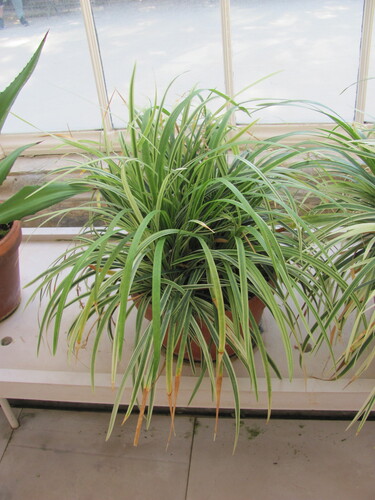
How to care for Spider plant
Watering
Spider plants (Chlorophytum comosum) have thick, fleshy storage roots that tolerate short dry spells, but they grow best when the soil is kept evenly lightly moist during spring and summer. Water thoroughly until it drains from the bottom of the pot, then empty the saucer. Reduce watering in winter when growth slows. Brown leaf tips often signal mineral buildup or dry air rather than too little water, so use filtered or rested tap water if your water is hard.
Does it need water today?
Push your finger about 2 cm into the potting mix. If it feels dry, water now. If it still feels damp, wait a few days. You can also lift the pot: a dry pot feels noticeably lighter than one that was just watered.
Water in the morning so the foliage has time to dry, and let the top layer of soil dry slightly between waterings to prevent root rot.
Overwatering
Spider plants are fairly forgiving, but their fleshy roots can rot in soggy soil, which blocks oxygen and lets fungal pathogens take hold. Chlorophytum comosum is especially prone to this in pots without drainage holes or in cool, dim rooms where soil stays wet for days.
Symptoms: Yellowing leaves starting at the base, soft or mushy roots and crown, a sour smell from the soil, and slow growth with few new plantlets.
Solutions: Stop watering and let the soil dry out to the middle of the pot. Trim away black, mushy roots with clean scissors, repot into fresh well-draining mix in a pot with drainage holes, and resume watering only when the top few centimeters are dry.
Underwatering
Spider plants store some water in their roots, so brief dryness is tolerated. However, prolonged drought stresses the foliage and stops the plant from producing its arching runners and plantlets, which need steady moisture.
Symptoms: Crispy brown leaf tips and edges, limp or curling leaves, soil pulling away from the pot sides, and fewer or smaller plantlets.
Solutions: Water thoroughly using the bottom-watering method to rehydrate the root ball. Trim damaged brown tips with clean scissors following the leaf's natural shape, then return to a regular watering schedule.
Sunlight
Spider plants (Chlorophytum comosum) grow best in bright, filtered light similar to the dappled understory of their native southern African woodlands. Direct midday sun can scorch the leaves, turning them pale yellow or brown, while deep shade slows growth and makes the striped varieties lose their white or cream markings and turn plain green.
- Ideal: Bright, indirect light · 4-6 hours of bright, indirect light daily
- Tolerates: Partial sun, Shade
- Best spot in a room: Near the window
- Artificial light: A full-spectrum LED grow light placed 30 to 45 cm above the plant for 10 to 12 hours a day works well in rooms with little natural light. Variegated cultivars need more light than plain green ones to keep their patterns.
Too little light
Spider plants rely on light to produce the carbohydrates that fuel new leaves and plantlets. Chlorophytum comosum grown in dim corners will stretch, become leggy, and stop producing the arching runners that make this plant recognizable.
Symptoms: Pale, elongated leaves, weak stems that flop over, loss of variegation in striped cultivars, and no new plantlets for months.
Solutions: Move the plant closer to a bright east or north-facing window, or add a grow light. Rotate the pot every few weeks so all sides receive light and growth stays even.
Too much sun
Although tolerant, spider plants can be damaged by strong direct sun, especially through south- or west-facing glass. Chlorophytum comosum has thin leaves that lose moisture quickly, so intense light combined with heat dries them out and bleaches their color.
Symptoms: Bleached or yellowish leaves, crispy brown patches on the side facing the sun, and curled or dry leaf tips.
Solutions: Pull the plant back from the window or shade it with a sheer curtain during the strongest afternoon sun. Water a little more often in summer if the soil dries faster in brighter spots.
Temperature
Spider plants (Chlorophytum comosum) grow best between 18 and 24 °C and tolerate ordinary indoor room temperatures well. Keep them away from cold drafts and hot radiator or heater blasts, since sudden swings stress the roots and leaf tips.
- Ideal: 18–24 °C
- Tolerates: 7–35 °C
- Hardiness zones: 10-12
Fertilizing
Spider plants are fast growers that produce many runners and plantlets, so they use a fair amount of nutrients during spring and summer. Feed them only while they are actively growing, and always water the soil before fertilizing so the roots do not get burned.
- Slow-release fertilizer: Once a year in early spring, if the plant is in the same pot for more than a year. Otherwise not needed.
- Balanced liquid houseplant fertilizer (for example, 10-10-10 or 20-20-20), Slow-release granular houseplant fertilizer, Liquid fertilizer labeled for foliage plants
Soil
Spider plants (Chlorophytum comosum) grow best in a slightly acidic to neutral, well-draining mix that stays lightly moist but never soggy. Their fleshy roots rot quickly in dense, waterlogged soil, so drainage matters more than richness.
- Standard peat-based potting mix with perlite: About 60-70% peat or coir, 20-30% perlite, and a little added compost for nutrients.
- Aerated houseplant mix: Potting mix blended with orchid bark or small coconut chips, roughly one part amendment to three parts mix.
- Sandy cactus-style mix (for dry, bright homes): Half potting mix and half coarse sand or perlite; use only if your home is warm and you water sparingly.
- pH 6–7
Repotting
Spider plants (Chlorophytum comosum) develop thick, fleshy roots that can crack weak pots, and they bloom and produce plantlets best when slightly root-bound. Repot in a pot with drainage holes, ideally one that is wider than deep.
- How often: Every 1-2 years, or when roots fill the pot
- New pot: Move up only 2-5 cm in diameter at a time; spider plants like being slightly snug.
- Repotting season: Spring, Summer
How to repot
- Turn the pot on its side and gently tap the edges until the root ball loosens.
- Hold the base of the plant and slide the root ball out; do not pull by the leaves.
- Gently tease apart the outer roots, and trim any brown, mushy, or dead roots with clean scissors.
- Place a layer of fresh soil in the new pot so the crown sits at the same depth as before.
- Set the plant in the center, fill around the roots, and firm the soil lightly with your fingers.
- Water thoroughly until it drains from the holes, then empty the saucer.
Pruning
Use clean, sharp scissors and cut only the parts that are yellow, brown, or damaged. Spider plants tolerate pruning well, so light trimming at any time of year is safe.
Pruning season: Spring, Summer, Autumn
How to prune
- Inspect the plant and identify leaves that are fully yellow, brown, or crisp.
- Follow each damaged leaf down to its base and cut it off close to the soil line with clean scissors.
- Trim brown tips at a slant, following the leaf's natural shape, if you prefer to keep the rest of the leaf.
- Cut stolons that are tangled or dried out, leaving healthy ones you want to keep for plantlets.
- Remove any dead flower stalks after blooming to keep the plant tidy.
- Water the plant lightly after pruning and keep it in bright, indirect light while it recovers.
Propagation
Plantlet rooting in water · Spring, Summer
- Look for the small plantlets (spiderettes) that dangle on long arching stolons from a mature Spider plant.
- Choose plantlets that already show small aerial roots, which are the little white nubs at their base.
- Snip the stolon about 2 cm from the plantlet using clean scissors.
- Place the plantlet with its roots in a glass of room-temperature water so the base sits in the water but the leaves stay dry.
- Change the water every few days and keep the glass in bright, indirect light.
- When the roots are 3 to 5 cm long, usually in 2 to 4 weeks, pot the plantlet into a small container of light, peaty potting mix.
Plantlet rooting in soil · Spring, Summer
- Fill a small pot with a light mix of peat and perlite or standard potting mix.
- Lay a rooted or unrooted plantlet on the soil surface, or pin its base into the mix with a bent hairpin.
- Keep the soil lightly moist and place the pot in bright, indirect light.
- Once new leaves appear and the plant resists a gentle tug, the plantlet has rooted and can be cut free from the mother plant.
Division of the mature clump · Spring
- Water the mother plant the day before so the root ball is moist and easier to separate.
- Slide the plant out of its pot and gently tease apart the fleshy, tuberous roots by hand.
- Make sure each new section has several healthy roots and at least three to four leaves.
- Pot each division into its own container with fresh potting mix and water lightly.
- Keep the divisions out of direct sun for a week while they recover.
Spider plants produce many plantlets in spring and summer when they are well lit and slightly pot-bound. Propagating in spring gives the new plants a full growing season to establish.
About Spider plant
Also known as: Spider ivy, Ribbon plant, Airplane plant, St. Bernard's lily
- Plant type: herb, perennial, rhizomatous geophyte
- Lifespan: perennial
- Distribution: Native to tropical and southern Africa, from West Africa east to Ethiopia and south to South Africa.
- Mature height: 15-30 cm leaves; flower stems to about 60 cm
- Bloom time: Spring to summer, mainly on mature plants
Pets · People
Pets: Safe · People: Safe. Non-toxic to cats, dogs and humans according to the ASPCA. Eating large amounts may cause mild stomach upset in pets.
Common problems
- Brown leaf tips: Usually caused by dry air, fluoride or salts in tap water, or overwatering. Use filtered or rainwater and let the soil dry between waterings.
- Root rot: Caused by soggy soil and poor drainage. Repot into a free-draining mix and reduce watering.
- Spider mites: Fine webbing and speckled leaves in dry, warm conditions. Rinse leaves and increase humidity.
- Yellowing leaves: Often older leaves dying naturally, but widespread yellowing can indicate overwatering or nutrient deficiency.
- Scale insects: Brown bumps on stems and leaf undersides. Wipe off with alcohol on a cotton swab.
Uses
Widely grown as an ornamental houseplant and hanging basket plant. In its native range, parts of the plant have been used in traditional African medicine, though it is mainly valued for decoration and as an indoor air-quality plant in popular practice.
Is it edible?
Not edible in any practical sense; the leaves are not used as food, and the plant is not a recognized vegetable.
History & legends
Spider plants were collected from tropical Africa in the 19th century and introduced to European horticulture, where they became popular in Victorian conservatories. Their hanging plantlets earned them affectionate names such as spider ivy and airplane plant, and they became a staple of homes across the twentieth century.
Did you know?
A single mature spider plant can send out dozens of plantlets on long arching runners, and NASA's Clean Air Study listed it among plants that help filter indoor air pollutants.
Frequently asked questions
How often should I water Spider plant?
every 7 days. Spider plants (Chlorophytum comosum) have thick, fleshy storage roots that tolerate short dry spells, but they grow best when the soil is kept evenly lightly moist during spring and summer. Water thoroughly until it drains from the bottom of the pot, then empty the saucer. Reduce watering in winter when growth slows. Brown leaf tips often signal mineral buildup or dry air rather than too little water, so use filtered or rested tap water if your water is hard. Push your finger about 2 cm into the potting mix. If it feels dry, water now. If it still feels damp, wait a few days. You can also lift the pot: a dry pot feels noticeably lighter than one that was just watered.
How much light does Spider plant need?
Bright, indirect light (4-6 hours of bright, indirect light daily). Spider plants (Chlorophytum comosum) grow best in bright, filtered light similar to the dappled understory of their native southern African woodlands. Direct midday sun can scorch the leaves, turning them pale yellow or brown, while deep shade slows growth and makes the striped varieties lose their white or cream markings and turn plain green.
What temperature does Spider plant like?
18–24 °C. Spider plants (Chlorophytum comosum) grow best between 18 and 24 °C and tolerate ordinary indoor room temperatures well. Keep them away from cold drafts and hot radiator or heater blasts, since sudden swings stress the roots and leaf tips.
Is Spider plant toxic to cats and dogs?
It is safe for cats and dogs. Non-toxic to cats, dogs and humans according to the ASPCA. Eating large amounts may cause mild stomach upset in pets.
What are the most common problems of Spider plant?
Brown leaf tips: Usually caused by dry air, fluoride or salts in tap water, or overwatering. Use filtered or rainwater and let the soil dry between waterings. Root rot: Caused by soggy soil and poor drainage. Repot into a free-draining mix and reduce watering. Spider mites: Fine webbing and speckled leaves in dry, warm conditions. Rinse leaves and increase humidity. Yellowing leaves: Often older leaves dying naturally, but widespread yellowing can indicate overwatering or nutrient deficiency. Scale insects: Brown bumps on stems and leaf undersides. Wipe off with alcohol on a cotton swab.
When should I repot Spider plant?
Every 1-2 years, or when roots fill the pot. Spider plants (Chlorophytum comosum) develop thick, fleshy roots that can crack weak pots, and they bloom and produce plantlets best when slightly root-bound. Repot in a pot with drainage holes, ideally one that is wider than deep.
How do I propagate Spider plant?
Plantlet rooting in water, Plantlet rooting in soil, Division of the mature clump. Look for the small plantlets (spiderettes) that dangle on long arching stolons from a mature Spider plant. Choose plantlets that already show small aerial roots, which are the little white nubs at their base. Snip the stolon about 2 cm from the plantlet using clean scissors. Place the plantlet with its roots in a glass of room-temperature water so the base sits in the water but the leaves stay dry. Change the water every few days and keep the glass in bright, indirect light. When the roots are 3 to 5 cm long, usually in 2 to 4 weeks, pot the plantlet into a small container of light, peaty potting mix.
How this guide was written
Verdiss writes each guide with AI from botanical references and checks the species against iNaturalist and Plants of the World Online (Kew). Readers can rate every guide in the app.
Sources
Verdiss's information is for general guidance. Never eat or use a plant as medicine based on an app: ask a professional.