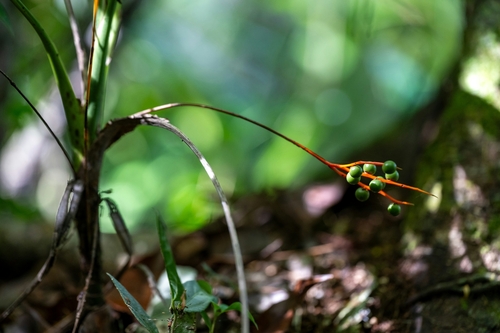
How to care for Parlour Palm
Watering
Parlour Palm (Chamaedorea elegans) likes evenly moist soil that is never soggy. Its fine roots sit close to the surface of a small pot and rot quickly if they stand in water, yet they dry out and brown at the tips if left bone dry for long. Use a loose, peat-based mix with some perlite, and a pot with drainage holes. Water thoroughly until it runs out of the bottom, then empty the saucer after 30 minutes. Use room-temperature water, ideally rainwater or filtered water, since this palm is sensitive to salts and fluoride that build up in tap water and show as brown leaf edges.
Does it need water today?
Push a finger 2-3 cm into the soil. If it feels dry at that depth, water now. If it feels damp, wait. Lift the pot too: a light pot needs water, while a heavy, wet pot does not. Parlour Palm prefers slightly drier soil over waterlogged soil, so when in doubt, wait another day.
Water less in winter, when growth slows and the soil stays wet for longer. Air humidity matters as much as watering, so mist the foliage or stand the pot on a tray of wet pebbles during dry heated months.
Overwatering
Parlour Palm evolved on the shaded, humid forest floor of southern Mexico and Guatemala, where soil drains freely but stays moist. Its roots need oxygen, so constantly wet compost quickly suffocates them and invites root rot. Because the palm grows slowly, it cannot quickly use up excess water, so the problem builds up unnoticed.
Symptoms: Yellowing lower fronds, leaves that droop despite wet soil, a sour or musty smell from the pot, black or mushy stems at the base, and fungus gnats hovering around the soil.
Solutions: Stop watering and let the top 5 cm dry out. Remove the palm from its pot, cut away black or mushy roots with clean scissors, and repot into fresh, well-draining mix in a pot only slightly larger than the root ball. Make sure the drainage holes are clear and never let the pot sit in standing water.
Underwatering
Parlour Palm has thin, fine roots and delicate, feathery fronds that lose water quickly through their large surface area. In a small pot, dry soil shrinks away from the sides and water runs past without soaking in. Repeated drying stresses the palm and weakens its fronds.
Symptoms: Crisp brown leaf tips and edges, fronds that curl or hang limply, soil pulling away from the pot wall, and new fronds emerging small and pale.
Solutions: Soak the pot in a tray of water for 30 minutes until the root ball is fully moist, then drain. Trim only fully brown tips with clean scissors, following the leaf's natural shape. Water more often in summer and raise humidity with regular misting or a pebble tray.
Sunlight
Parlour Palm grows naturally under the canopy of tropical forests, so it is adapted to bright but filtered light. Direct sun, especially through glass in summer, scorches its soft fronds, leaving pale or bleached patches. Too little light makes it grow leggy and sparse with small, dark fronds. Rotate the pot a quarter turn every few weeks so the palm grows evenly.
- Ideal: Bright, indirect light · Bright, filtered light for 6-8 hours a day, with no direct midday sun
- Tolerates: Partial sun, Shade
- Best spot in a room: Near the window
- Artificial light: In rooms without good daylight, a full-spectrum LED grow light placed 30-45 cm above the fronds for 10-12 hours a day keeps Parlour Palm healthy. Use a timer for consistency and raise the light as the palm grows.
Too little light
Parlour Palm's fronds are thin and lightly built for the dim understory of its native forest, but they still need enough brightness to photosynthesise steadily. In deep shade growth slows, the stems stretch toward any light, and the palm loses its compact, arching form.
Symptoms: Pale, small new fronds, stretched and leaning stems, sparse growth with gaps between fronds, and slow or stalled growth through spring and summer.
Solutions: Move the palm closer to a bright east or north-facing window, or place it a metre or so back from a south or west window with a sheer curtain. Add a full-spectrum LED grow light for 10-12 hours a day in dark months. Rotate the pot regularly so it does not lean.
Too much sun
Parlour Palm's soft, thin fronds are not built for strong sun. Intense light through a glass window heats the leaf surface faster than the palm can cool itself, leading to scorched, bleached tissue that does not recover.
Symptoms: Pale yellow or whitish patches on the fronds, crisp brown scorch marks on the sun-facing side, and leaves that look faded or dry at the edges.
Solutions: Move the palm a metre or more back from a south or west window, or add a sheer curtain or blind during the strongest hours. Cut off badly scorched fronds at the base. New growth will recover once the palm is in gentler light.
Temperature
Parlour Palm (Chamaedorea elegans) grows best in warm, steady indoor conditions between 18 and 24 °C. It tolerates ordinary room temperatures well but dislikes sudden swings, drafts, and dry heat. Keep it away from cold windows and heating vents.
- Ideal: 18–24 °C
- Tolerates: 10–32 °C
- Hardiness zones: 10-12
Fertilizing
Parlour Palm is a light feeder. It grows slowly indoors and uses fertilizer only during its active growing season, roughly March through September. Too much fertilizer is a common cause of problems, so when in doubt, feed less.
- Slow-release fertilizer: Once a year in early spring, if the plant is in a pot with fresh potting mix, or not needed for palms repotted within the last year.
- Balanced liquid houseplant fertilizer (such as 20-20-20 or 10-10-10) diluted to half strength, Slow-release granular fertilizer formulated for indoor plants, Organic liquid fish or seaweed fertilizer diluted to half strength
Soil
Parlour Palm (Chamaedorea elegans) grows best in a soil that holds some moisture but drains quickly, because its roots rot in soggy, dense soil.
- Peat-based potting mix with perlite: About 2 parts peat or coir, 1 part perlite, plus a handful of coarse bark or orchid mix for drainage
- Commercial palm and cycad mix: Ready-made palm mix with added perlite or pumice; a good choice for beginners
- pH 5.5–6.5
Repotting
Parlour Palm (Chamaedorea elegans) has a thin, fibrous root system that is easily damaged, so repot only when truly needed and handle the root ball gently.
- How often: every 2-3 years, or when roots fill the pot
- New pot: Move up only one pot size (about 2-5 cm wider) with drainage holes; Parlour Palm dislikes oversized pots that hold wet soil.
- Repotting season: Spring, Summer
How to repot
- Tip the pot on its side and gently ease the root ball out, supporting the stem at the base
- Loosen the outer roots with your fingers only; do not pull or tease them hard
- Trim away any black, mushy or dead roots with clean scissors
- Place a 2-3 cm layer of fresh mix in the new pot and set the palm so the root ball sits at the same depth as before
- Fill around the root ball with mix, firm it lightly, and leave a 2 cm gap below the rim for watering
- Water thoroughly until it drains out the base, then let excess drain away
Pruning
Parlour Palm rarely needs heavy pruning; remove only fronds that are fully brown or yellow, cutting them at the base of the stem without tearing the sheath.
Pruning season: Spring, Summer
How to prune
- Identify fronds that are fully yellow or brown, since green fronds still produce food for the plant.
- Sterilize sharp shears with rubbing alcohol and let them dry.
- Cut each dead frond close to the main stem, leaving a small stub so you do not damage the growing point.
- Remove any spent flower stalks after blooming if you do not want seed, cutting them at the base.
- Clean up debris from the soil surface and wipe your tools again before storing them.
Propagation
Seed sowing · Spring
- Collect fresh seeds from a ripe red-to-black berry, since Chamaedorea elegans seed loses viability quickly once dried.
- Remove the pulp by soaking the seeds in warm water for 24 hours, then rubbing them gently to clear the flesh.
- Fill a small pot with a light mix of peat or coir and perlite, and press each seed about 1 cm deep.
- Keep the mix evenly moist and hold the temperature around 24 to 27 °C.
- Expect germination in roughly 2 to 4 months, and be patient because some seeds may take longer.
Division of offsets · Spring, Summer
- Wait until the plant is mature and has produced several clumping stems at its base, which is typical for this palm.
- Water the plant a day before, so the root ball is moist and easier to separate.
- Gently tip the plant out and tease apart clumps, making sure each division has its own roots.
- Pot each division into a container only slightly larger than its root ball, using a well-draining palm or indoor mix.
- Keep divisions in bright indirect light and water lightly until new growth appears.
Division is far more reliable than seed for home gardeners, because Parlour Palm seed is short-lived and slow to sprout.
About Parlour Palm
Also known as: Parlor Palm, Neanthe Bella Palm, Good Luck Palm
- Plant type: palm, understory plant
- Lifespan: perennial
- Distribution: Native to the understory of moist tropical forests of southern Mexico and Guatemala.
- Mature height: 1-2 m indoors, up to about 2 m in the wild
- Bloom time: Spring to summer, mainly on mature plants
Pets · People
Pets: Safe · People: Safe. Non-toxic to cats, dogs and children according to ASPCA listings; eating large amounts may cause mild stomach upset only.
Common problems
- Brown leaf tips: Usually caused by dry air, underwatering or fluoride and salt build-up in tap water; use filtered or rainwater and raise humidity.
- Root rot: Results from waterlogged soil and pots without drainage; let the soil dry between waterings and check roots for black mush.
- Spider mites: Thrive in hot, dry indoor air and cause speckled yellow fronds; wipe leaves regularly and increase humidity.
- Yellowing fronds: Older fronds yellow naturally, but widespread yellowing suggests overwatering or nutrient deficiency.
- Scale insects: Brown bumps on stems and leaf undersides; remove by hand or treat with horticultural oil.
Uses
Primarily an ornamental indoor palm prized for its elegant arching fronds and tolerance of low light in offices and homes. In its native range, its leaves are sometimes used locally in plaited crafts and decorative work.
Is it edible?
not edible
History & legends
Introduced to European horticulture in the nineteenth century, it became a fashionable parlour plant in Victorian homes, where its tolerance of gas light and dim rooms made it popular. Its place in parlours gave it the common name that has endured across generations of indoor gardeners.
Did you know?
Chamaedorea elegans is one of the few palms that produces small yellow flowers and then tiny black berries on a plant only tens of centimetres tall, even indoors.
Frequently asked questions
How often should I water Parlour Palm?
every 8 days. Parlour Palm (Chamaedorea elegans) likes evenly moist soil that is never soggy. Its fine roots sit close to the surface of a small pot and rot quickly if they stand in water, yet they dry out and brown at the tips if left bone dry for long. Use a loose, peat-based mix with some perlite, and a pot with drainage holes. Water thoroughly until it runs out of the bottom, then empty the saucer after 30 minutes. Use room-temperature water, ideally rainwater or filtered water, since this palm is sensitive to salts and fluoride that build up in tap water and show as brown leaf edges. Push a finger 2-3 cm into the soil. If it feels dry at that depth, water now. If it feels damp, wait. Lift the pot too: a light pot needs water, while a heavy, wet pot does not. Parlour Palm prefers slightly drier soil over waterlogged soil, so when in doubt, wait another day.
How much light does Parlour Palm need?
Bright, indirect light (Bright, filtered light for 6-8 hours a day, with no direct midday sun). Parlour Palm grows naturally under the canopy of tropical forests, so it is adapted to bright but filtered light. Direct sun, especially through glass in summer, scorches its soft fronds, leaving pale or bleached patches. Too little light makes it grow leggy and sparse with small, dark fronds. Rotate the pot a quarter turn every few weeks so the palm grows evenly.
What temperature does Parlour Palm like?
18–24 °C. Parlour Palm (Chamaedorea elegans) grows best in warm, steady indoor conditions between 18 and 24 °C. It tolerates ordinary room temperatures well but dislikes sudden swings, drafts, and dry heat. Keep it away from cold windows and heating vents.
Is Parlour Palm toxic to cats and dogs?
It is safe for cats and dogs. Non-toxic to cats, dogs and children according to ASPCA listings; eating large amounts may cause mild stomach upset only.
What are the most common problems of Parlour Palm?
Brown leaf tips: Usually caused by dry air, underwatering or fluoride and salt build-up in tap water; use filtered or rainwater and raise humidity. Root rot: Results from waterlogged soil and pots without drainage; let the soil dry between waterings and check roots for black mush. Spider mites: Thrive in hot, dry indoor air and cause speckled yellow fronds; wipe leaves regularly and increase humidity. Yellowing fronds: Older fronds yellow naturally, but widespread yellowing suggests overwatering or nutrient deficiency. Scale insects: Brown bumps on stems and leaf undersides; remove by hand or treat with horticultural oil.
When should I repot Parlour Palm?
every 2-3 years, or when roots fill the pot. Parlour Palm (Chamaedorea elegans) has a thin, fibrous root system that is easily damaged, so repot only when truly needed and handle the root ball gently.
How do I propagate Parlour Palm?
Seed sowing, Division of offsets. Collect fresh seeds from a ripe red-to-black berry, since Chamaedorea elegans seed loses viability quickly once dried. Remove the pulp by soaking the seeds in warm water for 24 hours, then rubbing them gently to clear the flesh. Fill a small pot with a light mix of peat or coir and perlite, and press each seed about 1 cm deep. Keep the mix evenly moist and hold the temperature around 24 to 27 °C. Expect germination in roughly 2 to 4 months, and be patient because some seeds may take longer.
How this guide was written
Verdiss writes each guide with AI from botanical references and checks the species against iNaturalist and Plants of the World Online (Kew). Readers can rate every guide in the app.
Sources
Verdiss's information is for general guidance. Never eat or use a plant as medicine based on an app: ask a professional.