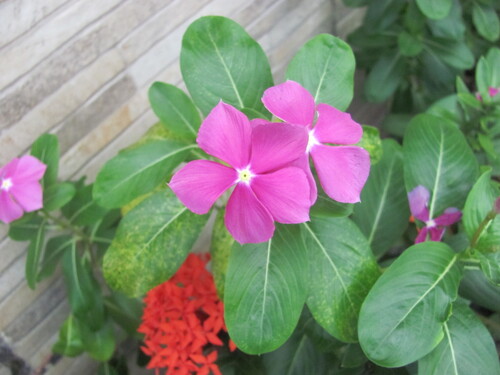
How to care for Madagascar Periwinkle
Watering
Madagascar Periwinkle (Catharanthus roseus) is a succulent-like tropical sub-shrub that stores some water in its roots and stems, so it prefers to dry out between drinks. Water deeply until it drains from the pot, then let the top 2-3 cm of soil dry before watering again. Soggy roots rot quickly, especially in cool months. Always empty the saucer after watering. Use a pot with drainage holes and a well-draining mix such as cactus compost mixed with perlite.
Does it need water today?
Push a finger 2-3 cm into the soil. If it feels dry and crumbly, water now. If it feels cool or damp, wait a few days. Lift the pot too: a light pot means the soil is dry, a heavy pot means it still holds water.
Water at the soil level, not over the flowers and leaves, which can encourage fungal spots. Plants in full sun and warm rooms need water more often than those in cooler, dimmer spots.
Overwatering
Madagascar Periwinkle has fleshy roots that cannot tolerate sitting in wet soil, and it is especially sensitive to cold, damp conditions. Constant wetness starves the roots of oxygen and invites Phytophthora and Pythium root rot.
Symptoms: Yellowing lower leaves, wilting even when the soil is wet, a dark brown or black stem base, soft roots, and a sour or musty smell from the soil.
Solutions: Stop watering and let the soil dry out. Remove the plant, cut away any black or mushy roots with clean scissors, and repot into fresh dry mix in a pot with drainage holes. Water again only when the top 2-3 cm are dry. Cut back severely rotted stems to healthy, firm tissue.
Underwatering
Madagascar Periwinkle copes well with short dry spells because its roots and stems store water. Long dry periods, though, cause the plant to drop flowers and buds to conserve moisture, and the soil can become hydrophobic.
Symptoms: Drooping leaves that perk up after watering, dry crispy leaf edges, soil pulling away from the pot sides, flower buds dropping, and slowed flowering.
Solutions: Water thoroughly until water drains out of the base. If the soil has become dry and shrunk, soak the pot in a tray of water for 30 minutes. Trim off dead leaves and flowers so the plant can direct energy to new growth. Increase watering frequency gradually over the next week rather than all at once.
Sunlight
Madagascar Periwinkle is a sun-loving plant native to the dry, bright coasts of Madagascar. Strong light drives the continuous flowering this species is known for. Indoors, it needs the brightest possible spot, and outdoors it performs best in a fully sunny position. It can handle partial shade but will flower less and grow leggy.
- Ideal: Full sun · 6-8 hours of direct sun per day
- Tolerates: Full sun, Partial sun, Bright, indirect light
- Best spot in a room: At the window
- Artificial light: Use a full-spectrum LED grow light for 10-12 hours a day, placed 15-30 cm above the plant, if a south-facing window is not available or winter days are short.
Too little light
Madagascar Periwinkle is a light-hungry plant, and weak light makes its stems stretch and its flowering stop. Without enough light it cannot produce the energy needed for blooms.
Symptoms: Long pale stems with big gaps between leaves, small or few flowers, leaves turning dull green or yellowish, and the plant leaning toward the light source.
Solutions: Move the plant closer to the brightest window, ideally south-facing. Rotate the pot each week so growth stays even. Add a grow light for 10-12 hours a day in winter. Cut back leggy stems in spring to encourage bushier growth.
Too much sun
Although Madagascar Periwinkle loves sun, intense afternoon light through glass or in very hot weather can scorch the leaves, especially when the plant has been moved from a shadier spot. Its leaves are thin enough to burn quickly.
Symptoms: Bleached or white patches on leaves, brown crispy spots, leaves curling inward, and flowers fading or wilting faster than normal.
Solutions: Move the plant back a little from the glass during the hottest hours, or use a sheer curtain. Acclimatise it over 7-10 days when moving it into stronger sun. Water a little more often in hot, bright weather, and keep the soil from drying completely.
Temperature
Madagascar Periwinkle is a tropical perennial that thrives in warmth and blooms best when temperatures stay between 18 and 30 °C. It is frost-tender and will die below freezing, so in most temperate gardens it is grown as an annual or brought indoors before autumn cold arrives.
- Ideal: 18–30 °C
- Tolerates: 10–38 °C
- Hardiness zones: 10-12
Fertilizing
Madagascar Periwinkle feeds heavily during its long flowering season, so container plants in particular need regular nutrients because frequent watering washes them out of the soil. Favor a fertilizer with moderate nitrogen and higher phosphorus and potassium to encourage blooms rather than leafy growth.
- Slow-release fertilizer: Apply once a year in spring at planting time, following the packet rate, or skip it if you use liquid feed regularly.
- Balanced liquid fertilizer such as 20-20-20 for container plants, Low-nitrogen, higher-phosphorus bloom fertilizer such as 10-30-20 for maximum flowering, Slow-release granular fertilizer for in-ground plants, Organic compost or well-rotted manure tea as a gentle alternative
Soil
Madagascar Periwinkle needs a loose, fast-draining medium that dries out between waterings. Soggy, compacted soil is the most common cause of root rot in Catharanthus roseus, so drainage matters more than richness.
- Cactus or succulent mix: Mix two parts commercial potting soil with one part perlite or coarse sand, which keeps roots from staying wet while still holding enough moisture for a flowering annual
- Loam-based potting mix: A quality peat-free potting mix blended with about 20 percent perlite to improve drainage and aeration around the roots
- Garden bed soil: Well-drained garden soil amended with compost and coarse sand, suitable for planting Madagascar Periwinkle outdoors in full sun
- pH 5.5–6.5
Repotting
Use a pot with drainage holes, fresh well-draining potting mix, and tools cleaned with rubbing alcohol. Catharanthus roseus is a tender perennial grown as an annual in most climates, so repotting in late spring keeps the plant growing strongly through summer.
- How often: Every 1-2 years, or when roots fill the pot or emerge from drainage holes
- New pot: Move up only 2-5 cm in diameter at a time; Madagascar Periwinkle flowers best when slightly root-bound, so avoid oversized pots that stay wet
- Repotting season: Spring, Summer
How to repot
- Lay the pot on its side and gently loosen the root ball by tapping the edges or sliding a knife around the inside
- Ease the plant out by its base, never by pulling the stems
- Tease apart the outer roots with your fingers and trim any brown, mushy, or hollow roots with clean shears
- Add a layer of fresh mix to the new pot so the top of the root ball sits about 2 cm below the rim
- Set the plant upright in the center, fill around the sides with mix, and firm gently with your hands to remove large air pockets
- Water thoroughly until it drains from the bottom, then top up the soil level if it settles
- Keep the plant out of direct midday sun for several days while it recovers
Pruning
Pinch or trim Madagascar Periwinkle regularly during the growing season, and remove spent flowers so the plant keeps blooming. Make cuts just above a leaf node, and avoid cutting into bare old wood, since the plant may not regrow from it.
Pruning season: Spring, Summer, Autumn
How to prune
- In late spring, pinch out the growing tips of young plants when they are about 15 cm tall to encourage side branching.
- Throughout summer, deadhead faded flowers by snipping the stem just above the next leaf node.
- If a stem becomes long and leggy, cut it back by about one third to just above a healthy node.
- Remove any yellowed, damaged, or diseased leaves and stems at the base whenever you see them.
- In early autumn, before cool nights arrive, trim the plant back to a tidy shape if you plan to bring it indoors for winter.
Propagation
Stem cutting in water or moist mix · Spring, Summer
- Take a 8 to 10 cm non-flowering stem tip from a healthy Madagascar Periwinkle plant in late spring or summer.
- Strip the lower leaves so at least two nodes are bare, and cut just below a node.
- Dip the cut end in rooting hormone powder if you have it, then place the cutting in a glass of water or in a pot of moist seed-starting mix.
- Keep it in bright, indirect light at about 22 to 28 °C, and change the water every few days if you use water.
- Roots usually form in 2 to 4 weeks. Pot the cutting into well-draining soil once roots are about 2 cm long.
Seed sowing indoors · Spring
- Sow Catharanthus roseus seeds indoors about 10 to 12 weeks before your last spring frost date.
- Fill a tray with seed-starting mix and press the seeds lightly onto the surface, since they need light to germinate.
- Keep the mix moist and warm, around 24 to 27 °C, using a heat mat if your home is cool.
- Germination typically takes 1 to 3 weeks. Thin to the strongest seedling per cell once they have true leaves.
- Harden the seedlings off for a week before moving them outdoors after frost danger has passed.
Madagascar Periwinkle roots well from stem cuttings even though it is a tender perennial, so a cutting taken in summer can overwinter indoors as a new plant. Keep it bright and warm, and let the top 2 cm of soil dry between waterings.
About Madagascar Periwinkle
Also known as: Madagascar periwinkle, Rose periwinkle, Cape periwinkle, Old maid
- Plant type: subshrub, herb
- Lifespan: perennial in frost-free climates; grown as an annual or tender perennial elsewhere
- Distribution: Native to Madagascar, and not to the Caribbean or the rest of the tropics where it is now widespread.
- Mature height: 30-60 cm
- Bloom time: Late spring through autumn, continuously in warm climates
Pets · People
Pets: Toxic · People: Toxic. All parts contain vinca alkaloids, including vincristine and vinblastine, and are toxic if swallowed; the sap can irritate skin and eyes. Keep away from children and pets, and wash hands after handling.
Common problems
- Root rot: Caused by overwatering or poorly drained soil, leading to yellowing and wilting despite wet compost.
- Powdery mildew: White powdery coating on leaves in humid, crowded conditions with poor air movement.
- Leaf spot: Fungal or bacterial brown spots on leaves, often worsened by overhead watering.
- Spider mites: Fine stippling and webbing on leaves in hot, dry indoor air.
- Failure to flower: Caused by too little sun or too much nitrogen fertilizer, producing leafy growth with few blooms.
Uses
Widely grown as an ornamental bedding and container plant. Its alkaloids are extracted commercially and used to produce the chemotherapy drugs vincristine and vinblastine, and it is used in traditional medicine for diabetes, although these uses are not supported by strong clinical evidence.
Is it edible?
not edible
History & legends
Long used in Madagascar and by traditional healers in many regions, the plant was introduced to Europe in the 18th century. Its anticancer potential was discovered in the 1950s and 1960s by researchers searching for diabetes treatments, a discovery that led to the development of vinca alkaloid drugs.
Did you know?
Two alkaloids from this plant, vincristine and vinblastine, transformed treatment for childhood leukemia and Hodgkin lymphoma, and they remain essential chemotherapy drugs today.
Frequently asked questions
How often should I water Madagascar Periwinkle?
every 7 days. Madagascar Periwinkle (Catharanthus roseus) is a succulent-like tropical sub-shrub that stores some water in its roots and stems, so it prefers to dry out between drinks. Water deeply until it drains from the pot, then let the top 2-3 cm of soil dry before watering again. Soggy roots rot quickly, especially in cool months. Always empty the saucer after watering. Use a pot with drainage holes and a well-draining mix such as cactus compost mixed with perlite. Push a finger 2-3 cm into the soil. If it feels dry and crumbly, water now. If it feels cool or damp, wait a few days. Lift the pot too: a light pot means the soil is dry, a heavy pot means it still holds water.
How much light does Madagascar Periwinkle need?
Full sun (6-8 hours of direct sun per day). Madagascar Periwinkle is a sun-loving plant native to the dry, bright coasts of Madagascar. Strong light drives the continuous flowering this species is known for. Indoors, it needs the brightest possible spot, and outdoors it performs best in a fully sunny position. It can handle partial shade but will flower less and grow leggy.
What temperature does Madagascar Periwinkle like?
18–30 °C. Madagascar Periwinkle is a tropical perennial that thrives in warmth and blooms best when temperatures stay between 18 and 30 °C. It is frost-tender and will die below freezing, so in most temperate gardens it is grown as an annual or brought indoors before autumn cold arrives.
Is Madagascar Periwinkle toxic to cats and dogs?
It is toxic to cats and dogs: keep it out of their reach. All parts contain vinca alkaloids, including vincristine and vinblastine, and are toxic if swallowed; the sap can irritate skin and eyes. Keep away from children and pets, and wash hands after handling.
What are the most common problems of Madagascar Periwinkle?
Root rot: Caused by overwatering or poorly drained soil, leading to yellowing and wilting despite wet compost. Powdery mildew: White powdery coating on leaves in humid, crowded conditions with poor air movement. Leaf spot: Fungal or bacterial brown spots on leaves, often worsened by overhead watering. Spider mites: Fine stippling and webbing on leaves in hot, dry indoor air. Failure to flower: Caused by too little sun or too much nitrogen fertilizer, producing leafy growth with few blooms.
When should I repot Madagascar Periwinkle?
Every 1-2 years, or when roots fill the pot or emerge from drainage holes. Use a pot with drainage holes, fresh well-draining potting mix, and tools cleaned with rubbing alcohol. Catharanthus roseus is a tender perennial grown as an annual in most climates, so repotting in late spring keeps the plant growing strongly through summer.
How do I propagate Madagascar Periwinkle?
Stem cutting in water or moist mix, Seed sowing indoors. Take a 8 to 10 cm non-flowering stem tip from a healthy Madagascar Periwinkle plant in late spring or summer. Strip the lower leaves so at least two nodes are bare, and cut just below a node. Dip the cut end in rooting hormone powder if you have it, then place the cutting in a glass of water or in a pot of moist seed-starting mix. Keep it in bright, indirect light at about 22 to 28 °C, and change the water every few days if you use water. Roots usually form in 2 to 4 weeks. Pot the cutting into well-draining soil once roots are about 2 cm long.
How this guide was written
Verdiss writes each guide with AI from botanical references and checks the species against iNaturalist and Plants of the World Online (Kew). Readers can rate every guide in the app.
Sources
Verdiss's information is for general guidance. Never eat or use a plant as medicine based on an app: ask a professional.