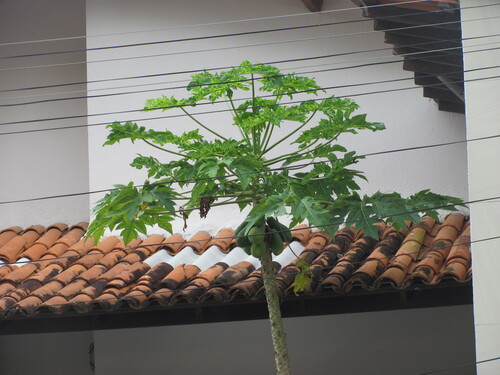
How to care for Papaya
Watering
Papaya (Carica papaya) has a shallow, fleshy root system that rots quickly in soggy soil, so the goal is evenly moist soil that dries slightly between waterings, never waterlogged. Water deeply until it drains from the pot, then empty the saucer. Plants in active growth in warm, bright conditions use more water; reduce watering sharply in cool, dim winter months. Use a pot with several drainage holes and a loose, peat-free mix with perlite or coarse sand.
Does it need water today?
Push a finger 3-5 cm into the soil. If it feels cool or damp, wait. If it is dry at that depth, water. Also lift the pot: a light pot means the soil is dry, a heavy pot means it still holds water. Yellowing lower leaves with soft, wet stems point to too much water rather than too little.
Water at the base of the trunk, not over the crown, because water sitting in the central leaf rosette can cause stem rot. Papaya trunks are soft and hollow-like, so keep the stem dry.
Overwatering
Papaya is a tropical plant adapted to well-drained, humid soils, but its roots need oxygen and cannot tolerate sitting in water. Constantly wet soil quickly leads to root and crown rot, which can kill a young plant within weeks.
Symptoms: Yellowing and dropping lower leaves, soft or water-soaked trunk near the soil line, a sour or musty smell from the soil, black mushy roots, and fungus gnats.
Solutions: Stop watering and let the top 5 cm of soil dry out. Remove the plant, cut away any black or mushy roots with clean scissors, and repot into fresh, fast-draining mix in a pot with more drainage holes. If the trunk is soft at the base, the plant may be too far gone, so take cuttings from healthy top growth if possible.
Underwatering
Papaya grows fast and produces large leaves that lose a great deal of water, so it needs regular moisture to keep growing. Its shallow roots dry out quickly in warm rooms and in pots that are not well insulated, especially in summer.
Symptoms: Drooping or limp leaves that may recover after watering, crispy brown leaf edges, slowed growth, and leaves that fall from the lower part of the plant.
Solutions: Water thoroughly until it drains, then check again after 1-2 days in warm weather. If the soil has pulled away from the pot edge or is very dry, soak the pot in a basin of water for 30 minutes. Increase watering frequency in spring and summer, and raise humidity by grouping plants or using a pebble tray.
Sunlight
Papaya (Carica papaya) is a sun-loving tropical plant that grows best in strong, direct light. Plants grown in dim light become tall, weak and thin-stemmed, with small leaves and few or no fruits. Gradually acclimatise young plants to full sun over 1-2 weeks to avoid leaf scorch. Indoors, a south-facing window with the brightest light possible is the best option.
- Ideal: Full sun · 6-8 hours of direct sun
- Tolerates: Full sun, Partial sun, Bright, indirect light
- Best spot in a room: At the window
- Artificial light: Use a full-spectrum LED grow light placed 30-45 cm above the crown for 12-14 hours a day during autumn and winter, when natural light is weak. Keep the light on a timer so the plant gets a consistent day length. Rotate the pot every week so the trunk grows straight.
Too little light
Papaya stretches toward light when it lacks sun, and the soft, fast-growing trunk becomes leggy and prone to bending or toppling. Low light also reduces the plant's energy for flowering and fruiting, so it may never produce papayas indoors.
Symptoms: Tall, pale, thin stems with long gaps between leaves, small new leaves, leaves leaning toward the window, and no flowers or fruit.
Solutions: Move the plant to the brightest window available, ideally south-facing. Add a grow light for 12-14 hours a day in winter. Support leaning stems with a stake, and clean dust off leaves so they can absorb more light.
Too much sun
Although papaya loves sun, plants moved suddenly from shade to strong midday sun, or grown behind glass that intensifies heat, can suffer leaf burn. Papaya leaves are thin and easily damaged by intense light and heat stress.
Symptoms: Bleached or white patches on leaves, brown crispy scorched edges, leaves curling or wilting in the afternoon, and dry soil that dries faster than usual.
Solutions: Move the plant gradually into stronger light over 1-2 weeks. Provide light shade during the hottest part of the afternoon in summer if temperatures exceed 35°C. Water a little more often when the plant is in intense sun, and keep the trunk and soil well watered without waterlogging.
Temperature
Papaya is a tropical plant that grows best in warm, steady heat. Keep it above 18°C for healthy growth and fruiting. Even short exposure below 5°C can damage or kill the leaves and trunk, so bring container plants indoors before nights turn cold.
- Ideal: 21–32 °C
- Tolerates: 10–40 °C
- Hardiness zones: 10-12
Fertilizing
Papaya is a heavy feeder that grows fast and fruits continuously in warm weather. It needs steady nitrogen for leaves, plus potassium and magnesium for sweet, well-formed fruit. Feed lightly and regularly rather than all at once, and always water before and after feeding to protect the shallow roots.
- Slow-release fertilizer: Apply a balanced slow-release fertilizer once in early spring, when new growth begins, and again in midsummer for container plants.
- Balanced liquid fertilizer such as 10-10-10 or 20-20-20 for steady growth, Slow-release granular fertilizer with added magnesium and micronutrients, Higher-potassium fertilizer such as 5-10-10 once flowering and fruiting begin, Compost or well-rotted manure as a gentle organic option
Soil
Papaya (Carica papaya) needs soil that drains quickly yet holds some moisture. Roots suffocate and rot in heavy, waterlogged ground, which is the main reason plants fail. Rich organic matter supports the heavy feeding this fast-growing plant needs.
- Loose potting mix for container papaya: Two parts peat-free potting mix, one part perlite or pumice, and one part compost to provide steady nutrients without holding excess water
- Garden bed mix for in-ground papaya: Native topsoil blended with about 30 percent well-rotted compost and coarse sand or grit to keep water from pooling around the roots
- Sandy loam for sites with heavy clay: One part sand, two parts loam, and one part compost, mounded 15-20 cm above the surrounding ground to improve drainage
- pH 6–7
Repotting
Papaya (Carica papaya) has a shallow, fast-growing, fleshy root system that resents disturbance. Repot gently, keep the root ball intact, and always use a pot with drainage holes.
- How often: Every 1-2 years for young container papayas; container-grown plants often need root-bound checks yearly once they reach 1 m or more
- New pot: Move up only one pot size (about 5-7 cm wider) at a time; papaya roots are fleshy and sensitive, so an oversized pot holds wet soil that rots them
- Repotting season: Spring, Summer
How to repot
- Tip the plant gently on its side, supporting the trunk, and ease the root ball out without pulling on the stem
- Loosen only the outer roots lightly with your fingers; do not tease apart or cut the main root mass
- Set the plant in the new pot so the root ball sits about 2 cm below the rim, keeping the trunk's base at the same level it was before
- Fill around the root ball with fresh soil, firm lightly to remove large air pockets, and leave a 2-3 cm gap below the rim for watering
- Water slowly until it drains freely, then keep the plant in partial shade for a week
Pruning
Papaya does not branch naturally after its main stem, and it has no woody branches to prune back. Pruning is mainly about removing leaves and shoots, not cutting the trunk. Always use clean, sharp tools and sterilize them between plants.
Pruning season: Spring, Summer
How to prune
- Cut off dead, yellow, or torn leaves at the base of the leaf stalk using clean shears.
- Remove any suckers growing from the base of the trunk, cutting them close to the stem.
- If the top of the plant is too tall to reach, you can cut the main trunk at the desired height, but expect the plant to produce a few new shoots below the cut and a lower yield.
- Pick off old flower stalks that did not set fruit, especially on male-only branches, to direct energy to new growth.
- Dispose of removed leaves and debris away from the garden to limit pests and disease.
Propagation
Seed sowing · Spring, Summer
- Choose fresh seeds from a ripe, fully yellow or orange papaya fruit, since papaya seeds lose viability within a few months.
- Rinse the seeds in water to remove the gelatinous coating, then spread them on paper towel to dry for one to two days.
- Sow two or three seeds per pot, about 1 cm deep, in a light, well-draining mix such as equal parts potting soil and perlite.
- Keep the mix warm, around 25 to 30 °C, and moist but not soggy. Seeds typically germinate in two to three weeks.
- Once seedlings have two or three true leaves, keep only the strongest one per pot and move it to a sunny spot.
Stem cutting from a young plant · Spring, Summer
- Use a healthy young papaya stem with at least one leaf node, avoiding old woody trunk, which rarely roots.
- Cut a section about 30 cm long with a clean, sharp knife, then let the cut end callus for a day or two.
- Dip the cut end in rooting hormone and place it in moist perlite or sand kept at about 25 °C.
- Keep the cutting humid and bright but out of direct sun until new growth appears, which can take several weeks.
- Papaya roots are fragile, so transplant gently once roots are established.
Plant seeds directly in their final pot or spot when possible, because papaya dislikes transplanting. Warmth matters more than water: cool soil slows germination dramatically.
About Papaya
Also known as: Pawpaw, Papaya tree, Papaw
- Plant type: tree-like herb, fruit tree
- Lifespan: perennial, though individual plants are usually productive for only 3-5 years
- Distribution: Native to the lowlands of southern Mexico and northern Central America.
- Mature height: 2-10 m
- Bloom time: Year-round in frost-free climates
Pets · People
Pets: Toxic · People: Toxic. The unripe fruit, latex (milky sap) and seeds contain papain and other compounds that can irritate skin and the digestive tract; ripe flesh is generally safe. ASPCA lists papaya as toxic to dogs, cats and horses, mainly for the unripe fruit, leaves and seeds.
Common problems
- Root rot: Waterlogged or poorly drained soil causes the roots and trunk base to rot, often leading to sudden collapse.
- Spider mites: Dry indoor air encourages webbing and stippled, bronzed leaves, especially on the undersides.
- Papaya ringspot virus: A viral disease causing ringed, water-soaked markings on fruit and leaves; infected plants cannot be cured and should be removed.
- Cold damage: Temperatures below about 10°C cause leaf yellowing, blackening and stunted growth.
- Fruit fly infestations: Larvae feed inside ripening fruit, making it sour and prone to decay.
Uses
The ripe fruit is eaten fresh, made into juice, smoothies and desserts, and the unripe fruit is cooked as a vegetable in many cuisines. Papain, an enzyme from the latex, is used as a meat tenderizer and in digestive supplements, and the leaves are used in traditional medicine across the tropics.
Is it edible?
The ripe orange flesh is edible raw; unripe fruit and young leaves are cooked. Seeds are edible but peppery; the latex and unripe fruit are not eaten raw.
History & legends
Papaya was cultivated by Maya and other Mesoamerican peoples long before European contact, and Spanish and Portuguese traders carried it to Asia, Africa and the Pacific in the 16th century. Its milky latex was used for centuries as a meat tenderizer and folk remedy.
Did you know?
Papaya is technically a herb, not a tree, because its trunk is hollow-centred, soft and contains no true woody tissue, and a single plant can live only a few years.
Frequently asked questions
How often should I water Papaya?
every 3 days. Papaya (Carica papaya) has a shallow, fleshy root system that rots quickly in soggy soil, so the goal is evenly moist soil that dries slightly between waterings, never waterlogged. Water deeply until it drains from the pot, then empty the saucer. Plants in active growth in warm, bright conditions use more water; reduce watering sharply in cool, dim winter months. Use a pot with several drainage holes and a loose, peat-free mix with perlite or coarse sand. Push a finger 3-5 cm into the soil. If it feels cool or damp, wait. If it is dry at that depth, water. Also lift the pot: a light pot means the soil is dry, a heavy pot means it still holds water. Yellowing lower leaves with soft, wet stems point to too much water rather than too little.
How much light does Papaya need?
Full sun (6-8 hours of direct sun). Papaya (Carica papaya) is a sun-loving tropical plant that grows best in strong, direct light. Plants grown in dim light become tall, weak and thin-stemmed, with small leaves and few or no fruits. Gradually acclimatise young plants to full sun over 1-2 weeks to avoid leaf scorch. Indoors, a south-facing window with the brightest light possible is the best option.
What temperature does Papaya like?
21–32 °C. Papaya is a tropical plant that grows best in warm, steady heat. Keep it above 18°C for healthy growth and fruiting. Even short exposure below 5°C can damage or kill the leaves and trunk, so bring container plants indoors before nights turn cold.
Is Papaya toxic to cats and dogs?
It is toxic to cats and dogs: keep it out of their reach. The unripe fruit, latex (milky sap) and seeds contain papain and other compounds that can irritate skin and the digestive tract; ripe flesh is generally safe. ASPCA lists papaya as toxic to dogs, cats and horses, mainly for the unripe fruit, leaves and seeds.
What are the most common problems of Papaya?
Root rot: Waterlogged or poorly drained soil causes the roots and trunk base to rot, often leading to sudden collapse. Spider mites: Dry indoor air encourages webbing and stippled, bronzed leaves, especially on the undersides. Papaya ringspot virus: A viral disease causing ringed, water-soaked markings on fruit and leaves; infected plants cannot be cured and should be removed. Cold damage: Temperatures below about 10°C cause leaf yellowing, blackening and stunted growth. Fruit fly infestations: Larvae feed inside ripening fruit, making it sour and prone to decay.
When should I repot Papaya?
Every 1-2 years for young container papayas; container-grown plants often need root-bound checks yearly once they reach 1 m or more. Papaya (Carica papaya) has a shallow, fast-growing, fleshy root system that resents disturbance. Repot gently, keep the root ball intact, and always use a pot with drainage holes.
How do I propagate Papaya?
Seed sowing, Stem cutting from a young plant. Choose fresh seeds from a ripe, fully yellow or orange papaya fruit, since papaya seeds lose viability within a few months. Rinse the seeds in water to remove the gelatinous coating, then spread them on paper towel to dry for one to two days. Sow two or three seeds per pot, about 1 cm deep, in a light, well-draining mix such as equal parts potting soil and perlite. Keep the mix warm, around 25 to 30 °C, and moist but not soggy. Seeds typically germinate in two to three weeks. Once seedlings have two or three true leaves, keep only the strongest one per pot and move it to a sunny spot.
How this guide was written
Verdiss writes each guide with AI from botanical references and checks the species against iNaturalist and Plants of the World Online (Kew). Readers can rate every guide in the app.
Sources
Verdiss's information is for general guidance. Never eat or use a plant as medicine based on an app: ask a professional.