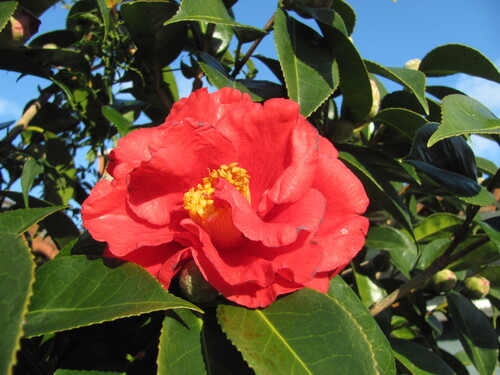
How to care for Japanese camellia
Watering
Japanese camellia (Camellia japonica) likes evenly moist, well-drained soil that never dries out completely, yet sits wet for days. Its fine roots sit near the surface and rot quickly in waterlogged pots. Water deeply when the top few centimetres of soil feel dry, and let excess drain away freely. Soft water or rainwater suits it best, since it dislikes lime. Water more during bud set and flowering in late winter and spring, and less in the cool, dormant months.
Does it need water today?
Push a finger 3 to 4 cm into the soil. If it feels dry and crumbly, water now. If it feels cool and damp, wait. Lift the pot too: a light pot needs water, while a heavy, soggy one does not. Wilting leaves that look dull and limp mean the plant is thirsty, but the leaves should perk up within hours after a drink.
Camellias often drop buds when the root ball dries out during bud formation in late summer and autumn. Keep the soil steadily moist through those months, and avoid letting the pot dry out between waterings.
Overwatering
Japanese camellia roots need oxygen, and soggy compost quickly causes them to rot. Heavy clay or pots without drainage holes make this worse, because the soil stays saturated for days after each watering.
Symptoms: Yellowing leaves that drop, a sour smell from the soil, soft or blackened stems at the base, and buds that turn brown and fall off.
Solutions: Stop watering and let the soil dry to the top few centimetres. Make sure the pot has drainage holes and empty any saucer. If root rot is severe, repot into fresh, free-draining ericaceous compost, trimming away any brown, mushy roots.
Underwatering
Japanese camellia has shallow roots and large glossy leaves that lose water quickly through transpiration. Once the root ball dries and pulls away from the pot wall, the plant can no longer take up water even when you add it.
Symptoms: Limp, dull leaves that curl at the edges, dry crispy leaf margins, and buds that shrivel or drop before opening.
Solutions: Soak the pot in a tray of water for 30 minutes to rehydrate the root ball, then drain. Mist the leaves and move the plant out of hot, draughty spots. Water a little more often until new growth shows it has recovered.
Sunlight
Japanese camellia grows best in dappled light or bright shade, the way it grows under woodland canopy in its native Japan, Korea and China. Morning sun helps buds form and open, but hot afternoon sun scorches the leaves and dries the soil. Shelter it from harsh midday light, especially in summer.
- Ideal: Partial sun · 2-4 hours of gentle morning sun, with bright light the rest of the day
- Tolerates: Bright, indirect light, Shade
- Best spot in a room: At the window
- Artificial light: A bright, cool room with a north or east window works well. For dim rooms, use a full-spectrum LED grow light for 10 to 12 hours a day, placed 30 to 40 cm above the foliage. Keep the plant cool, around 5 to 12°C, while it sets buds in autumn, since warm rooms often cause bud drop.
Too little light
Japanese camellia needs enough light to make the energy for flower buds, which form in late summer and autumn for the following spring. Too little light leads to sparse leaves and few or no flowers.
Symptoms: Long, leggy stems, pale or dark green leaves that are small and thin, and a lack of flower buds in autumn.
Solutions: Move the plant closer to a bright window or to a spot with morning sun. Add a full-spectrum LED grow light in winter. Increase light gradually to avoid sunburn, and keep the plant cool while it forms buds.
Too much sun
Japanese camellia has thin, glossy leaves that burn easily in strong direct sun, especially when the root ball is dry. Hot, reflected light from south or west windows can damage the foliage quickly.
Symptoms: Bleached or yellowish patches on the leaves, brown scorched edges, faded leaf colour, and wilting on hot days even when the soil is moist.
Solutions: Move the plant away from direct afternoon sun or add a sheer curtain. Outdoors, place it under deciduous trees or on a shaded patio. Water well during heat waves, since sunburnt plants lose water quickly.
Temperature
Japanese camellia (Camellia japonica) grows best in cool, mild conditions with winter chill and a sheltered spot out of hot afternoon sun. Mature plants in the ground tolerate short frosts down to about -10 to -15°C, but flower buds are damaged by late frosts, so protect the plant when cold snaps hit during bud development in late winter and early spring.
- Ideal: 7–18 °C
- Tolerates: -15–32 °C
- Hardiness zones: 7-10
Fertilizing
Japanese camellia prefers acidic soil around pH 5.5 to 6.5 and does not need heavy feeding. Feed lightly during the active growing season from spring to early summer, and stop feeding in late summer so new growth does not become soft before winter. Nitrogen-heavy general fertilizers can burn the shallow roots and cause leaf yellowing when used in excess.
- Slow-release fertilizer: Apply once a year in early spring, just as new growth begins, or after flowering in late spring. Japanese camellia is an acid-loving plant, so choose a product made for azaleas, camellias, or rhododendrons.
- Acid-loving plant food formulated for camellias, azaleas, or rhododendrons, Slow-release granular fertilizer labeled for acid-loving shrubs, Cottonseed meal or other organic acidifying fertilizer, Well-rotted leaf mold or pine-bark compost as a light top dressing
Soil
Japanese camellia needs acidic, well-drained, humus-rich soil. Heavy alkaline or chalky soil leads to yellowing leaves, poor flowering, and slow decline, so pH matters as much as drainage.
- Ericaceous potting mix: Peat-free or peat-reduced compost with acidic pH, blended with pine bark fines and perlite or coarse sand for drainage.
- Pine bark and loam blend: Two parts fine pine bark, one part leaf mould or acidic garden loam, and one part coarse grit.
- Garden soil for planting out: Native or amended acidic loam with added leaf mould or composted pine bark to lower pH and improve structure.
- pH 5–6.5
Repotting
Use a pot with drainage holes, a loose acidic ericaceous-type mix, and repot in early spring just as new growth begins to swell, before the flower buds open. Avoid repotting during bloom or in hot summer weather.
- How often: Every 2-3 years for young plants; older Japanese camellias in large containers can go 3-4 years between repots, with top-dressing in between.
- New pot: Move up only one pot size (about 2-5 cm wider in diameter) each time. Japanese camellia roots sit close to the surface and sulk in oversized pots that hold wet soil.
- Repotting season: Spring
How to repot
- Tip the pot on its side and tap the edges, then ease the root ball out gently, supporting the trunk with one hand.
- Loosen the outer roots with your fingers. Trim any black, mushy, or dead roots with clean shears.
- Place a 2-3 cm layer of fresh mix in the bottom of the new pot, then set the plant so the top of the root ball sits about 2 cm above the rim.
- Fill in around the roots with fresh mix, firming gently with your fingers rather than pressing hard. Keep the root crown level with or just above the soil surface.
- Water slowly until it runs out the drainage holes, then add more mix to settle the surface if needed.
Pruning
Prune Camellia japonica just after it finishes flowering in spring, because it sets next season's flower buds in late summer and autumn. Pruning later in the year removes these buds and reduces the display. Avoid heavy cutting in one year, and never remove more than about one third of the plant's growth at once.
Pruning season: Spring, Summer
How to prune
- Step back and look at the whole shrub, noting dead, damaged, or diseased wood first.
- Cut out any dead, dry, or brown branches back to healthy green or white wood.
- Remove weak, thin, or crossing shoots at the base to open the center of the plant.
- Shorten long, leggy shoots by cutting just above an outward-facing leaf node.
- Trim lightly to shape the outline, leaving the natural rounded form of the shrub.
- Remove any remaining spent flowers and fallen petals from the base to limit petal blight.
- Clear all cut material from around the plant and dispose of it, especially any leaves showing gall or spotting.
- Water the plant well after pruning and mulch lightly to keep the roots moist during the warm months.
Propagation
Semi-hardwood cuttings under mist or humidity cover · Summer, Autumn
- Take 8 to 10 cm tip cuttings from a healthy Camellia japonica in late summer, when the new shoots have turned slightly firm at the base.
- Strip the lower leaves and cut each remaining leaf in half to reduce moisture loss.
- Dip the cut end in a rooting hormone powder containing IBA.
- Insert the cutting into a pot of moist mix of equal parts perlite and peat-free compost.
- Cover with a clear plastic bag or propagation dome and keep in bright, indirect light at about 20 to 24 °C.
- Keep the mix damp but never soggy. Check for roots after 3 to 4 months by a gentle tug.
- Pot rooted cuttings into individual containers and keep them sheltered until spring.
Air layering on a woody branch · Spring, Summer
- Choose a healthy branch about pencil-thick and one to two years old.
- Make a 2 to 3 cm ring cut through the bark, removing a strip of bark down to the wood, on a stem of Camellia japonica.
- Dust the exposed wood with rooting hormone.
- Wrap the wound in damp sphagnum moss and cover with clear plastic, tied tightly at both ends.
- Keep the moss moist. Roots usually form in 6 to 12 months.
- Once roots show through the moss, cut the branch below the layer and pot it up.
Grafting onto rootstock · Spring
- Use a vigorous understock of Camellia sasanqua or a seedling of Camellia japonica that is at least one year old.
- Make a matching side-veneer or cleft graft in early spring, just before active growth starts.
- Bind the graft firmly with grafting tape and seal the joint with wax.
- Place the plant in a humid, shaded spot at about 15 to 20 °C until the graft unites.
- Remove any shoots from the rootstock below the graft as they appear.
Seed sowing · Autumn
- Collect ripe seed capsules in autumn, when they split open and show dark brown seeds.
- Soak the seeds in water for 24 hours.
- Sow them 2 cm deep in a pot of gritty, free-draining compost.
- Keep the pot outdoors in a sheltered, cold frame over winter, as the seeds need cold to break dormancy.
- Expect seedlings in spring. Note that seed-grown plants vary in flower color and may not match the parent.
Camellia japonica is slow to root and is best propagated from semi-hardwood cuttings or air layering. Keep cuttings out of direct sun and avoid waterlogged mix, which quickly causes rot.
About Japanese camellia
Also known as: Common camellia, Japanese rose, Tsubaki
- Plant type: shrub, small tree
- Lifespan: perennial
- Distribution: Native to Japan, Korea, Taiwan and southeastern China, mainly in coastal and mountain forests.
- Mature height: 2-6 m in gardens, occasionally taller in the wild
- Bloom time: Late winter to spring
Pets · People
Pets: Mildly toxic · People: Mildly toxic. Seeds, leaves and flowers contain saponins and theobromine-like compounds that can cause vomiting, diarrhoea and drooling if eaten in quantity, according to ASPCA-style guidance for Camellia species; seed and leaf ingestion is the main concern.
Common problems
- Bud drop: Flower buds fall before opening, often due to dry soil, sudden temperature changes or root disturbance.
- Camellia petal blight: Fungal disease that browns and rots flowers, especially in wet spring weather.
- Leaf gall: Fleshy, swollen leaf distortions caused by fungal infection, usually in cool wet conditions.
- Scale insects: Sap-feeding pests on stems and leaf undersides that weaken the plant and leave sticky residue.
- Chlorosis: Yellowing leaves caused by alkaline soil or waterlogging that prevents iron uptake.
Uses
Widely grown as an ornamental shrub, hedge and container plant in temperate gardens. Its seeds yield camellia oil, used in Japanese cooking and cosmetics, and the wood has traditionally been used for carving and charcoal.
Is it edible?
Seeds are edible when processed and pressed into oil; the petals, leaves and raw seeds are not edible and may cause stomach upset.
History & legends
In Japan, camellias have been associated with Shinto shrines and island gardens for centuries, and the species was carried to Europe in the 18th century, where it became a fashionable plant for conservatories. Its flowers have featured in Japanese poetry and in stories about longevity and steadfast love.
Did you know?
Camellia japonica was one of the first plants whose cultivated forms were widely traded to Europe, and its oil-rich seeds have long been pressed in Japan for cooking and hair care.
Frequently asked questions
How often should I water Japanese camellia?
every 7 days. Japanese camellia (Camellia japonica) likes evenly moist, well-drained soil that never dries out completely, yet sits wet for days. Its fine roots sit near the surface and rot quickly in waterlogged pots. Water deeply when the top few centimetres of soil feel dry, and let excess drain away freely. Soft water or rainwater suits it best, since it dislikes lime. Water more during bud set and flowering in late winter and spring, and less in the cool, dormant months. Push a finger 3 to 4 cm into the soil. If it feels dry and crumbly, water now. If it feels cool and damp, wait. Lift the pot too: a light pot needs water, while a heavy, soggy one does not. Wilting leaves that look dull and limp mean the plant is thirsty, but the leaves should perk up within hours after a drink.
How much light does Japanese camellia need?
Partial sun (2-4 hours of gentle morning sun, with bright light the rest of the day). Japanese camellia grows best in dappled light or bright shade, the way it grows under woodland canopy in its native Japan, Korea and China. Morning sun helps buds form and open, but hot afternoon sun scorches the leaves and dries the soil. Shelter it from harsh midday light, especially in summer.
What temperature does Japanese camellia like?
7–18 °C. Japanese camellia (Camellia japonica) grows best in cool, mild conditions with winter chill and a sheltered spot out of hot afternoon sun. Mature plants in the ground tolerate short frosts down to about -10 to -15°C, but flower buds are damaged by late frosts, so protect the plant when cold snaps hit during bud development in late winter and early spring.
Is Japanese camellia toxic to cats and dogs?
It is mildly toxic to cats and dogs. Seeds, leaves and flowers contain saponins and theobromine-like compounds that can cause vomiting, diarrhoea and drooling if eaten in quantity, according to ASPCA-style guidance for Camellia species; seed and leaf ingestion is the main concern.
What are the most common problems of Japanese camellia?
Bud drop: Flower buds fall before opening, often due to dry soil, sudden temperature changes or root disturbance. Camellia petal blight: Fungal disease that browns and rots flowers, especially in wet spring weather. Leaf gall: Fleshy, swollen leaf distortions caused by fungal infection, usually in cool wet conditions. Scale insects: Sap-feeding pests on stems and leaf undersides that weaken the plant and leave sticky residue. Chlorosis: Yellowing leaves caused by alkaline soil or waterlogging that prevents iron uptake.
When should I repot Japanese camellia?
Every 2-3 years for young plants; older Japanese camellias in large containers can go 3-4 years between repots, with top-dressing in between.. Use a pot with drainage holes, a loose acidic ericaceous-type mix, and repot in early spring just as new growth begins to swell, before the flower buds open. Avoid repotting during bloom or in hot summer weather.
How do I propagate Japanese camellia?
Semi-hardwood cuttings under mist or humidity cover, Air layering on a woody branch, Grafting onto rootstock, Seed sowing. Take 8 to 10 cm tip cuttings from a healthy Camellia japonica in late summer, when the new shoots have turned slightly firm at the base. Strip the lower leaves and cut each remaining leaf in half to reduce moisture loss. Dip the cut end in a rooting hormone powder containing IBA. Insert the cutting into a pot of moist mix of equal parts perlite and peat-free compost. Cover with a clear plastic bag or propagation dome and keep in bright, indirect light at about 20 to 24 °C. Keep the mix damp but never soggy. Check for roots after 3 to 4 months by a gentle tug. Pot rooted cuttings into individual containers and keep them sheltered until spring.
How this guide was written
Verdiss writes each guide with AI from botanical references and checks the species against iNaturalist and Plants of the World Online (Kew). Readers can rate every guide in the app.
Sources
Verdiss's information is for general guidance. Never eat or use a plant as medicine based on an app: ask a professional.