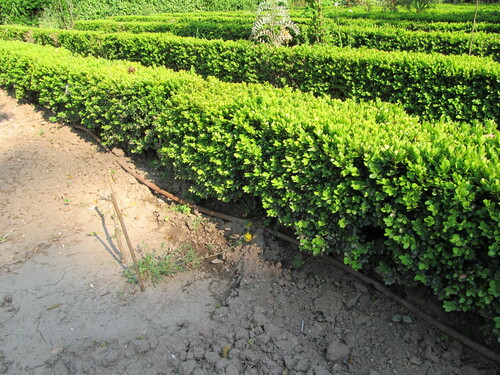
How to care for common box
Watering
Common box (Buxus sempervirens) has shallow, fibrous roots and dense evergreen foliage that loses water steadily all year, so it prefers evenly moist soil that is never waterlogged or bone dry. Water deeply when the top few centimetres of soil feel dry, and let the excess drain away freely. In containers, water until it runs out of the drainage holes, then empty the saucer after 15 minutes. Established shrubs in the ground need roughly 2.5 cm of water per week during hot, dry spells and little or none in cool, wet weather.
Does it need water today?
Push a finger 3 cm into the soil near the root ball. If it feels dry and crumbly, water now. If it feels cool and slightly damp, wait. For pots, lift the container: a light pot needs water, while a heavy, soggy one does not. Leaves that look dull grey-green and slightly limp in the afternoon are also a sign of thirst.
Box is more often killed by too much water than too little. Mulch the root zone with 5 cm of bark or compost to keep moisture steady, and keep mulch away from the stems.
Overwatering
Common box grows in well-drained, moisture-retentive soils but its fine roots suffocate quickly in saturated ground, and wet roots invite Boxwood blight (Calonectria pseudonaviculata) and root rot. Container plants are especially at risk because their compost stays wet longer than garden soil.
Symptoms: Yellowing leaves that drop, a soft or brown base, a sour smell from the soil, and sudden wilting even though the soil is wet.
Solutions: Stop watering and let the soil dry to a depth of 5 cm. Improve drainage by adding grit or perlite to containers and raising the pot on feet. In the ground, loosen compacted soil and avoid planting in low spots. Remove any blackened or rotted roots and repot into fresh, free-draining compost.
Underwatering
Box has a shallow root system and no reserve of stored water, so drought stress shows quickly, particularly in sunny spots and in pots. Young plants and new plantings are most vulnerable because they have not yet grown deep roots.
Symptoms: Dull, bronze or yellowish leaves, crisp leaf edges, leaves that curl inward, and dry, pulling-away compost in containers.
Solutions: Water thoroughly until moisture reaches the root ball, then check again in two days. Mulch to conserve moisture. For severely dry pots, soak by bottom watering. Shade a newly planted box from hot afternoon sun for a few weeks while it recovers.
Sunlight
Common box is naturally a woodland-edge shrub that tolerates a wide range of light, from full sun in cool climates to deep shade. In hot, dry summers, full afternoon sun can scorch its leaves, while in deep shade it grows sparse, leggy and loses its dense form. Good light keeps the foliage compact and a rich dark green.
- Ideal: Partial sun · 3-6 hours of direct sun a day, ideally morning sun with light afternoon shade
- Tolerates: Full sun, Partial sun, Bright, indirect light, Shade
- Best spot in a room: Near the window
- Artificial light: Indoors, box is best kept as a short-term houseplant. Use a bright, south- or east-facing window or a full-spectrum LED grow light set 15 to 30 cm above the foliage for 12 to 14 hours a day. Rotate the pot every week so growth stays even.
Too little light
Box relies on steady light to build the dense, woody growth that makes it a clipped hedge plant, so low light makes it stretch and thin out. Its leaves become less dense and the plant becomes more open and susceptible to disease.
Symptoms: Pale, lax new growth, long gaps between leaves, a thinning shape that leans toward the light, and reduced new shoots.
Solutions: Move the plant to a brighter position, such as a window or outdoor spot with morning sun. Prune lightly in spring to encourage bushier growth. Add a grow light during the darker winter months when moving outdoors is not possible.
Too much sun
Common box tolerates sun in cool climates but in hot, dry regions intense midday light combined with heat dries and bleaches the leaves. Plants in exposed positions, or in containers in full sun, are especially at risk.
Symptoms: Bleached yellow or bronze patches on the sun-facing side, crispy brown leaf edges, and leaves that look dry even when the soil is moist.
Solutions: Move the plant to a spot with afternoon shade or relocate it to a sheltered position. Water more often during heat, and mulch the root zone to keep the roots cool. Increase humidity around indoor plants with a pebble tray. Leaves already damaged will not recover, but new growth will be healthy in the right position.
Temperature
Common box (Buxus sempervirens) is a hardy evergreen shrub that tolerates cold winters well, but its leaves can scorch in hot, dry, windy conditions. Keep it in cool to mild temperatures, and protect it from both harsh winter wind and midday summer heat.
- Ideal: -15–24 °C
- Tolerates: -23–35 °C
- Hardiness zones: 5-8
Fertilizing
Common box grows slowly and needs only modest feeding. Too much nitrogen produces soft, lush growth that is more prone to box blight and winter damage, so feed lightly and keep the feeding schedule steady.
- Slow-release fertilizer: Apply a balanced slow-release fertilizer once a year in early spring, just before new growth starts.
- Balanced slow-release granular fertilizer (such as 10-10-10 or a similar formula), Organic compost or well-rotted manure, Acid-neutral to slightly alkaline formulations suited to box, which tolerates alkaline soil, Balanced liquid fertilizer diluted to half strength for container-grown plants
Soil
Common box grows best in fertile, neutral to slightly alkaline soil that drains freely but stays evenly moist. It tolerates a wide range of conditions, including chalky soils, but it dislikes waterlogged ground and very acidic soil. Good drainage is the single most important factor for healthy roots.
- Loam-based potting compost: Good-quality loam or peat-reduced potting compost blended with about 20-30% horticultural grit or perlite
- Free-draining garden loam: Topsoil with added leaf mould or well-rotted compost, and some coarse sand to open up the structure
- Alkaline-tolerant lime-based mix: Loam with a small addition of crushed limestone or garden lime for gardens where the soil is naturally acidic
- pH 6.5–8
Repotting
Common box (Buxus sempervirens) has a fine, fibrous root system that is sensitive to disturbance and to waterlogging. Repot gently, keep the root ball mostly intact, and avoid large jumps in pot size.
- How often: every 2-3 years for young container-grown plants; established specimens may only need top-dressing with fresh compost every 2-3 years
- New pot: Move up only one size, about 2-5 cm wider in diameter, so the roots do not sit in wet, unused soil. Choose a pot with at least one drainage hole.
- Repotting season: Spring, Autumn
How to repot
- Tip the pot on its side and gently ease the plant out, supporting the stem at the base
- Loosen the outer roots with your fingers, teasing out only the tightest circling roots
- Trim away any black, mushy roots with clean scissors, and keep healthy white roots intact
- Place the plant in the new pot so the soil surface sits about 2 cm below the rim
- Fill around the root ball with compost, firming gently with your hands to remove large air pockets
- Water slowly until water drains freely from the base
Pruning
Common box regrows well from hard pruning, but it does not sprout reliably from very old bare wood, so avoid cutting far into leafless stems. Make light, regular trims rather than severe cuts, and aim to keep most of the foliage on each shoot.
Pruning season: Spring, Summer
How to prune
- Choose a mild, dry day in late spring, after the main frosts have passed, or lightly trim again in midsummer for a neat finish.
- Avoid pruning in autumn or winter, when cuts stay open to cold and damp weather, which can encourage fungal problems.
- For a formal hedge, trim the sides first, working from the base upward so the top is slightly narrower than the bottom. This lets light reach lower leaves.
- Use hand shears or hedge shears for small leaves, cutting just above a leaf pair so new shoots emerge from that point.
- For topiary, shape gradually over several seasons, removing no more than a third of the growth in any single session.
- Rake or gather fallen leaves and clippings, and check the plant for pests before finishing.
Propagation
Semi-hardwood stem cuttings · Summer, Autumn
- In late summer, choose healthy, non-flowering shoots of common box about 8 to 10 cm long that have started to firm up at the base.
- Cut just below a leaf node with clean, sharp secateurs, then strip the leaves from the bottom third of each cutting.
- Dip the cut end in a rooting hormone powder suited to woody plants.
- Insert cuttings into a pot of gritty mix, such as equal parts peat-free compost and horticultural grit, so at least one node is buried.
- Water in, cover loosely with a clear bag or propagator lid, and keep in bright indirect light at about 18 to 22°C.
- Check every few weeks; roots usually form within 8 to 12 weeks. Pot on individually once new growth appears, and keep them sheltered over their first winter.
Layering · Spring, Summer
- In spring, pick a low, flexible branch of the common box shrub that reaches the ground.
- Scrape a small patch of bark off the underside of the branch where it will touch soil, about the width of a pencil.
- Pin that wounded section into a shallow trench with a bent wire or stone, leaving the tip of the shoot above the surface.
- Keep the soil moist through summer.
- After about 12 months, when roots have formed, cut the rooted section free from the parent plant and transplant it.
Seed sowing · Autumn
- Collect ripe seed capsules in autumn, when they turn brown and split open to release small black seeds.
- Soak the seeds in water for 24 hours.
- Sow them 5 mm deep in seed compost and leave the pots outdoors in a cold frame for winter.
- Expect slow germination, often over 12 months or more, and keep the compost lightly moist.
- Note that seedlings do not reliably match the parent plant, so this method is mainly for breeding or for growing large numbers of plants.
Semi-hardwood cuttings taken in late summer are the most reliable method for common box. Keep the cuttings in a sheltered spot out of hard frost, and do not let the compost dry out completely while roots are forming.
About common box
Also known as: Common box, Boxwood, European box, Box tree
- Plant type: shrub, small tree
- Lifespan: perennial
- Distribution: Native to southern and central Europe, North Africa, southwest Asia and the Caucasus region, growing in open woodland and rocky slopes.
- Mature height: 1-6 m in the wild, usually 1-3 m in gardens
- Bloom time: Early spring
Pets · People
Pets: Toxic · People: Toxic. Leaves and twigs contain alkaloids such as cyclovirobuxine and buxamine that can cause vomiting, diarrhoea and abdominal pain if eaten; contact may irritate skin. The ASPCA lists Buxus species as toxic to dogs, cats and horses.
Common problems
- Box blight: Fungal disease caused by Calonectria pseudonaviculata, causing brown leaf spots and rapid defoliation; remove infected material and avoid overhead watering.
- Box tree caterpillar: Larvae of the moth Cydalima perspectalis feed on foliage and can strip plants; check regularly and remove webbing and caterpillars.
- Leaf miner: Small larvae tunnel inside leaves, creating pale blotches; usually cosmetic and best managed by removing affected leaves.
- Root rot: Waterlogged soil leads to decline and dieback; improve drainage and avoid overwatering.
- Winter scorch: Cold dry winds and frost cause browning of leaves; site in shelter and water well before freezing weather.
Uses
Common box is widely grown as an ornamental hedge, topiary and edging plant in formal gardens. Its hard, close-grained wood has been used for carving, turnery, musical instruments, inlay work and chess pieces. Historically, extracts of the leaves were used in folk medicine, though these uses are not recommended due to toxicity.
Is it edible?
not edible
History & legends
Box has been cultivated since antiquity, with Greek and Roman writers describing its wood and garden use. In medieval and Renaissance Europe it was clipped into knots and parterres, and its wood was used for printing blocks and engraving. Its association with the sanctuary of the Mediterranean and with funerary and church gardens made it a long-lived symbol in European tradition.
Did you know?
Box wood is so dense that it sinks in water, and it was traditionally used for printing blocks in the age before modern printing presses.
Frequently asked questions
How often should I water common box?
every 10 days. Common box (Buxus sempervirens) has shallow, fibrous roots and dense evergreen foliage that loses water steadily all year, so it prefers evenly moist soil that is never waterlogged or bone dry. Water deeply when the top few centimetres of soil feel dry, and let the excess drain away freely. In containers, water until it runs out of the drainage holes, then empty the saucer after 15 minutes. Established shrubs in the ground need roughly 2.5 cm of water per week during hot, dry spells and little or none in cool, wet weather. Push a finger 3 cm into the soil near the root ball. If it feels dry and crumbly, water now. If it feels cool and slightly damp, wait. For pots, lift the container: a light pot needs water, while a heavy, soggy one does not. Leaves that look dull grey-green and slightly limp in the afternoon are also a sign of thirst.
How much light does common box need?
Partial sun (3-6 hours of direct sun a day, ideally morning sun with light afternoon shade). Common box is naturally a woodland-edge shrub that tolerates a wide range of light, from full sun in cool climates to deep shade. In hot, dry summers, full afternoon sun can scorch its leaves, while in deep shade it grows sparse, leggy and loses its dense form. Good light keeps the foliage compact and a rich dark green.
What temperature does common box like?
-15–24 °C. Common box (Buxus sempervirens) is a hardy evergreen shrub that tolerates cold winters well, but its leaves can scorch in hot, dry, windy conditions. Keep it in cool to mild temperatures, and protect it from both harsh winter wind and midday summer heat.
Is common box toxic to cats and dogs?
It is toxic to cats and dogs: keep it out of their reach. Leaves and twigs contain alkaloids such as cyclovirobuxine and buxamine that can cause vomiting, diarrhoea and abdominal pain if eaten; contact may irritate skin. The ASPCA lists Buxus species as toxic to dogs, cats and horses.
What are the most common problems of common box?
Box blight: Fungal disease caused by Calonectria pseudonaviculata, causing brown leaf spots and rapid defoliation; remove infected material and avoid overhead watering. Box tree caterpillar: Larvae of the moth Cydalima perspectalis feed on foliage and can strip plants; check regularly and remove webbing and caterpillars. Leaf miner: Small larvae tunnel inside leaves, creating pale blotches; usually cosmetic and best managed by removing affected leaves. Root rot: Waterlogged soil leads to decline and dieback; improve drainage and avoid overwatering. Winter scorch: Cold dry winds and frost cause browning of leaves; site in shelter and water well before freezing weather.
When should I repot common box?
every 2-3 years for young container-grown plants; established specimens may only need top-dressing with fresh compost every 2-3 years. Common box (Buxus sempervirens) has a fine, fibrous root system that is sensitive to disturbance and to waterlogging. Repot gently, keep the root ball mostly intact, and avoid large jumps in pot size.
How do I propagate common box?
Semi-hardwood stem cuttings, Layering, Seed sowing. In late summer, choose healthy, non-flowering shoots of common box about 8 to 10 cm long that have started to firm up at the base. Cut just below a leaf node with clean, sharp secateurs, then strip the leaves from the bottom third of each cutting. Dip the cut end in a rooting hormone powder suited to woody plants. Insert cuttings into a pot of gritty mix, such as equal parts peat-free compost and horticultural grit, so at least one node is buried. Water in, cover loosely with a clear bag or propagator lid, and keep in bright indirect light at about 18 to 22°C. Check every few weeks; roots usually form within 8 to 12 weeks. Pot on individually once new growth appears, and keep them sheltered over their first winter.
How this guide was written
Verdiss writes each guide with AI from botanical references and checks the species against iNaturalist and Plants of the World Online (Kew). Readers can rate every guide in the app.
Sources
Verdiss's information is for general guidance. Never eat or use a plant as medicine based on an app: ask a professional.