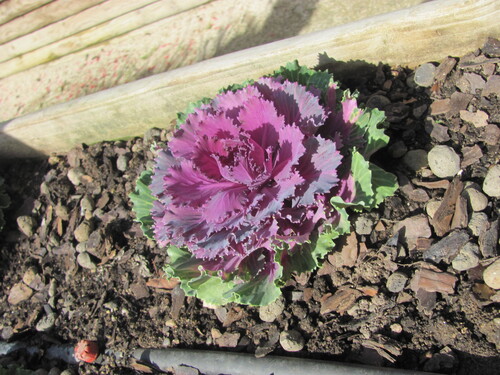
How to care for Brassica oleracea
Watering
Cabbage, kale and broccoli (all Brassica oleracea) are heavy, fast-growing feeders that need steady moisture. Aim for about 2.5 cm of water per week, delivered deeply at the base of the plant so roots stay evenly damp. Consistent watering prevents the splitting of cabbage heads and the woody, bitter leaves that come from drought stress. Water in the morning so leaves dry before evening.
Does it need water today?
Push a finger 3 cm into the soil near the stem. If it feels dry, water now. If it is still moist, wait a day and check again. In containers, lift the pot: a light pot needs water, a heavy one does not. Wilted leaves in the cool morning mean the plant is thirsty, but leaves that droop only in the afternoon heat may recover by evening.
A thick layer of mulch, such as straw or shredded leaves, keeps the soil cool and damp so you water less often. Stop watering heads of cabbage or broccoli a few days before harvest to reduce cracking.
Overwatering
Brassicas are sensitive to waterlogged soil because their roots need oxygen, and soggy ground invites clubroot and rot. Cabbage family plants grown in poorly drained beds or pots without holes are especially at risk.
Symptoms: Yellowing lower leaves, soft or mushy stems at the soil line, a sour smell from the soil, and wilting even though the soil is wet.
Solutions: Stop watering and let the top few centimetres dry before watering again. Improve drainage by mixing in compost or raising the bed, and make sure containers have holes. Remove badly rotted leaves to improve airflow.
Underwatering
Cabbage and kale have large leaves that lose a lot of water to the air, so they wilt quickly when the soil dries. Drought stress makes them bolt, toughen, or become bitter, and heads stay small.
Symptoms: Leaves that droop and feel limp, curled or crispy leaf edges, small or loose heads, and early flowering stalks.
Solutions: Water deeply right away and add mulch to slow evaporation. Water more often during heat waves and in containers. Plants usually recover within a day if the damage is not severe.
Sunlight
Cabbage, kale and broccoli need strong, direct sunlight to form dense heads and sweet, tender leaves. Plants in too much shade grow long and leggy, with loose heads and pale, weak leaves. Partial sun, with about 4 hours of direct light, can still produce leafy crops like kale, though yields will be lower.
- Ideal: Full sun · 6-8 hours of direct sun per day
- Tolerates: Full sun, Partial sun
- Best spot in a room: At the window
- Artificial light: Indoors, a bright south-facing window is usually not enough for full growth. A full-spectrum LED grow light placed 15-30 cm above the leaves for 12-14 hours a day helps seedlings and young kale stay compact and healthy.
Too little light
Brassica oleracea grows toward light, and a lack of sun weakens its stems and delays head formation. Cabbage and broccoli need plenty of energy to build dense, compact heads, so shade leads to loose, poor-quality harvests.
Symptoms: Tall, thin, floppy stems, pale leaves, large gaps between leaves, and small or missing heads.
Solutions: Move the plant to the sunniest spot available, or thin neighboring plants to open up light. Indoors, add a grow light. Outdoors, choose a site that gets at least 6 hours of direct sun.
Too much sun
Brassicas can tolerate strong sun, but intense heat combined with dry soil can scorch leaves and stress the plant. Hot afternoon sun in summer is the most common cause of damage in warm climates.
Symptoms: Bleached or white patches on leaves, crispy brown edges, leaves that curl upward, and premature bolting.
Solutions: Provide light afternoon shade with shade cloth during heat waves, keep the soil consistently moist, and mulch around the base. Move container plants to a spot with some afternoon shade.
Temperature
Brassica oleracea covers cabbage, broccoli, cauliflower, kale, Brussels sprouts and kohlrabi. Most grow best in cool weather, around 13 to 21 °C. Cool-season crops hold their quality longer than warm-season crops, and hot spells cause most of the problems. Hardy kale and Brussels sprouts tolerate frost well, while cauliflower and broccoli are more sensitive to cold snaps during heading.
- Ideal: 13–21 °C
- Tolerates: -10–30 °C
- Hardiness zones: 6-9
Fertilizing
Brassica oleracea is a heavy feeder that needs steady nitrogen for leafy growth and enough potassium and phosphorus for firm heads. Soil should be rich in organic matter and have a pH of about 6.5 to 7.5. Boron and molybdenum are also important, so a balanced feed or a little kelp helps prevent hollow stems and brown heart.
- Slow-release fertilizer: Apply once at planting in spring, mixing a slow-release balanced fertilizer into the top 10 cm of soil, and do not repeat unless growth looks weak.
- Balanced organic fertilizer such as 10-10-10 or 5-5-5, Fish emulsion or fish-based liquid feed, Composted manure or well-rotted compost, Blood meal as a quick nitrogen boost during early growth, Kelp or seaweed extract for trace minerals
Soil
Cabbage grows best in fertile, well-drained soil that holds moisture. It prefers a slightly alkaline to neutral pH of about 6.5 to 7.0, and a soil test helps you check this before planting. Mix in plenty of compost before planting, because these heavy feeders need steady nitrogen to form dense leaves and heads.
- Loamy garden soil: Roughly 40 percent sand, 40 percent silt, and 20 percent clay, with a good amount of organic matter.
- Compost-enriched bed: Garden soil mixed with 20 to 30 percent well-rotted compost or leaf mould.
- Raised bed mix: Equal parts topsoil, compost, and coarse horticultural sand or perlite.
- pH 6–7.5
Repotting
Cabbage (Brassica oleracea) has a shallow but spreading root system and dislikes root disturbance, so transplant young plants gently and as early as possible. Harden seedlings off before planting out, and keep them moist but never waterlogged.
- How often: Not repotted as a mature plant. Transplant seedlings once, when they have 4 to 6 true leaves, usually 4 to 6 weeks after sowing indoors.
- New pot: For seedlings, start in 7 to 9 cm pots. Move a young cabbage to a 20 to 25 cm container only if you are growing it on a patio, and plan to plant it in the ground or a large bed by the time it is 15 to 20 cm tall.
- Repotting season: Spring, Summer
How to repot
- Dig a hole slightly larger than the root ball, about 10 to 15 cm deep for a cabbage seedling.
- Gently slide the seedling out of its pot, keeping the root ball intact. Do not pull it by the stem.
- Set the plant in the hole so the soil level matches where it grew before, and firm the soil lightly around the root ball.
- Space plants 40 to 60 cm apart, depending on the variety, so heads have room to form.
- Water thoroughly to settle the soil around the roots.
Pruning
Use clean, sharp secateurs or a knife and remove only a few leaves at a time, never more than about a third of the plant's foliage at once. Always leave the growing tip and the central leaves intact, because removing them will stop the plant growing.
Pruning season: Spring, Summer, Autumn, Winter
How to prune
- Remove yellowing or damaged lower leaves as soon as you notice them by cutting the leaf stalk close to the main stem, leaving the plant's healthy upper leaves in place.
- For kale, collards, and other leafy forms, harvest the outer, mature leaves first and leave the young central leaves to keep growing.
- For Brussels sprouts, remove the lower leaves when the sprouts near the base are the size of a marble, which lets them swell evenly; remove no more than the lowest third of leaves in a season.
- For cabbage, pull off outer leaves that are damaged or split and keep the tightly wrapped head protected by at least two or three layers of healthy leaves.
- For broccoli and cauliflower, cut the main head with about 10 cm of stem and leave the plant in place, since side shoots will often produce smaller heads over the following weeks.
- In late autumn or early winter, remove spent plants and any flower stalks that have gone to seed, and compost healthy material while sending diseased plants to the bin to protect next year's crop.
Propagation
Seed sowing indoors · Winter, Spring
- Sow seeds of your cabbage, kale, or broccoli variety about 0.5 cm deep in seed trays of moist seed-starting mix 6 to 8 weeks before your last spring frost.
- Keep the tray at 18 to 24°C, which is the ideal range for germination; seedlings usually appear within 5 to 10 days.
- Place seedlings under bright light for 12 to 16 hours a day so they stay short and sturdy rather than leggy.
- Move seedlings into individual pots once they have two true leaves, and water when the surface feels dry.
- Harden off the seedlings over 7 to 10 days, starting with a few hours outdoors in mild weather and building up to full days.
- Transplant when seedlings have four to six true leaves and nights stay above about 5°C, spacing plants 40 to 60 cm apart depending on the variety.
Direct sowing outdoors · Spring, Summer, Autumn
- Choose a sunny bed with fertile, well-drained soil that has been enriched with compost.
- Sow spring crops as soon as the soil can be worked and reaches about 7°C, placing seeds 1 cm deep.
- Sow summer and autumn crops in midsummer for a fall or winter harvest; soil this warm germinates quickly.
- Thin seedlings to the final spacing for your variety once they are a few centimetres tall, so the remaining plants have room to form full heads or leaves.
- Keep the soil evenly moist during germination, and protect young seedlings from flea beetles and cabbage moth caterpillars with fine netting.
Stem cuttings (kale only) · Spring, Summer
- Choose a healthy, non-flowering kale plant with a sturdy, unbranched stem and take 10 to 15 cm cuttings from the top, just below a leaf node.
- Remove the lower leaves and keep the top two or three leaves on each cutting.
- Place the cuttings in a glass of water or a pot of moist potting mix, kept in bright indirect light at about 18 to 22°C.
- Roots usually form in two to three weeks; once they are established, pot the cuttings up and grow them on before planting outdoors.
- Note that this method works mainly for kale and not for head cabbage or broccoli, which are normally grown from seed.
Sow a few extra seeds in each pot so you can remove the weakest seedling and keep the strongest one; cabbage-family seedlings transplant best when their roots are not disturbed too much, so handle them by the leaves rather than the stem.
About Brassica oleracea
Also known as: wild cabbage, sea cabbage, colewort, cole
- Plant type: herb, biennial vegetable, coastal plant
- Lifespan: biennial or short-lived perennial in the wild
- Distribution: Native to the Atlantic and Mediterranean coasts of western and southern Europe, growing on sea cliffs and rocky shores.
- Mature height: 0.3 to 1 m
- Bloom time: late spring to early summer in the second year
Pets · People
Pets: Safe · People: Safe. Not listed as toxic by the ASPCA. Large amounts of raw brassicas can cause mild digestive upset or gas in pets and people; cooking reduces this.
Common problems
- Cabbage white caterpillars: Green larvae of the cabbage white butterfly chew holes in leaves and heads; use fine netting and check leaf undersides.
- Clubroot: Soil-borne Plasmodiophora brassicae causes swollen, distorted roots and wilting; rotate crops and improve drainage, as there is no cure.
- Downy mildew: Grey-purple fungal growth on leaf undersides in damp weather; improve airflow and water at the base.
- Aphids: Colonies cluster on new growth and flower stalks, causing distortion; blast with water or encourage ladybirds.
- Flea beetles: Tiny jumping beetles leave shot-hole damage on young leaves; cover seedlings with insect fleece.
Uses
Cultivated as a major vegetable worldwide in its many forms: cabbage, kale, broccoli, cauliflower, Brussels sprouts, kohlrabi and collards. Leaves, buds, stems and heads are eaten fresh, steamed, fermented or pickled, and the plant is also grown as an ornamental kale in winter bedding.
Is it edible?
Leaves, young shoots, flower buds, stems and roots are edible when cooked. Edibility of the wild form is best left to experts, as wild plants are tougher and more bitter than cultivars.
History & legends
Wild cabbage has been eaten since antiquity, and Greek and Roman writers recommended it for health and as a food. Medieval herbals prescribed it for many ailments, and the wide variety of cultivated forms developed over centuries of selective breeding in Europe.
Did you know?
Cabbage, kale, broccoli, cauliflower, kohlrabi and Brussels sprouts are all the same species, Brassica oleracea, grown as different cultivar groups that mainly differ in the part of the plant that is eaten.
Frequently asked questions
How often should I water Brassica oleracea?
every 3 days. Cabbage, kale and broccoli (all Brassica oleracea) are heavy, fast-growing feeders that need steady moisture. Aim for about 2.5 cm of water per week, delivered deeply at the base of the plant so roots stay evenly damp. Consistent watering prevents the splitting of cabbage heads and the woody, bitter leaves that come from drought stress. Water in the morning so leaves dry before evening. Push a finger 3 cm into the soil near the stem. If it feels dry, water now. If it is still moist, wait a day and check again. In containers, lift the pot: a light pot needs water, a heavy one does not. Wilted leaves in the cool morning mean the plant is thirsty, but leaves that droop only in the afternoon heat may recover by evening.
How much light does Brassica oleracea need?
Full sun (6-8 hours of direct sun per day). Cabbage, kale and broccoli need strong, direct sunlight to form dense heads and sweet, tender leaves. Plants in too much shade grow long and leggy, with loose heads and pale, weak leaves. Partial sun, with about 4 hours of direct light, can still produce leafy crops like kale, though yields will be lower.
What temperature does Brassica oleracea like?
13–21 °C. Brassica oleracea covers cabbage, broccoli, cauliflower, kale, Brussels sprouts and kohlrabi. Most grow best in cool weather, around 13 to 21 °C. Cool-season crops hold their quality longer than warm-season crops, and hot spells cause most of the problems. Hardy kale and Brussels sprouts tolerate frost well, while cauliflower and broccoli are more sensitive to cold snaps during heading.
Is Brassica oleracea toxic to cats and dogs?
It is safe for cats and dogs. Not listed as toxic by the ASPCA. Large amounts of raw brassicas can cause mild digestive upset or gas in pets and people; cooking reduces this.
What are the most common problems of Brassica oleracea?
Cabbage white caterpillars: Green larvae of the cabbage white butterfly chew holes in leaves and heads; use fine netting and check leaf undersides. Clubroot: Soil-borne Plasmodiophora brassicae causes swollen, distorted roots and wilting; rotate crops and improve drainage, as there is no cure. Downy mildew: Grey-purple fungal growth on leaf undersides in damp weather; improve airflow and water at the base. Aphids: Colonies cluster on new growth and flower stalks, causing distortion; blast with water or encourage ladybirds. Flea beetles: Tiny jumping beetles leave shot-hole damage on young leaves; cover seedlings with insect fleece.
When should I repot Brassica oleracea?
Not repotted as a mature plant. Transplant seedlings once, when they have 4 to 6 true leaves, usually 4 to 6 weeks after sowing indoors.. Cabbage (Brassica oleracea) has a shallow but spreading root system and dislikes root disturbance, so transplant young plants gently and as early as possible. Harden seedlings off before planting out, and keep them moist but never waterlogged.
How do I propagate Brassica oleracea?
Seed sowing indoors, Direct sowing outdoors, Stem cuttings (kale only). Sow seeds of your cabbage, kale, or broccoli variety about 0.5 cm deep in seed trays of moist seed-starting mix 6 to 8 weeks before your last spring frost. Keep the tray at 18 to 24°C, which is the ideal range for germination; seedlings usually appear within 5 to 10 days. Place seedlings under bright light for 12 to 16 hours a day so they stay short and sturdy rather than leggy. Move seedlings into individual pots once they have two true leaves, and water when the surface feels dry. Harden off the seedlings over 7 to 10 days, starting with a few hours outdoors in mild weather and building up to full days. Transplant when seedlings have four to six true leaves and nights stay above about 5°C, spacing plants 40 to 60 cm apart depending on the variety.
How this guide was written
Verdiss writes each guide with AI from botanical references and checks the species against iNaturalist and Plants of the World Online (Kew). Readers can rate every guide in the app.
Sources
Verdiss's information is for general guidance. Never eat or use a plant as medicine based on an app: ask a professional.