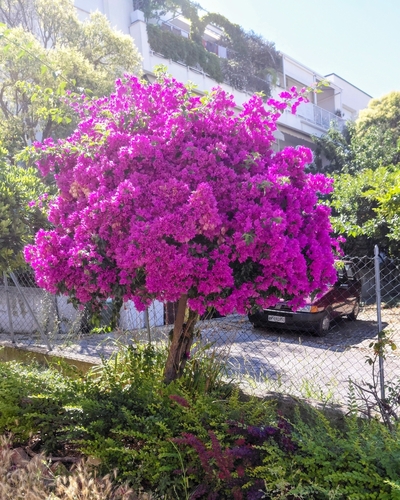
How to care for lesser bougainvillea
Watering
Lesser bougainvillea (Bougainvillea glabra) is a drought-tolerant vine that stores water in its woody stems and fleshy roots, so it prefers to dry out between drinks. Let the top 5 cm of soil dry completely, then water deeply until it runs out of the drainage holes. Empty any saucer within 15 minutes. Water less in winter, when growth slows and soggy roots can rot quickly. Indoors, it needs more frequent watering only during the bright growing season.
Does it need water today?
Push a finger 5 cm into the soil. If it feels dry and crumbly, water it. If it feels cool or damp, wait. Lift the pot too: a light pot means it is thirsty, a heavy pot means it can wait. Leaves that droop slightly in the afternoon, then perk up by evening, are normal and not a sign of thirst.
Bougainvillea blooms best when it is slightly stressed for water in the growing season. Don't keep the soil constantly moist, or you will get lush leaves and few of the colourful bracts.
Overwatering
Lesser bougainvillea is native to dry, seasonal regions of South America, where its roots are adapted to brief wet periods followed by long dry spells. Constantly wet soil suffocates the roots and invites root rot, which is the most common way this plant dies in pots.
Symptoms: Yellowing lower leaves, leaves dropping while the soil is still wet, a sour or musty smell from the soil, soft or blackened stem bases, and a sudden wilting even though the soil is damp.
Solutions: Stop watering and let the soil dry out fully. Remove the plant from its pot, cut away any black, mushy roots with clean scissors, and repot in fresh, fast-draining mix in a pot only slightly larger than the root ball. Water sparingly until new growth appears.
Underwatering
Because bougainvillea is built to tolerate drought, it usually shows stress slowly. However, a plant in a pot or hanging basket dries out faster than one in the ground, and prolonged drought during the growing season reduces flowering.
Symptoms: Leaves curling, wilting and turning dull, small or crisp brown leaf edges, bracts dropping early, and soil pulling away from the pot sides. A plant that is badly dry will feel very light.
Solutions: Water thoroughly until water drains from the base, then wait for the soil to become evenly moist. If the root ball is hard and dry, soak the pot in a bucket for 30 minutes. Recovery usually takes a few weeks, and leaves do not recover once they have turned completely brown.
Sunlight
Lesser bougainvillea needs strong, direct sun to produce its papery, colourful bracts. In full sun it grows compact and flowers heavily. In partial shade it becomes leggy, with long stems and few flowers. Indoors it struggles, so give it the brightest spot you have and move it outdoors when nights stay above 10°C.
- Ideal: Full sun · 6-8 hours of direct sun
- Tolerates: Full sun, Partial sun
- Best spot in a room: At the window
- Artificial light: If grown indoors, use a full-spectrum grow light at 15 to 30 cm above the canopy for 12 to 14 hours a day during the growing season. Rotate the pot every week so growth stays even.
Too little light
Bougainvillea evolved in open, sunny habitats where it climbs and spreads with bright light. Without enough light it cannot build the energy needed for flower bracts, so it stretches toward any light source.
Symptoms: Long, weak, pale stems, large gaps between leaves, leaves that are smaller and darker green than normal, and very few or no coloured bracts.
Solutions: Move the plant to a sunnier spot, ideally a south- or west-facing window or outdoors. Prune back leggy stems in late winter or early spring to encourage bushier growth, and add a grow light if sun is limited.
Too much sun
Lesser bougainvillea tolerates strong sun well once acclimatised, but a plant moved abruptly from shade into intense midday sun, especially in a hot reflective location, can scorch.
Symptoms: Pale, bleached or whitish patches on leaves, crisp brown edges or spots, and leaves wilting in the afternoon even when the soil is moist.
Solutions: Acclimatise the plant over 7 to 10 days, starting with 1 to 2 hours of direct sun and building up gradually. Provide light afternoon shade during heatwaves, and water deeply on hot days, since sun-scorched leaves lose water quickly.
Temperature
Lesser bougainvillea (Bougainvillea glabra) is a tropical to subtropical vine that thrives in warmth and sun. It stops growing below about 15°C and is damaged by frost, so keep it above 5°C in winter. Night temperatures of 15°C or higher suit it best, and it flowers most strongly when days are hot and nights are cool but not cold.
- Ideal: 15–30 °C
- Tolerates: 2–38 °C
- Hardiness zones: 10-12
Fertilizing
Lesser bougainvillea flowers best when it is slightly underfed on nitrogen. Too much nitrogen produces lush green leaves and few bracts. Phosphorus and potassium support flowering, so choose a fertilizer with more of those nutrients than nitrogen. Water the plant before applying any fertilizer to avoid burning the roots.
- Slow-release fertilizer: Apply once a year in early spring, just as new growth begins. Bougainvillea grows in poor soil and does not need much feeding.
- Low-nitrogen, high-phosphorus flowering plant fertilizer (for example, a 5-10-5 or 10-20-10 formula), Bone meal or rock phosphate for slow phosphorus supply, Slow-release granular fertilizer formulated for flowering shrubs and vines
Soil
Lesser bougainvillea needs soil that drains freely and never stays soggy. Its roots rot quickly in heavy, wet, or compacted soil, so drainage matters more than fertility. A slightly sandy, gritty mix that dries out between waterings is ideal.
- Fast-draining potting mix: Two parts peat-free potting mix, one part perlite or pumice, and one part coarse sand or horticultural grit
- Cactus or succulent mix: Commercial cactus mix, lightly amended with extra perlite to hold a little moisture while still draining quickly
- Garden bed soil (in-ground): Native or sandy loam mixed with compost and coarse sand where drainage is poor; raised beds are recommended in wet areas
- pH 6–7.5
Repotting
Repot in warm weather, when the plant is actively growing and temperatures stay above 18°C. Lesser bougainvillea has thin, brittle roots that dislike disturbance, so handle the root ball gently and avoid tearing it apart.
- How often: Every 2-3 years, or when roots fill the pot and water runs straight through
- New pot: Move up only 2-5 cm in diameter at a time; choose a pot with drainage holes. Bougainvillea glabra prefers to be slightly root-bound, so oversized pots hold wet soil and invite root rot.
- Repotting season: Spring, Summer
How to repot
- Tip the plant on its side and ease it out of the old pot, supporting the stems with one hand
- Gently loosen the outer roots with your fingers; trim away any dead, black, or mushy roots with clean shears
- Place a 3-4 cm layer of fresh mix in the new pot, then set the plant so the root ball sits at the same depth it grew before
- Fill around the root ball with fresh mix, firming lightly with your hands to remove large air pockets
- Water thoroughly until it drains from the holes, then leave the pot in bright, sheltered light
Pruning
Bougainvillea glabra blooms best when it is slightly root-bound and gets full sun, and it flowers on new wood. Prune hard in late winter or early spring, before the new growth begins, then lightly trim during the growing season to shape the plant and encourage repeat flowering. Always wear gloves, because the thorns are sharp.
Pruning season: Winter, Spring
How to prune
- In late winter, remove all dead, diseased, or damaged wood first, cutting back to healthy tissue.
- Cut out any thin, weak, or crossing stems at their base to open up the center of the plant.
- Shorten the remaining main canes by about one-third to one-half, cutting just above an outward-facing node or bud.
- For a container plant, cut back long shoots to keep the size manageable, and trim the top to maintain a compact shape.
- During the growing season, pinch or snip back long, unruly shoots after each flush of bloom to encourage branching and more flowers.
- Avoid heavy pruning in autumn, as new growth may not harden off before cold weather arrives.
- Clear fallen leaves and debris, and dispose of any cuttings from diseased plants rather than composting them.
Propagation
Semi-hardwood stem cuttings · Spring, Summer
- Choose a healthy, non-flowering stem of the current season's growth that has partly firmed up at the base, about 10 to 15 cm long with 3 to 4 nodes.
- Cut just below a node using clean, sharp pruners dipped in rubbing alcohol.
- Strip the leaves from the lower two-thirds of the cutting, leaving a few leaves at the top.
- Optionally dip the cut end in a rooting hormone powder, tapping off any excess.
- Insert the cutting about 4 cm deep into a pot of moist mix of equal parts perlite and peat or coir, or a sandy potting mix.
- Cover loosely with a clear plastic bag or place in a propagator to keep humidity high, and set it in bright, indirect light at about 24 to 28 °C.
- Check weekly. Roots usually form in 4 to 8 weeks. Gently tug the cutting to test for resistance before potting it up.
Air layering · Spring, Summer
- Pick a healthy, woody branch about pencil thickness and at least one year old, ideally with a nearby node.
- Make two parallel cuts about 2 cm apart around the stem, then peel away a ring of bark between them, exposing the lighter wood underneath.
- Scrape the exposed wood lightly to remove the green cambium layer and dust with rooting hormone if you have it.
- Wrap a handful of damp sphagnum moss around the wound and secure it with clear plastic wrap, sealing both ends with tape or twine.
- Keep the moss moist by reopening and misting when it feels dry. Roots typically appear in 6 to 10 weeks.
- Once a dense root ball is visible through the wrap, cut the branch below the roots and pot it in well-draining soil.
Hardwood cuttings · Winter
- In late winter, when the plant is dormant, select mature, pencil-thick stems that grew last season.
- Cut 20 to 25 cm lengths just below a node and remove any leaves and flower remnants.
- Push the lower half of each cutting into a container of gritty, free-draining mix, leaving two or three nodes above the surface.
- Keep the pot in a warm, bright spot around 18 to 22 °C and water sparingly until new leaves appear in spring.
Bougainvillea glabra is one of the easier bougainvilleas to root from softwood tips, but it roots slowly and dislikes soggy soil. Keep the medium just barely moist, never waterlogged, and be patient: the cutting may look unchanged for several weeks before roots form. Once rooted, let the young plant get plenty of sun so it blooms well in its first season.
About lesser bougainvillea
Also known as: Lesser bougainvillea, Paperflower, Bougainvillier glabre
- Plant type: climber, shrub, woody vine
- Lifespan: perennial
- Distribution: Native to south-eastern Brazil and adjacent parts of South America.
- Mature height: Up to 5-10 m when climbing, often kept at 2-3 m in gardens
- Bloom time: Mainly late winter to summer in the Northern Hemisphere, and in warm climates across much of the year
Pets · People
Pets: Mildly toxic · People: Mildly toxic. The sap and leaves can irritate the mouth and stomach if chewed, causing mild gastrointestinal upset; the thorns can also cause scratches. Keep out of reach of curious pets and children.
Common problems
- No flowers: Usually caused by too little sun, too much nitrogen fertiliser, or overwatering; move to a sunnier spot and switch to a bloom feed.
- Yellowing leaves: Often from waterlogged soil or poor drainage, leading to root stress; let the soil dry more between waterings and check the pot has drainage holes.
- Leaf drop after cold: Sensitive to temperatures below about 10 °C; cold snaps cause leaf loss, so protect young plants in winter.
- Mealybugs and scale: White cottony clusters on stems and leaf joints; wipe off with alcohol on a cotton swab or treat with horticultural oil.
- Aphids on new growth: Soft tips attract aphids in spring; rinse them off with water or use insecticidal soap.
Uses
Mainly ornamental, grown as a climber on walls, fences and pergolas, in hanging baskets, and as a clipped hedge or bonsai in warm regions. In parts of South America its wood and bracts have been used in local folk remedies, though these uses are not well documented.
Is it edible?
Not edible; the sap and leaves are irritating if eaten.
History & legends
Bougainvillea was first described in Europe in the late eighteenth century after botanists collected specimens from South America, and was named for the French explorer Louis Antoine de Bougainville. Many stories attach to the plant as it spread through tropical gardens, and it became a symbol of Mediterranean and tropical gardens alike.
Did you know?
The colourful parts are bracts, leaf-like modified structures, not petals; the actual flowers are tiny and white, tucked inside each cluster of three bracts.
Frequently asked questions
How often should I water lesser bougainvillea?
every 10 days. Lesser bougainvillea (Bougainvillea glabra) is a drought-tolerant vine that stores water in its woody stems and fleshy roots, so it prefers to dry out between drinks. Let the top 5 cm of soil dry completely, then water deeply until it runs out of the drainage holes. Empty any saucer within 15 minutes. Water less in winter, when growth slows and soggy roots can rot quickly. Indoors, it needs more frequent watering only during the bright growing season. Push a finger 5 cm into the soil. If it feels dry and crumbly, water it. If it feels cool or damp, wait. Lift the pot too: a light pot means it is thirsty, a heavy pot means it can wait. Leaves that droop slightly in the afternoon, then perk up by evening, are normal and not a sign of thirst.
How much light does lesser bougainvillea need?
Full sun (6-8 hours of direct sun). Lesser bougainvillea needs strong, direct sun to produce its papery, colourful bracts. In full sun it grows compact and flowers heavily. In partial shade it becomes leggy, with long stems and few flowers. Indoors it struggles, so give it the brightest spot you have and move it outdoors when nights stay above 10°C.
What temperature does lesser bougainvillea like?
15–30 °C. Lesser bougainvillea (Bougainvillea glabra) is a tropical to subtropical vine that thrives in warmth and sun. It stops growing below about 15°C and is damaged by frost, so keep it above 5°C in winter. Night temperatures of 15°C or higher suit it best, and it flowers most strongly when days are hot and nights are cool but not cold.
Is lesser bougainvillea toxic to cats and dogs?
It is mildly toxic to cats and dogs. The sap and leaves can irritate the mouth and stomach if chewed, causing mild gastrointestinal upset; the thorns can also cause scratches. Keep out of reach of curious pets and children.
What are the most common problems of lesser bougainvillea?
No flowers: Usually caused by too little sun, too much nitrogen fertiliser, or overwatering; move to a sunnier spot and switch to a bloom feed. Yellowing leaves: Often from waterlogged soil or poor drainage, leading to root stress; let the soil dry more between waterings and check the pot has drainage holes. Leaf drop after cold: Sensitive to temperatures below about 10 °C; cold snaps cause leaf loss, so protect young plants in winter. Mealybugs and scale: White cottony clusters on stems and leaf joints; wipe off with alcohol on a cotton swab or treat with horticultural oil. Aphids on new growth: Soft tips attract aphids in spring; rinse them off with water or use insecticidal soap.
When should I repot lesser bougainvillea?
Every 2-3 years, or when roots fill the pot and water runs straight through. Repot in warm weather, when the plant is actively growing and temperatures stay above 18°C. Lesser bougainvillea has thin, brittle roots that dislike disturbance, so handle the root ball gently and avoid tearing it apart.
How do I propagate lesser bougainvillea?
Semi-hardwood stem cuttings, Air layering, Hardwood cuttings. Choose a healthy, non-flowering stem of the current season's growth that has partly firmed up at the base, about 10 to 15 cm long with 3 to 4 nodes. Cut just below a node using clean, sharp pruners dipped in rubbing alcohol. Strip the leaves from the lower two-thirds of the cutting, leaving a few leaves at the top. Optionally dip the cut end in a rooting hormone powder, tapping off any excess. Insert the cutting about 4 cm deep into a pot of moist mix of equal parts perlite and peat or coir, or a sandy potting mix. Cover loosely with a clear plastic bag or place in a propagator to keep humidity high, and set it in bright, indirect light at about 24 to 28 °C. Check weekly. Roots usually form in 4 to 8 weeks. Gently tug the cutting to test for resistance before potting it up.
How this guide was written
Verdiss writes each guide with AI from botanical references and checks the species against iNaturalist and Plants of the World Online (Kew). Readers can rate every guide in the app.
Sources
Verdiss's information is for general guidance. Never eat or use a plant as medicine based on an app: ask a professional.