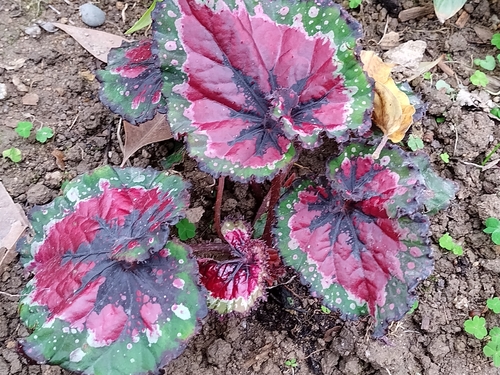
How to care for king begonia
Watering
King begonia (Begonia rex) has fleshy, rhizomatous stems and thin, hairy leaves that lose water quickly but rot easily when kept wet. Water when the top layer of potting mix feels dry, letting the mix dry slightly between waterings, and always pour water so the leaves and crown stay dry. Use room-temperature water and a pot with drainage holes, and empty any saucer within 30 minutes so roots never sit in water.
Does it need water today?
Push your finger about 2 cm (1 inch) into the potting mix. If it feels dry, water now; if it feels cool and moist, wait a day. Lift the pot too: a light pot means it is dry, a heavy pot means it still holds water.
Water at the soil edge rather than over the leaves, and let excess drain fully before returning the pot to its place. Humidity around 50 percent helps the leaves stay firm between waterings.
Overwatering
King begonia's thick rhizomes and stems store some water, but its roots need air to function. In soggy mix, roots and the rhizome rot quickly, and the plant cannot take up water even though it is surrounded by it.
Symptoms: Leaves turn limp and yellow, the stems become soft or mushy near the soil, a sour or musty smell comes from the pot, and the leaves may drop even though the mix is wet.
Solutions: Stop watering and remove the plant from its pot. Cut away black or mushy rhizome and roots with clean scissors, let the remaining tissue dry for a day, then repot into fresh, fast-draining mix in a clean pot with drainage holes.
Underwatering
The leaves of king begonia are thin and hairy, so they lose moisture fast in warm rooms or near heaters. Without enough water, the plant cannot keep its leaves turgid and it stops growing to conserve resources.
Symptoms: Leaves wilt, curl at the edges, and feel crisp or papery, while the potting mix pulls away from the pot wall and feels dry several centimetres down.
Solutions: Water thoroughly from the bottom for 20 to 30 minutes until the mix is evenly moist, then let it drain. Mist the air around the plant or set the pot on a humidity tray, and check the mix every few days until new leaves firm up.
Sunlight
King begonia grows best in bright, indirect light, which brings out the silver, red, and purple patterns on its leaves. Direct midday sun scorches the thin leaves, while deep shade makes the plant leggy and dulls its colors. A position a little back from a bright window usually suits it best.
- Ideal: Bright, indirect light · 6-8 hours of bright, filtered light per day
- Tolerates: Partial sun, Bright, indirect light
- Best spot in a room: Near the window
- Artificial light: If natural light is weak, use a full-spectrum LED grow light 30 to 45 cm (12 to 18 inches) above the leaves for 12 to 14 hours a day. Keep the light on a timer so the plant gets a consistent rhythm.
Too little light
King begonia relies on bright light to maintain its vivid leaf colors and compact growth. In low light, it stretches toward any available light and uses its stored energy poorly, which weakens the stems over time.
Symptoms: Stems become long and thin, leaves grow smaller and lose their metallic sheen, and the plant stops producing new leaves or flowers.
Solutions: Move the plant closer to a bright east or north window, or add a full-spectrum LED grow light for 12 to 14 hours a day. Rotate the pot a quarter turn each week so growth stays even.
Too much sun
The thin, hairy leaves of king begonia are not built for strong direct sun. Intense rays heat the leaf tissue faster than the roots can supply water, so the leaves bleach and dry out.
Symptoms: Pale, bleached patches or brown scorched edges appear on the leaves, which may curl and feel crisp, and the potting mix dries out much faster than usual.
Solutions: Move the plant out of direct sun to a spot a few feet back from a bright window or behind a sheer curtain. Trim badly scorched leaves at the base and check the mix more often while the plant recovers.
Temperature
King begonia (Begonia rex) grows best in warm, steady indoor conditions between 18 and 24 °C. It is a tropical plant from humid forest floors in Assam and southeast Asia, so it dislikes sudden swings and drafts more than gradual warmth.
- Ideal: 18–24 °C
- Tolerates: 10–29 °C
- Hardiness zones: 10-12
Fertilizing
King begonia is grown mainly for its foliage, so it benefits from balanced nutrition and steady moisture, not heavy feeding. Feed only while it is actively growing, from spring through early autumn, and rest it in winter when light levels are low.
- Slow-release fertilizer: Not needed for most houseplants; if you repot in spring, use a light dose of slow-release granules once a year instead.
- Balanced liquid houseplant fertilizer, such as a 10-10-10 or 20-20-20 formula, diluted to half strength, Liquid seaweed or fish emulsion for gentle feeding, Slow-release balanced granular fertilizer for repotted plants
Soil
Begonia rex needs a loose, airy, slightly acidic mix that drains quickly but holds some moisture. Dense or heavy soil quickly leads to rhizome rot, so always add perlite, pumice, or bark.
- Peat-free begonia mix: Equal parts peat-free potting compost, perlite, and orchid bark or coco chips for air around the roots.
- Leaf mould blend: Two parts all-purpose potting mix, one part leaf mould, and one part perlite or pumice.
- African violet mix: Commercial African violet mix with an added handful of perlite to improve drainage for the rhizome.
- pH 5.5–6.5
Repotting
Repot in spring or early summer while the plant is actively growing. Use a shallow, wide pot with drainage holes, and handle the fleshy rhizome gently because it bruises and rots easily.
- How often: every 1-2 years, or when roots fill the pot
- New pot: Move up only one pot size (about 2-3 cm wider) to avoid soggy soil; Begonia rex has a shallow, spreading rhizome and dislikes oversized pots.
- Repotting season: Spring, Summer
How to repot
- Slide the plant out gently by tilting the pot and tapping its sides, supporting the rhizome with your hand.
- Shake off old, compacted soil and trim away any black, mushy, or thread-like roots with clean scissors.
- Place a 2-3 cm layer of fresh mix in the new pot and set the rhizome on top, with the top of the rhizome just at or slightly above the soil line.
- Fill around the roots with fresh mix, pressing lightly so there are no large air pockets, and keep the leaves clear of the soil.
- Water lightly until moisture drains out the bottom, then let the excess drain fully before returning the pot to its spot.
Pruning
Begonia rex is grown mainly for its patterned foliage, so pruning focuses on removing leaves and stems rather than shaping flowers. Remove the flower stalks as soon as they appear, because the blooms are small and draw energy from the leaves.
Pruning season: Spring, Summer
How to prune
- Remove any yellow, brown, or mushy leaves by cutting the petiole close to the rhizome or main stem.
- Cut off flower stalks at their base as soon as you see them.
- To control height, cut a leggy stem just above a leaf node; new growth will sprout from that point.
- Remove no more than about one-third of the foliage at once to avoid stressing the plant.
- Discard cuttings you cannot root, and wash your tools with rubbing alcohol afterward.
- Avoid heavy pruning in late autumn and winter, when growth slows and wounds heal more slowly at cooler indoor temperatures.
Propagation
Leaf cutting · Spring, Summer
- Choose a healthy, mature leaf from a Begonia rex plant with no spots, holes, or mildew.
- Cut the leaf stalk (petiole) at an angle, leaving about 3 to 5 cm attached to the leaf.
- Make small cuts across the main veins on the underside of the leaf, or cut the leaf into wedges so each piece has a vein, then lay it flat on the surface of moist potting mix, veins facing down.
- Pin the leaf down with small stones or hairpins so it stays in contact with the soil.
- Cover loosely with a clear plastic bag or dome to keep humidity high, and keep the tray in bright, indirect light at about 20 to 24°C.
- Mist lightly when the surface looks dry. Small plantlets usually appear at the cut veins within 4 to 8 weeks.
- Once plantlets have two or three leaves, separate them and pot each one individually.
Stem or petiole cutting · Spring, Summer
- Cut a healthy stem section with at least one leaf and a node, about 5 to 8 cm long.
- Let the cut end dry for an hour so it forms a callus.
- Insert the cut end about 2 cm deep into moist perlite or a light potting mix.
- Keep in bright, indirect light and maintain warmth around 21 to 24°C.
- Roots typically form in 3 to 6 weeks. Transplant when a gentle tug meets resistance.
Division · Spring
- When repotting in spring, slide the plant out of its pot and examine the rhizome, the thick fleshy stem at soil level.
- Using a clean knife, cut the rhizome into sections so each piece has at least two or three leaves and some roots.
- Pot each section in fresh, well-draining potting mix, keeping the top of the rhizome just at soil level.
- Water lightly and keep out of direct sun for a week while roots settle.
Begonia rex grows from rhizomes and leaves, so a leaf cutting is the most rewarding method. Keep humidity high but air moving gently to prevent fungal problems, and never let the cuttings sit in standing water.
About king begonia
Also known as: Painted-leaf begonia, King begonia, Rex begonia
- Plant type: herb, rhizomatous perennial
- Lifespan: perennial
- Distribution: Native to northeastern India, Assam and neighbouring parts of Southeast Asia, growing in shaded, humid forests.
- Mature height: 20-40 cm
- Bloom time: Mostly late winter to spring; flowers are inconspicuous and often removed
Pets · People
Pets: Toxic · People: Toxic. Begonias contain soluble calcium oxalate crystals, which cause mouth and throat irritation, drooling, vomiting and pain if chewed or swallowed; ASPCA lists Begonia species as toxic to cats and dogs.
Common problems
- Leaf edge browning: Usually caused by low humidity or dry air, and sometimes by inconsistent watering.
- Root rot: Overwatering or poorly draining soil leads to soft, blackening rhizomes and collapsing stems.
- Powdery mildew: White powdery coating on leaves in stagnant, humid, poorly ventilated conditions.
- Leaf scorch: Brown patches from direct sun through glass, especially in summer.
- Mealybugs: White cottony clusters at leaf joints and undersides that suck sap and weaken the plant.
Uses
Mainly ornamental, grown as a houseplant and in shaded greenhouse and terrarium displays for its colourful leaves. It has no significant culinary, medicinal or industrial use in traditional practice.
Is it edible?
Not edible; the leaves and stems contain calcium oxalate and cause irritation if eaten.
History & legends
Begonia rex was first described in the 19th century after plant collectors brought it from India to European botanical gardens, where its leaves quickly captured the attention of Victorian plant enthusiasts. Breeders then produced many hybrids, and the species became a centrepiece of the nineteenth-century houseplant craze.
Did you know?
Begonia rex is often called the 'painted-leaf begonia' and its leaf patterns are so varied that many hundreds of cultivars have been bred from it, with no two plants leaving the nursery quite the same.
Frequently asked questions
How often should I water king begonia?
every 7 days. King begonia (Begonia rex) has fleshy, rhizomatous stems and thin, hairy leaves that lose water quickly but rot easily when kept wet. Water when the top layer of potting mix feels dry, letting the mix dry slightly between waterings, and always pour water so the leaves and crown stay dry. Use room-temperature water and a pot with drainage holes, and empty any saucer within 30 minutes so roots never sit in water. Push your finger about 2 cm (1 inch) into the potting mix. If it feels dry, water now; if it feels cool and moist, wait a day. Lift the pot too: a light pot means it is dry, a heavy pot means it still holds water.
How much light does king begonia need?
Bright, indirect light (6-8 hours of bright, filtered light per day). King begonia grows best in bright, indirect light, which brings out the silver, red, and purple patterns on its leaves. Direct midday sun scorches the thin leaves, while deep shade makes the plant leggy and dulls its colors. A position a little back from a bright window usually suits it best.
What temperature does king begonia like?
18–24 °C. King begonia (Begonia rex) grows best in warm, steady indoor conditions between 18 and 24 °C. It is a tropical plant from humid forest floors in Assam and southeast Asia, so it dislikes sudden swings and drafts more than gradual warmth.
Is king begonia toxic to cats and dogs?
It is toxic to cats and dogs: keep it out of their reach. Begonias contain soluble calcium oxalate crystals, which cause mouth and throat irritation, drooling, vomiting and pain if chewed or swallowed; ASPCA lists Begonia species as toxic to cats and dogs.
What are the most common problems of king begonia?
Leaf edge browning: Usually caused by low humidity or dry air, and sometimes by inconsistent watering. Root rot: Overwatering or poorly draining soil leads to soft, blackening rhizomes and collapsing stems. Powdery mildew: White powdery coating on leaves in stagnant, humid, poorly ventilated conditions. Leaf scorch: Brown patches from direct sun through glass, especially in summer. Mealybugs: White cottony clusters at leaf joints and undersides that suck sap and weaken the plant.
When should I repot king begonia?
every 1-2 years, or when roots fill the pot. Repot in spring or early summer while the plant is actively growing. Use a shallow, wide pot with drainage holes, and handle the fleshy rhizome gently because it bruises and rots easily.
How do I propagate king begonia?
Leaf cutting, Stem or petiole cutting, Division. Choose a healthy, mature leaf from a Begonia rex plant with no spots, holes, or mildew. Cut the leaf stalk (petiole) at an angle, leaving about 3 to 5 cm attached to the leaf. Make small cuts across the main veins on the underside of the leaf, or cut the leaf into wedges so each piece has a vein, then lay it flat on the surface of moist potting mix, veins facing down. Pin the leaf down with small stones or hairpins so it stays in contact with the soil. Cover loosely with a clear plastic bag or dome to keep humidity high, and keep the tray in bright, indirect light at about 20 to 24°C. Mist lightly when the surface looks dry. Small plantlets usually appear at the cut veins within 4 to 8 weeks. Once plantlets have two or three leaves, separate them and pot each one individually.
How this guide was written
Verdiss writes each guide with AI from botanical references and checks the species against iNaturalist and Plants of the World Online (Kew). Readers can rate every guide in the app.
Sources
Verdiss's information is for general guidance. Never eat or use a plant as medicine based on an app: ask a professional.