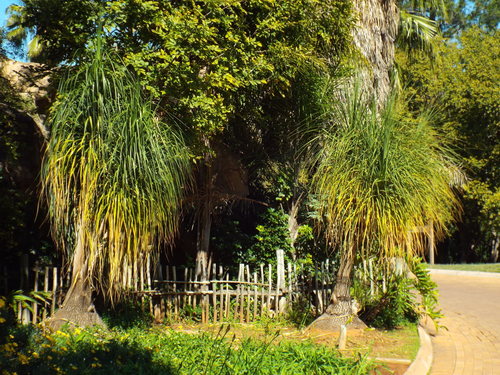
How to care for Elephant's-foot
Watering
Elephant's-foot (Beaucarnea recurvata) stores water in its swollen trunk base, so it tolerates drought far better than it tolerates wet roots. Water thoroughly until it runs out of the drainage holes, then let the potting mix dry out almost completely before the next watering. In winter, when growth slows, water sparingly and keep the trunk from sitting in moisture. Use a pot with drainage holes and a gritty mix such as cactus or succulent soil with added perlite.
Does it need water today?
Push a finger about 5 cm into the soil. If it feels completely dry, it is time to water. You can also lift the pot: a dry pot feels noticeably light compared with one that was just watered. If the soil is still damp, wait and check again in a few days. Gently press the trunk too; a firm, plump base is healthy, while a soft or wrinkled base signals a problem.
When in doubt, wait a few more days. Elephant's-foot survives long dry spells, but a constantly wet root zone can rot the base quickly.
Overwatering
Elephant's-foot is native to the dry, sandy regions of eastern Mexico, where its swollen trunk evolved to bank water through long droughts. Its roots and base cannot cope with prolonged saturation, so excess water quickly leads to oxygen starvation and rot.
Symptoms: A soft, mushy or darkening trunk base, yellowing and dropping leaves, a sour smell from the soil, and fungus gnats hovering over the pot.
Solutions: Stop watering immediately and let the soil dry out fully. Gently remove the plant, cut away any black or mushy roots and trunk tissue with a clean knife, and let the cut areas callus for a few days. Repot into fresh, fast-draining mix in a pot with drainage holes, and water only when the soil is completely dry.
Underwatering
The swollen trunk is a water reserve, so Elephant's-foot tolerates drought well. However, a long period without water will eventually drain that reserve, especially in summer heat or in a warm, bright room.
Symptoms: Leaves becoming dull, brittle and brown at the tips, and the trunk shrinking, wrinkling or feeling soft and slack instead of plump.
Solutions: Water thoroughly until it drains from the bottom, then increase the interval slightly during the growing season. Check the trunk every few weeks; it should slowly firm up again within a few weeks. Avoid large sudden soakings after a long drought, which can stress the roots, and water in steady, measured amounts instead.
Sunlight
Elephant's-foot (Beaucarnea recurvata) is a desert plant from open, sunny habitats in Mexico, so it thrives in strong light. Bright conditions keep the trunk compact, the leaves dense and the plant sturdy. In low light it stretches, leans and drops leaves. Acclimatize it gradually when moving it outdoors, since sudden full sun can scorch leaves that have grown indoors.
- Ideal: Full sun · 4-6 hours of direct sun per day, ideally more
- Tolerates: Full sun, Partial sun, Bright, indirect light
- Best spot in a room: At the window
- Artificial light: Use a full-spectrum LED grow light for 10 to 12 hours a day if the plant gets less than about 4 hours of direct sun. Place it about 30 cm below the light and raise the light as the plant grows.
Too little light
Elephant's-foot needs strong light to build its trunk and keep its leaves compact. In dim corners it grows weakly and cannot store enough energy to maintain its water-storing base.
Symptoms: Leaves growing long, pale and floppy, a thin or leaning trunk, slow growth, and older leaves dropping off.
Solutions: Move the plant to the sunniest window available, ideally a south- or west-facing one. Rotate the pot a quarter turn every couple of weeks for even growth. Supplement with a grow light during darker months if needed.
Too much sun
Although it loves sun, Elephant's-foot can be scorched when suddenly exposed to intense midday light after living indoors. Its leaves have a waxy surface but can still burn when heat and drought combine.
Symptoms: Bleached, yellowish or brown patches on leaves, crisp leaf tips, and a dried, wrinkled trunk surface facing the sun.
Solutions: Move the plant gradually into brighter light over one to two weeks. In summer, provide light shade during the hottest afternoon hours if the leaves show scorch. Water normally, since heat increases water loss.
Temperature
Elephant's-foot (Beaucarnea recurvata) is a desert-adapted plant from the dry woodlands of eastern Mexico, so it prefers warm, stable indoor or outdoor conditions and tolerates heat far better than cold or soggy roots. Keep it above 15°C most of the year, and bring it indoors before nights drop toward freezing.
- Ideal: 15–29 °C
- Tolerates: -3–40 °C
- Hardiness zones: 9-11
Fertilizing
Elephant's-foot grows slowly and stores nutrients in its trunk, so it needs only light feeding. Fertilize during active growth in spring and summer, and skip feeding in winter when the plant rests.
- Slow-release fertilizer: Apply once a year in early spring, just as new growth begins, for plants in pots or in the ground.
- Balanced liquid houseplant fertilizer (such as 10-10-10), Slow-release granular fertilizer for cacti and succulents, Low-nitrogen cactus or palm fertilizer
Soil
Elephant's-foot needs a fast-draining, airy mix that never stays wet around the swollen base. Heavy garden soil or dense all-purpose potting soil alone will cause rot.
- Cactus and succulent mix: Commercial cactus mix with added perlite or pumice, roughly 50-60% mineral material, which drains fast and suits the plant's water-storing trunk
- Sandy loam blend: Two parts potting soil, one part coarse sand, and one part perlite, mimicking the sandy, dry ground of its native Mexican habitat
- Peat-free potting mix: Peat-free all-purpose mix with extra perlite or grit added, roughly one part grit to two parts mix, for an eco-friendly option that still drains well
- pH 6–7.5
Repotting
Elephant's-foot (Beaucarnea recurvata) stores water in its swollen trunk base, so it tolerates crowding and dislikes soggy soil. Repot gently and avoid disturbing the fibrous roots more than necessary.
- How often: Every 3-5 years, or only when roots fill the pot, since this species prefers being slightly root-bound
- New pot: Choose a pot only 2-5 cm wider than the bulb, with drainage holes; a too-large pot holds wet soil around the roots and invites rot
- Repotting season: Spring, Summer
How to repot
- Tip the pot on its side and gently ease the plant out, supporting the swollen base with one hand
- Loosen the outer roots with your fingers and trim any dead, brown, or mushy roots with clean scissors
- Set the bulb in the new pot so the top of the trunk base sits slightly above the rim, then fill around it with fresh mix
- Firm the soil lightly to remove large air gaps but keep it loose enough for drainage
- Leave the plant unwatered for about a week to let any root damage heal, then water thoroughly once
Pruning
Beaucarnea recurvata is a slow-growing plant with a bulbous trunk that stores water, and it only grows new leaves from the crown. Trim only the leaves you need to remove and never cut into the trunk itself, because cuts to the trunk heal poorly and can invite rot.
Pruning season: Spring, Summer
How to prune
- Identify leaves that are fully brown, dry, or dead, and follow each one down to where it joins the trunk.
- Cut the dead leaf off with clean, sharp scissors about 1 cm from the trunk, leaving a small stub so you do not damage the trunk tissue.
- Remove any dead flower stalks after blooming by cutting them back to the trunk.
- Wipe the cut surfaces with a dry cloth and check that no sap is oozing from the trunk.
- Avoid removing more than a few leaves at once, since the plant needs its remaining leaves to store energy.
- Clean your tools with rubbing alcohol before and after pruning to prevent disease spread.
Propagation
Offsets (pups) separation · Spring, Summer
- Wait until the pup at the base of the mature Beaucarnea recurvata has its own developed root system and is at least a third the size of the parent trunk.
- Use a clean, sharp knife to cut the pup away from the parent as close to its base as possible, keeping as many roots as you can.
- Let the cut surface of the pup dry in a shaded, airy spot for three to five days until a firm callus forms.
- Plant the pup in a pot only slightly larger than its root ball, using a fast-draining cactus or succulent mix.
- Water lightly once after planting, then wait about two weeks before watering again so the roots can settle.
Seed germination · Spring
- Collect fresh seeds from a mature Elephant's-foot plant if it has flowered and produced seed capsules, which is uncommon indoors.
- Soak the seeds in lukewarm water for 24 hours before sowing.
- Sow the seeds about 1 cm deep in a sterile, very well-draining seed mix kept warm at 24 to 27°C.
- Keep the mix barely moist and place the tray in bright, indirect light.
- Expect germination to take several weeks; seedlings grow slowly and need years before they resemble the adult plant.
Elephant's-foot is slow to produce pups, so a single offset is a valuable gain. Do not overwater the new pup, because rot is the most common cause of failure.
About Elephant's-foot
Also known as: Ponytail palm, Elephant's-foot, Pony tail palm, Bottle palm
- Plant type: succulent, shrub, tree
- Lifespan: perennial
- Distribution: Native to eastern and southern Mexico, in dry tropical forest and scrubland.
- Mature height: Up to 5-10 m in the wild; 1-2 m in cultivation
- Bloom time: Late spring to summer, rarely indoors
Pets · People
Pets: Safe · People: Safe. Not listed as toxic to cats, dogs, or humans by the ASPCA; the plant is non-toxic and safe to keep around pets and children.
Common problems
- Root and trunk rot: Overwatering in poorly draining soil causes the swollen base to soften and rot; let soil dry fully between waterings.
- Brown leaf tips: Usually caused by dry air, salt buildup from fertilizer, or tap water minerals; flush the soil and trim tips.
- Mealybugs: Cottony pests hide in leaf bases; wipe with rubbing alcohol on a cotton swab.
- Scale insects: Brown bumps on leaves and stems; scrape off and treat with insecticidal soap.
- Slow or no growth in low light: Plants in dim corners stall and become leggy; move to brighter indirect light.
Uses
Mainly ornamental, grown as a houseplant, patio plant, or landscape specimen in frost-free climates. In its native Mexico, local communities have historically used the fibres of its leaves for rope and brushes, and the trunk's water storage has made it a symbol of resilience in arid landscapes.
Is it edible?
Not edible; the seeds and foliage are not used as food.
History & legends
The plant was described scientifically in the 19th century and named after Carl Beaucarné, a Belgian official. Traditional Mexican communities have long used its fibres, and it became a popular houseplant in Europe and North America during the Victorian era. Its whimsical trunk and cascading leaves made it a fashionable ornamental plant.
Did you know?
The swollen base can store enough water to let the plant survive long dry spells, which is why it is sometimes called elephant's-foot.
Frequently asked questions
How often should I water Elephant's-foot?
every 21 days. Elephant's-foot (Beaucarnea recurvata) stores water in its swollen trunk base, so it tolerates drought far better than it tolerates wet roots. Water thoroughly until it runs out of the drainage holes, then let the potting mix dry out almost completely before the next watering. In winter, when growth slows, water sparingly and keep the trunk from sitting in moisture. Use a pot with drainage holes and a gritty mix such as cactus or succulent soil with added perlite. Push a finger about 5 cm into the soil. If it feels completely dry, it is time to water. You can also lift the pot: a dry pot feels noticeably light compared with one that was just watered. If the soil is still damp, wait and check again in a few days. Gently press the trunk too; a firm, plump base is healthy, while a soft or wrinkled base signals a problem.
How much light does Elephant's-foot need?
Full sun (4-6 hours of direct sun per day, ideally more). Elephant's-foot (Beaucarnea recurvata) is a desert plant from open, sunny habitats in Mexico, so it thrives in strong light. Bright conditions keep the trunk compact, the leaves dense and the plant sturdy. In low light it stretches, leans and drops leaves. Acclimatize it gradually when moving it outdoors, since sudden full sun can scorch leaves that have grown indoors.
What temperature does Elephant's-foot like?
15–29 °C. Elephant's-foot (Beaucarnea recurvata) is a desert-adapted plant from the dry woodlands of eastern Mexico, so it prefers warm, stable indoor or outdoor conditions and tolerates heat far better than cold or soggy roots. Keep it above 15°C most of the year, and bring it indoors before nights drop toward freezing.
Is Elephant's-foot toxic to cats and dogs?
It is safe for cats and dogs. Not listed as toxic to cats, dogs, or humans by the ASPCA; the plant is non-toxic and safe to keep around pets and children.
What are the most common problems of Elephant's-foot?
Root and trunk rot: Overwatering in poorly draining soil causes the swollen base to soften and rot; let soil dry fully between waterings. Brown leaf tips: Usually caused by dry air, salt buildup from fertilizer, or tap water minerals; flush the soil and trim tips. Mealybugs: Cottony pests hide in leaf bases; wipe with rubbing alcohol on a cotton swab. Scale insects: Brown bumps on leaves and stems; scrape off and treat with insecticidal soap. Slow or no growth in low light: Plants in dim corners stall and become leggy; move to brighter indirect light.
When should I repot Elephant's-foot?
Every 3-5 years, or only when roots fill the pot, since this species prefers being slightly root-bound. Elephant's-foot (Beaucarnea recurvata) stores water in its swollen trunk base, so it tolerates crowding and dislikes soggy soil. Repot gently and avoid disturbing the fibrous roots more than necessary.
How do I propagate Elephant's-foot?
Offsets (pups) separation, Seed germination. Wait until the pup at the base of the mature Beaucarnea recurvata has its own developed root system and is at least a third the size of the parent trunk. Use a clean, sharp knife to cut the pup away from the parent as close to its base as possible, keeping as many roots as you can. Let the cut surface of the pup dry in a shaded, airy spot for three to five days until a firm callus forms. Plant the pup in a pot only slightly larger than its root ball, using a fast-draining cactus or succulent mix. Water lightly once after planting, then wait about two weeks before watering again so the roots can settle.
How this guide was written
Verdiss writes each guide with AI from botanical references and checks the species against iNaturalist and Plants of the World Online (Kew). Readers can rate every guide in the app.
Sources
Verdiss's information is for general guidance. Never eat or use a plant as medicine based on an app: ask a professional.