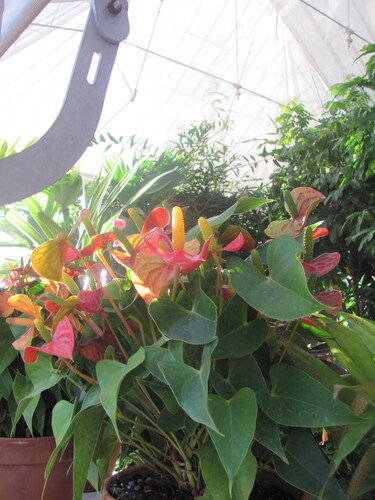
How to care for painter's-palette
Watering
Painter's-palette (Anthurium andraeanum) likes evenly moist but never soggy soil. Its roots are fleshy and rot quickly in standing water, yet they dry out fast in a warm room. Water when the top 2-3 cm of the potting mix feels dry, and use a chunky, airy aroid mix with perlite or bark. Let the pot drain fully and empty the saucer after 15 minutes. Use room-temperature water, and soft or rainwater if your tap water is very hard.
Does it need water today?
Push a finger into the mix up to the second knuckle. If it feels dry and crumbly, water now. If it still feels cool and damp, wait. Lifting the pot also helps: a dry pot feels noticeably light compared with one that was just watered.
Wilting leaves on painter's-palette often mean the soil is too dry, but a plant that droops while the mix is wet points to root rot. Check the soil before you reach for the watering can.
Overwatering
Painter's-palette originates from wet, humid understory forests of Colombia and Ecuador, where roots breathe in loose, fast-draining soil. Its thick roots cannot tolerate constant saturation, which starves them of oxygen and lets rot organisms take hold.
Symptoms: Yellowing lower leaves, soft or mushy brown roots, a sour smell from the pot, and limp leaves even though the soil is wet.
Solutions: Stop watering and let the mix dry to the top 3 cm. Gently unpot, cut away black or mushy roots with clean scissors, dust healthy roots with cinnamon or a fungicide, and repot into fresh, chunky mix in a pot with drainage holes.
Underwatering
Although painter's-palette tolerates brief dry spells, its fleshy roots store only limited water. In a heated home, the mix can dry out within days, and the plant then stops producing its glossy spathes.
Symptoms: Crispy leaf edges, drooping leaves that perk up after watering, dry and shrunken soil pulling away from the pot edge, and flower spathes that stay small or fail to open.
Solutions: Water thoroughly with the bottom-watering method until moisture returns through the whole root ball. Then increase watering frequency slightly during warm months, and mist or use a pebble tray to raise humidity between waterings.
Sunlight
Painter's-palette grows in the dappled shade of tropical forests, so it wants bright light that never hits its leaves directly for long. Too little light makes it stop flowering, while strong midday sun scorches the leaves, leaving pale or brown patches. A spot a little back from a bright window usually gives the best results.
- Ideal: Bright, indirect light · 6-8 hours of bright, filtered light per day
- Tolerates: Partial sun, Bright, indirect light
- Best spot in a room: Near the window
- Artificial light: A full-spectrum LED grow light set 30-40 cm above the plant for 10-12 hours a day works well in dark rooms or winter months. Keep the light on a timer so the plant gets a consistent rhythm.
Too little light
Anthurium andraeanum has evolved to use the diffuse light that filters through a high forest canopy. In low light it cannot make enough energy to produce its brightly coloured spathes, so it favours leaf growth and then stalls.
Symptoms: Long, thin, dark green leaves with weak stems, few or no new flowers, and older leaves gradually yellowing and dropping.
Solutions: Move the plant closer to a bright east or north-facing window, or add a grow light for 10-12 hours daily. Rotate the pot a quarter turn each week so it grows evenly.
Too much sun
Painter's-palette has thin, delicate leaf tissue adapted to filtered shade, so direct sun quickly overheats and damages it. Glass amplifies sunlight, so a south or west window in summer can burn the leaves within a few hours.
Symptoms: Bleached yellow or brown patches on the leaves facing the window, crispy edges, and spathes that fade or look washed out.
Solutions: Move the plant a metre or more back from the window or add a sheer curtain. Keep the room at 18-27 °C, as heat combined with strong light increases scorching.
Temperature
Painter's-palette (Anthurium andraeanum) is a tropical aroid from Colombia and Ecuador that grows best in warm, steady, humid air. Keep it between 18 and 27°C, away from drafts, radiators and cold windows. Its glossy red or pink spathes and leathery leaves are sensitive to sudden swings, so a stable spot matters more than a precise number.
- Ideal: 18–27 °C
- Tolerates: 13–35 °C
- Hardiness zones: 10-12
Fertilizing
Painter's-palette feeds heavily while it is producing its long-lasting spathes, so it needs regular light feeding in the growing season. Its roots are fine and sensitive to salt, so always dilute fertilizer and feed only moist soil. Pause feeding in winter when growth slows.
- Slow-release fertilizer: Once a year in early spring, mix a light dose of slow-release granules into the top of the potting mix, following the packet at half strength.
- Balanced liquid houseplant fertilizer, such as a 10-10-10 or 20-20-20 formula, Liquid fertilizer for flowering plants with a slightly higher middle number, Slow-release granular fertilizer for houseplants
Soil
Painter's-palette grows as an epiphyte in nature, so its roots need air as much as moisture. A dense, soggy mix causes rot quickly; a light, chunky, well-draining blend lets roots breathe and keeps the crown dry.
- Chunky aroid mix: About 40% orchid bark, 30% coco coir or peat, 20% perlite, and 10% horticultural charcoal or coarse sand
- Peat-free aroid mix: About 50% coco coir, 30% pine bark fines, and 20% perlite
- Orchid bark-rich mix: About 60% medium orchid bark, 20% perlite, and 20% sphagnum moss or coir
- pH 5.5–6.5
Repotting
Painter's-palette (Anthurium andraeanum) has thick, fleshy, somewhat brittle roots that resent disturbance and sit wet for long. Repot gently, use a chunky, fast-draining mix, and choose a pot with drainage holes.
- How often: Every 2 years, or when roots fill the pot and push above the soil surface
- New pot: Move up only 2-3 cm in diameter at a time; a pot slightly larger than the root ball keeps the soil from staying wet
- Repotting season: Spring
How to repot
- Turn the pot on its side and gently ease the plant out, supporting the base of the stem
- Loosen the outer roots with your fingers; trim away any roots that are mushy, black, or smell sour using clean scissors
- Remove old, compacted mix from the root ball, but keep the healthy, pale roots intact
- Place a thin layer of fresh mix in the new pot, set the plant so the top of the root ball sits 1-2 cm below the rim, and fill around it with chunky mix
- Firm the mix lightly with your hands to remove large air pockets, without packing it down hard
- Water thoroughly until it drains freely, then let the pot drain completely before returning it to its spot
Pruning
Use clean, sharp tools and cut only the parts that are dead, damaged, or past their prime, leaving healthy leaves and the central growing point intact.
Pruning season: Spring, Summer
How to prune
- Look over the plant and identify leaves that are fully yellow, brown, or torn.
- Cut each unwanted leaf stalk at its base, close to the soil line, with a clean knife, without tearing the stem.
- Remove a flower spathe once it has faded and turned brown, cutting it at the base of its stalk.
- Trim any dead or mushy roots that appear when you lift the plant, using sterilized scissors.
- Wipe the cut surfaces lightly with a dry cloth and avoid misting the crown for a day or two to reduce infection risk.
Propagation
Division of mature clumps · Spring
- Wait until the plant has finished flowering and has several crowns or offsets growing from the base.
- Slide the plant out of its pot and gently loosen the root ball with your fingers.
- Use a clean, sharp knife to split the clump so each section has at least two or three leaves and a healthy set of roots.
- Pot each division into a small container filled with a chunky, well-draining aroid mix of orchid bark, perlite, and peat or coir.
- Keep the divisions warm and humid, around 22 to 26 °C, out of direct sun, and water only when the top of the mix feels dry.
Stem cuttings with aerial roots · Spring, Summer
- Choose a healthy stem that has at least one node and a few aerial roots, or a section of stem where roots are starting.
- Cut the stem with clean shears just below a node, leaving a piece with one or two leaves.
- Let the cut end dry for a day so it can callus over.
- Set the cutting in moist sphagnum moss or a light aroid mix, keeping the aerial roots at or just above the surface.
- Maintain high humidity and bright indirect light until new leaves appear, which usually takes several weeks.
Seed sowing · Spring
- Collect ripe berries from a pollinated flower spike, which take several months to mature, then rinse the pulp off the seeds.
- Sow the seeds on the surface of a moist, peat-based mix, pressing them lightly without covering them deeply.
- Cover the tray with clear plastic to hold humidity and place it in bright, indirect light at about 24 to 28 °C.
- Mist the surface whenever it looks dry and keep the mix consistently damp but not waterlogged.
- Expect slow growth; seedlings may take a year or more to develop their first true leaves.
Anthurium andraeanum is usually grown from division or stem cuttings because seed-grown plants are slow and their flowers may differ from the parent. Keep the spathes and leaves dry when you mist, since wet bracts can develop spots.
About painter's-palette
Also known as: Flamingo flower, Painter's palette, Oilcloth flower, Tail flower
- Plant type: herb, epiphyte, aroid
- Lifespan: perennial
- Distribution: Native to wet montane forests of the western Andes in Colombia and Ecuador.
- Mature height: 30-60 cm indoors, up to about 1 m in the wild
- Bloom time: Mostly year-round indoors, peaking in spring and summer
Pets · People
Pets: Toxic · People: Toxic. Contains calcium oxalate raphides and other irritants in all parts; chewing causes burning mouth, drooling, swelling and vomiting. Keep out of reach of cats, dogs and toddlers (ASPCA).
Common problems
- Root rot: Waterlogged mix and pots without drainage cause black, mushy roots; repot into fresh, chunky mix and water less.
- Brown leaf tips: Low humidity or fertilizer salt buildup burns the edges; raise humidity and flush the soil periodically.
- Spathe fading or no blooms: Too little light prevents flowering; move to brighter indirect light.
- Spider mites: Dry, warm air encourages fine webbing and stippled leaves; rinse foliage and increase humidity.
- Thrips: Silvery streaks and distorted spathes appear on new growth; wipe leaves and use insecticidal soap.
Uses
Prized as an ornamental houseplant and cut flower, the long-lasting spathes are used in floristry and bouquets. In its native range it is valued locally as a garden and decorative plant, and it is a major commercial pot plant in the Netherlands and elsewhere.
Is it edible?
not edible
History & legends
Discovered in the Andes in the nineteenth century and introduced to Europe, it was first described botanically by Édouard André, who collected it in Colombia. Its striking form quickly made it a fashionable greenhouse plant, and breeders have since produced many coloured cultivars.
Did you know?
The red 'flower' is not a petal at all but a spathe, a leaf-like bract, and it can keep its gloss for several weeks, far longer than most true flowers.
Frequently asked questions
How often should I water painter's-palette?
every 7 days. Painter's-palette (Anthurium andraeanum) likes evenly moist but never soggy soil. Its roots are fleshy and rot quickly in standing water, yet they dry out fast in a warm room. Water when the top 2-3 cm of the potting mix feels dry, and use a chunky, airy aroid mix with perlite or bark. Let the pot drain fully and empty the saucer after 15 minutes. Use room-temperature water, and soft or rainwater if your tap water is very hard. Push a finger into the mix up to the second knuckle. If it feels dry and crumbly, water now. If it still feels cool and damp, wait. Lifting the pot also helps: a dry pot feels noticeably light compared with one that was just watered.
How much light does painter's-palette need?
Bright, indirect light (6-8 hours of bright, filtered light per day). Painter's-palette grows in the dappled shade of tropical forests, so it wants bright light that never hits its leaves directly for long. Too little light makes it stop flowering, while strong midday sun scorches the leaves, leaving pale or brown patches. A spot a little back from a bright window usually gives the best results.
What temperature does painter's-palette like?
18–27 °C. Painter's-palette (Anthurium andraeanum) is a tropical aroid from Colombia and Ecuador that grows best in warm, steady, humid air. Keep it between 18 and 27°C, away from drafts, radiators and cold windows. Its glossy red or pink spathes and leathery leaves are sensitive to sudden swings, so a stable spot matters more than a precise number.
Is painter's-palette toxic to cats and dogs?
It is toxic to cats and dogs: keep it out of their reach. Contains calcium oxalate raphides and other irritants in all parts; chewing causes burning mouth, drooling, swelling and vomiting. Keep out of reach of cats, dogs and toddlers (ASPCA).
What are the most common problems of painter's-palette?
Root rot: Waterlogged mix and pots without drainage cause black, mushy roots; repot into fresh, chunky mix and water less. Brown leaf tips: Low humidity or fertilizer salt buildup burns the edges; raise humidity and flush the soil periodically. Spathe fading or no blooms: Too little light prevents flowering; move to brighter indirect light. Spider mites: Dry, warm air encourages fine webbing and stippled leaves; rinse foliage and increase humidity. Thrips: Silvery streaks and distorted spathes appear on new growth; wipe leaves and use insecticidal soap.
When should I repot painter's-palette?
Every 2 years, or when roots fill the pot and push above the soil surface. Painter's-palette (Anthurium andraeanum) has thick, fleshy, somewhat brittle roots that resent disturbance and sit wet for long. Repot gently, use a chunky, fast-draining mix, and choose a pot with drainage holes.
How do I propagate painter's-palette?
Division of mature clumps, Stem cuttings with aerial roots, Seed sowing. Wait until the plant has finished flowering and has several crowns or offsets growing from the base. Slide the plant out of its pot and gently loosen the root ball with your fingers. Use a clean, sharp knife to split the clump so each section has at least two or three leaves and a healthy set of roots. Pot each division into a small container filled with a chunky, well-draining aroid mix of orchid bark, perlite, and peat or coir. Keep the divisions warm and humid, around 22 to 26 °C, out of direct sun, and water only when the top of the mix feels dry.
How this guide was written
Verdiss writes each guide with AI from botanical references and checks the species against iNaturalist and Plants of the World Online (Kew). Readers can rate every guide in the app.
Sources
Verdiss's information is for general guidance. Never eat or use a plant as medicine based on an app: ask a professional.