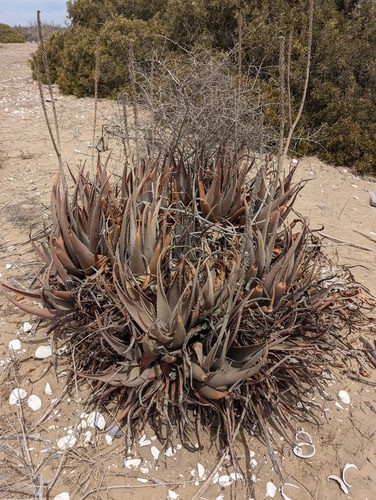
How to care for aloe vera
Watering
Aloe vera stores water in its thick leaves, so it wants a deep drink and then a long dry spell. Water thoroughly until it runs out of the drainage holes, then let the soil dry out completely before watering again. Use a fast-draining cactus or succulent mix in a pot with drainage holes, and never let it sit in a saucer of water.
Does it need water today?
Push a finger about 3 cm (1 inch) into the soil. If it feels dry and crumbly, water it. You can also lift the pot: if it feels light, the soil is dry. If the soil is still damp, wait and check again in a few days.
In winter, when growth slows and the leaves look plump, water much less often. Aloe vera rots quickly in cold, wet soil, so when in doubt, wait another few days.
Overwatering
Aloe vera is a desert succulent whose roots are adapted to dry, sandy soil and cannot breathe in waterlogged conditions. Its thick leaves hold so much water that excess moisture is hard for the plant to use, so roots rot quickly.
Symptoms: Soft, mushy, translucent leaves near the base, a dark or brown stem, a sour or foul smell from the soil, and a plant that leans or wobbles in its pot.
Solutions: Stop watering immediately. Tip the plant out, cut away any black or mushy roots and leaves with a clean knife, and let the cut areas dry for several days. Repot into dry, fast-draining cactus mix in a clean pot with drainage holes, and wait about a week before watering lightly.
Underwatering
Aloe vera relies on its stored water in the leaves, so it tolerates drought well. However, long periods without water eventually use up those reserves, and the plant starts to shrivel.
Symptoms: Thin, wrinkled, or curling leaves that look dull or grayish, leaves that bend or droop, and soil that pulls away from the pot edges and feels hard and dry.
Solutions: Water deeply and thoroughly, as described above. Because dry soil can repel water, set the pot in a tray of water for 20 minutes to rehydrate the root ball. Over the next few weeks, the leaves should slowly plump up again.
Sunlight
Aloe vera thrives in bright, direct sunlight, which keeps its leaves compact, firm, and healthy. Indoors, it needs the brightest spot you have. Gradually move it to a sunnier location in spring so it can adjust without getting sunburned.
- Ideal: Full sun · 6-8 hours of direct sun
- Tolerates: Full sun, Partial sun, Bright, indirect light
- Best spot in a room: At the window
- Artificial light: If natural light is weak, use a full-spectrum LED grow light placed about 15 to 30 cm (6 to 12 inches) above the plant for 12 to 14 hours a day. Plants under weak light often grow tall, floppy, and pale.
Too little light
Aloe vera grows in strong, sunny conditions in its native dry climates, and it needs lots of light to build the thick, firm leaves that store water and keep it compact. In dim rooms, it stretches toward the light and loses its sturdy shape.
Symptoms: Leaves becoming long, thin, pale green, and floppy, the rosette opening up or leaning to one side, and slow or no new growth.
Solutions: Move the plant to the sunniest window available, ideally a south- or west-facing one. Rotate the pot a quarter turn each week for even growth, and add a grow light if the room is still too dim.
Too much sun
Aloe vera is naturally adapted to intense sun, so it handles high light well. However, when it is suddenly moved from shade to harsh midday sun, or sits behind glass that magnifies heat, its leaves can burn.
Symptoms: Leaves turning reddish-brown, bronze, or white in patches, dry brown spots or scorched tips, and leaves that feel crispy or papery.
Solutions: Move the plant to a spot with bright light but some shade during the hottest hours, such as a few feet back from a south-facing window or behind sheer curtains. Acclimate it gradually over one to two weeks. Burned leaf tissue will not recover, so trim damaged leaves at the base with a clean knife.
Temperature
Aloe vera thrives in warm, dry conditions similar to its native arid climates of the Arabian Peninsula. Keep it above 13°C for healthy growth, and protect it from frost, which damages its succulent leaves quickly.
- Ideal: 13–27 °C
- Tolerates: 5–40 °C
- Hardiness zones: 9-11
Fertilizing
Aloe vera grows slowly and needs very little feeding. Its fleshy leaves store water and nutrients, so too much fertilizer is more harmful than too little. Feed only during the active growing season, from spring through summer.
- Slow-release fertilizer: Once a year in early spring, if the plant is in a container with poor soil. Not needed for aloe vera growing in good, fresh cactus or succulent mix.
- Balanced liquid fertilizer diluted to half strength, Cactus and succulent fertilizer, Slow-release granular fertilizer for succulents
Soil
Aloe vera needs soil that drains quickly and dries out between waterings. Heavy, peat-based or moisture-retaining mixes cause roots to rot, so always add plenty of grit or perlite.
- Cactus and succulent mix: Commercial mix with added perlite, pumice, or coarse sand, roughly 50-70% mineral material
- Homemade gritty mix: Equal parts standard potting soil, coarse sand or perlite, and small gravel or pumice
- Sandy loam with grit: One part garden loam mixed with two parts coarse sand and one part perlite; suitable for plants grown outdoors
- pH 6.5–8
Repotting
Aloe vera is a succulent with shallow, fibrous roots that rot easily in wet soil. Repot into fast-draining mix and wait a few days after repotting before watering.
- How often: every 2-3 years, or when roots fill the pot
- New pot: Choose a pot only 2-3 cm wider than the root ball, with a drainage hole. Aloe vera dislikes wet roots, so a pot that is too large holds moisture and invites rot.
- Repotting season: Spring, Summer
How to repot
- Gently tip the pot on its side and slide the plant out, supporting the base of the leaves with one hand
- Shake off loose old soil and look at the roots; trim any black, mushy, or smelly roots with clean scissors
- If you are separating offsets, pull them away from the mother plant at the base, letting each one dry for a day or two before planting
- Place the plant in the new pot at the same depth it grew before, with the leaf rosette centred
- Fill around the roots with fresh mix, firming it gently so the plant stands upright
- Leave the top of the root ball about 1 cm below the rim to allow room for the soil to settle
Pruning
Cut only lower leaves that are brown, dry, or fully yellow. Aloe vera stores water in its thick green leaves, so never remove more than a few healthy leaves at a time.
Pruning season: Spring, Summer, Autumn
How to prune
- Look at the base of the plant and identify leaves that are brown, withered, or completely yellow.
- Hold the leaf firmly at its base and cut it off close to the stem with a clean, sharp knife.
- Wipe the blade after each cut to avoid spreading disease between leaves.
- Allow the cut surfaces to dry for a day before watering the plant again.
- If the plant has become root-bound, remove any damaged roots when repotting, but avoid trimming healthy ones.
Propagation
Offsets (pups) separation · Spring, Summer
- Wait until the mother plant is at least three years old and has produced offsets (pups) about 8 to 10 cm tall, usually growing from the base.
- Slide the pot out and gently loosen the soil around the mother plant to expose the root connection of a pup.
- Cut the pup away from the mother with a clean, sharp knife, keeping as many roots on the pup as possible.
- Let the cut pup sit in a dry, shaded spot for two to three days so the wound forms a callus.
- Plant the pup in a small pot filled with a fast-draining cactus or succulent mix, setting it no deeper than before.
- Water lightly only after a week, then water again when the soil dries out completely.
Leaf cuttings · Spring, Summer
- Choose a healthy, mature outer leaf and cut it off close to the base with a sterilized knife.
- Let the cut end dry and callus for about one week in a shaded, airy place.
- Insert the calloused end about 2 cm into dry cactus mix.
- Keep the pot in bright, indirect light at 18 to 27 °C and water only when the soil is fully dry.
- Expect roots in several weeks; leaf cuttings often rot, so check for soft, dark tissue and remove any failing leaves.
Offsets are far more reliable than leaf cuttings for aloe vera. Pot the pup on its own soon after separation, and avoid watering for the first week so the wound can heal.
About aloe vera
Also known as: Barbados aloe, True aloe, Medicinal aloe
- Plant type: succulent, herb
- Lifespan: perennial
- Distribution: Native to the Arabian Peninsula, though its exact original range is debated because it has been cultivated for so long.
- Mature height: 60-100 cm
- Bloom time: Late winter to early summer, mainly when mature and grown in bright conditions
Pets · People
Pets: Toxic · People: Toxic. The yellow latex just under the leaf skin contains anthraquinones (aloin) that cause vomiting, diarrhoea, lethargy and abdominal pain in dogs, cats and children if swallowed; the clear gel is milder but can still irritate. ASPCA lists it as toxic to cats and dogs.
Common problems
- Root rot: Overwatering in cold or poorly draining soil causes mushy, dark roots and collapsing leaves.
- Leaf sunburn: Sudden exposure to intense direct sun turns leaves brown, reddish or scarred.
- Etiolation: Too little light makes plants stretch, pale and floppy.
- Mealybugs: White cottony pests hide in leaf axils and near the base, sucking sap.
- Frost damage: Freezing temperatures cause translucent, mushy leaves that cannot be saved.
Uses
Aloe vera is widely grown as an ornamental houseplant and garden succulent. Its gel is used in skin care, including moisturisers, sunburn lotions and wound dressings, and the bitter yellow latex has been used as a laxative, though this use is restricted in many countries due to safety concerns. It is also an ingredient in drinks, cosmetics and traditional remedies.
Is it edible?
The inner clear gel is edible and used in drinks and desserts after the latex is thoroughly rinsed away; the yellow latex is not edible and can cause harmful effects.
History & legends
Aloe vera has been used for thousands of years, with evidence of use in ancient Egypt, where it was associated with embalming and beauty, and in Greek and Roman medicine. Traditional healers across many cultures have applied its gel to burns and wounds, and it was often called the plant of immortality.
Did you know?
The name Aloe comes from the Arabic 'alloeh', meaning a shining bitter substance, a nod to the bitter sap and glossy gel of the leaves.
Frequently asked questions
How often should I water aloe vera?
every 21 days. Aloe vera stores water in its thick leaves, so it wants a deep drink and then a long dry spell. Water thoroughly until it runs out of the drainage holes, then let the soil dry out completely before watering again. Use a fast-draining cactus or succulent mix in a pot with drainage holes, and never let it sit in a saucer of water. Push a finger about 3 cm (1 inch) into the soil. If it feels dry and crumbly, water it. You can also lift the pot: if it feels light, the soil is dry. If the soil is still damp, wait and check again in a few days.
How much light does aloe vera need?
Full sun (6-8 hours of direct sun). Aloe vera thrives in bright, direct sunlight, which keeps its leaves compact, firm, and healthy. Indoors, it needs the brightest spot you have. Gradually move it to a sunnier location in spring so it can adjust without getting sunburned.
What temperature does aloe vera like?
13–27 °C. Aloe vera thrives in warm, dry conditions similar to its native arid climates of the Arabian Peninsula. Keep it above 13°C for healthy growth, and protect it from frost, which damages its succulent leaves quickly.
Is aloe vera toxic to cats and dogs?
It is toxic to cats and dogs: keep it out of their reach. The yellow latex just under the leaf skin contains anthraquinones (aloin) that cause vomiting, diarrhoea, lethargy and abdominal pain in dogs, cats and children if swallowed; the clear gel is milder but can still irritate. ASPCA lists it as toxic to cats and dogs.
What are the most common problems of aloe vera?
Root rot: Overwatering in cold or poorly draining soil causes mushy, dark roots and collapsing leaves. Leaf sunburn: Sudden exposure to intense direct sun turns leaves brown, reddish or scarred. Etiolation: Too little light makes plants stretch, pale and floppy. Mealybugs: White cottony pests hide in leaf axils and near the base, sucking sap. Frost damage: Freezing temperatures cause translucent, mushy leaves that cannot be saved.
When should I repot aloe vera?
every 2-3 years, or when roots fill the pot. Aloe vera is a succulent with shallow, fibrous roots that rot easily in wet soil. Repot into fast-draining mix and wait a few days after repotting before watering.
How do I propagate aloe vera?
Offsets (pups) separation, Leaf cuttings. Wait until the mother plant is at least three years old and has produced offsets (pups) about 8 to 10 cm tall, usually growing from the base. Slide the pot out and gently loosen the soil around the mother plant to expose the root connection of a pup. Cut the pup away from the mother with a clean, sharp knife, keeping as many roots on the pup as possible. Let the cut pup sit in a dry, shaded spot for two to three days so the wound forms a callus. Plant the pup in a small pot filled with a fast-draining cactus or succulent mix, setting it no deeper than before. Water lightly only after a week, then water again when the soil dries out completely.
How this guide was written
Verdiss writes each guide with AI from botanical references and checks the species against iNaturalist and Plants of the World Online (Kew). Readers can rate every guide in the app.
Sources
Verdiss's information is for general guidance. Never eat or use a plant as medicine based on an app: ask a professional.