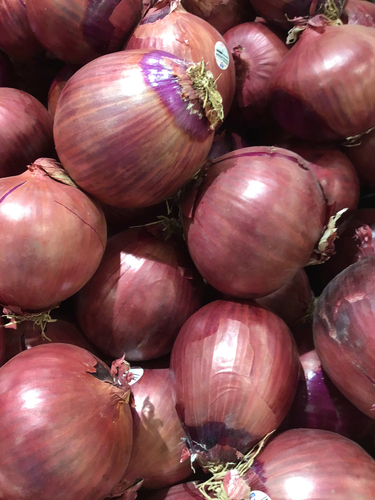
How to care for Common Onion
Watering
Common onion (Allium cepa) forms its bulb from a shallow, fibrous root system, so it needs steady moisture in the top 15 cm of soil rather than deep, infrequent soaks. Keep soil evenly moist during bulb swelling, which is the phase when the bulb expands most. Once the tops begin to yellow and fall over, stop watering so the bulb can cure and store well. Good drainage matters: onions sitting in soggy soil rot at the base.
Does it need water today?
Push a finger 2 to 3 cm into the soil next to the plant. If it feels dry at that depth, water now. For onions grown in containers, lift the pot: if it feels light compared with after its last watering, it is time to water.
Water at the base of the plant in the morning so the leaves stay dry and mildew has less chance to start. Aim for about 2.5 cm of water per week in the growing season, adjusted for rain.
Overwatering
Common onion bulbs are prone to rot because their swollen base sits in the soil and cannot tolerate waterlogged roots. Excess moisture also invites fungal diseases such as basal rot and downy mildew, which spread quickly in cool, wet conditions.
Symptoms: Yellowing leaves that turn soft, a mushy or brown neck and base, a sour smell from the bulb, and white or grey fuzzy growth on the soil surface.
Solutions: Stop watering and let the top layer dry out. Improve drainage by mixing in compost or grit, or move the container to a spot with better airflow. Remove and discard any rotting bulbs so the problem does not spread to healthy plants.
Underwatering
Onions have shallow roots and cannot draw water from deep in the soil, so they stress quickly during dry spells. Drought during bulb swelling leads to small, woody bulbs with reduced flavour.
Symptoms: Leaves that curl at the tips or turn dull blue-green, tips browning, and bulbs that stay small or split at the neck.
Solutions: Water deeply and evenly until the top 15 cm of soil is moist, then mulch with straw or dry grass to slow evaporation. Water more often in hot weather and during bulb formation, and avoid letting containers dry out completely.
Sunlight
Common onion (Allium cepa) builds leaf and bulb growth from the energy it captures in sunlight, so it performs best in full sun. Long days in late spring and early summer trigger bulb formation in many varieties, so good light at that time directly sets bulb size. Partial shade slows growth and gives smaller bulbs.
- Ideal: Full sun · 6-8 hours of direct sun per day
- Tolerates: Full sun, Partial sun
- Best spot in a room: At the window
- Artificial light: If growing indoors, use a full-spectrum LED grow light placed 15 to 30 cm above the leaves for 12 to 14 hours per day. Keep the light on a timer so the plant gets consistent exposure.
Too little light
Onions rely on steady sunlight to make the sugars that feed bulb growth. In shade, leaves grow thin and floppy, and the plant spends its energy on height rather than bulb swelling.
Symptoms: Tall, pale, floppy leaves that lean toward the light, slow growth, and very small or no bulbs forming.
Solutions: Move the plant to the sunniest spot available, ideally a south-facing window or outdoor bed. For outdoor onions, thin nearby plants or trim overhanging branches. Add a grow light for indoor plants during short winter days.
Too much sun
Onions tolerate strong sun well when their roots are kept moist, but intense heat combined with dry soil can scorch leaves and stress the bulb. Container onions heat up faster than ground-planted ones.
Symptoms: Leaf tips turning white or brown and crispy, leaves bleaching to a pale yellow-green, and the plant wilting in the afternoon even when soil is damp.
Solutions: Keep the soil moist and mulch around the base to cool the roots. During heatwaves above 30°C, provide light afternoon shade with a shade cloth. Move containers to a spot with some protection from the hottest midday sun.
Temperature
Common onion (Allium cepa) is a cool-season biennial grown as an annual. It forms bulbs when day length and temperature are right, so it grows best in mild spring and early summer weather and needs cooler nights during bulbing. Keep it between 13 and 24°C for most of its growth.
- Ideal: 13–24 °C
- Tolerates: -7–35 °C
- Hardiness zones: 5-10
Fertilizing
Common onions have shallow roots and feed heavily on nitrogen early, then need more potassium and less nitrogen as bulbs swell. Stop nitrogen feeding once bulbs begin to form, usually around midsummer, so they store well.
- Slow-release fertilizer: Apply once a year in early spring, before planting, worked into the soil.
- Balanced granular fertilizer such as 10-10-10, Compost or well-rotted manure, Nitrogen-rich liquid feed such as fish emulsion for leafy growth early on, Potassium-rich feed such as sulfate of potash to support bulb development
Soil
Common Onion needs soil that drains well yet holds steady moisture, because its shallow roots dry out quickly and waterlogged soil rots the bulb. Rich in organic matter and kept loose, the soil lets bulbs swell evenly. A pH between 6.0 and 7.5 suits it best.
- Loamy garden soil: Roughly 40 percent topsoil, 40 percent well-rotted compost, and 20 percent sharp sand or fine grit
- Peat-free potting mix: Multipurpose compost blended with about 20 percent perlite or grit for drainage
- Raised bed mix: Equal parts topsoil and compost with a handful of slow-release organic fertiliser per square metre
- pH 6–7.5
Repotting
Common Onion (Allium cepa) is a biennial grown as an annual for its bulb. It is not a long-lived potted plant, so 'repotting' means moving seedlings or sets into their final container or bed in early spring, then harvesting. Good drainage and full sun are the two essentials.
- How often: Every year for container-grown onions, since they are harvested or replanted each season rather than repotted to a larger pot over several years
- New pot: A pot 20-30 cm wide and at least 20 cm deep for a bulb onion, with about 10 cm between plants
- Repotting season: Spring
How to repot
- Gently loosen the seedling from its tray, holding it by a leaf rather than the thin stem
- Make a small hole in the soil about 5 cm deep and set the seedling in so the white base sits at the soil line
- For sets, push the bulb in so its tip just shows above the surface, spacing them about 10 cm apart
- Firm the soil lightly around each plant so the roots make good contact with it
- Water thoroughly to settle the soil, then keep it evenly moist without waterlogging
- Label the container with the planting date so you can track when bulbs are ready to harvest
Pruning
Allium cepa does not need pruning in the way shrubs or fruit trees do. The main task is removing flower stalks, which appear as tall, hollow stems topped with a round seed head. Cut these off as soon as you see them, close to the base, using clean secateurs or a sharp knife.
Pruning season: Spring, Summer
How to prune
- Check the bed weekly for tall flower stalks, which often appear in early to mid summer.
- Cut each flower stalk at its base with clean secateurs as soon as it is visible.
- Remove any brown, slimy or spotted leaves at the base of the plant, cutting them cleanly.
- Stop trimming when the tops begin to bend over and yellow, as this signals the bulb is ready.
- Do not cut green leaves for harvest more than about one third at a time, so the bulb keeps growing.
Propagation
Growing from sets (small bulbs) · Spring
- Buy healthy onion sets, firm and about 1.5 to 2 cm across, from a reputable garden centre.
- Choose a sunny bed with loose, well-drained soil that is rich in compost.
- Plant sets in early spring, when the soil can be worked and is around 10 °C, pushing each one into the soil so only the tip shows.
- Space sets about 10 cm apart in rows 30 cm apart.
- Water lightly once a week, more in dry spells, and keep the bed weed-free because onion roots are shallow.
Growing from seed · Spring, Summer
- Sow Allium cepa seed thinly, about 1 cm deep, in trays indoors six to eight weeks before the last spring frost.
- Keep the trays at about 15 to 20 °C until the seedlings emerge, which usually takes one to two weeks.
- Harden seedlings off for a week by moving them outdoors for a few hours each day.
- Transplant them into the garden when they are about pencil-thick, spacing them 10 cm apart.
Planting from transplants · Spring
- Buy young onion transplants with healthy green leaves and firm white bases.
- Plant them in a sunny spot in early spring, setting the roots just below the soil surface.
- Firm the soil gently around each plant and water it in well.
Choose a variety suited to your day length. Long-day onions form bulbs in northern summers, while short-day types suit gardens further south. Do not plant sets that are soft or already sprouting, as they often bolt, which means they flower early instead of forming a bulb.
About Common Onion
Also known as: Bulb onion, Garden onion, Common onion
- Plant type: herb, bulbous perennial grown as annual vegetable
- Lifespan: biennial (grown as an annual)
- Distribution: Native range is uncertain; it is thought to have originated in Central Asia (Iran to western Pakistan) and is known only as a cultivated plant.
- Mature height: 30 to 150 cm in flower; leaves usually 20 to 50 cm
- Bloom time: Late spring to summer in the second year, only if left to flower
Pets · People
Pets: Toxic · People: Toxic. Contains N-propyl disulfide and related sulfoxides that damage red blood cells (Heinz body hemolytic anemia) in dogs, cats and other animals; toxicity is cumulative, and cooking does not remove the risk. Also toxic to humans in large amounts, mainly as an irritant in raw form.
Common problems
- Onion thrips: Tiny insects that scrape leaves, causing silvery streaks and curled tips; control with regular watering and insecticidal soap.
- Bulb rot (basal rot): Fungal rot from Fusarium or Pythium in wet soil, causing soft basal decay; improve drainage and rotate crops.
- Downy mildew: Grey-purple fuzzy growth on leaves in humid, cool weather; improve airflow and avoid overhead watering.
- Bolting: Premature flowering triggered by cold snaps or transplant stress, producing hollow, woody bulbs; use appropriate varieties and remove flower stalks.
- Onion maggot: Larvae of a fly tunneling into bulbs; use row covers and rotate away from alliums.
Uses
Onion is one of the most important culinary vegetables worldwide, used raw, cooked, pickled, dried and powdered as a flavoring base in countless cuisines. Bulbs, leaves and seeds have been used in traditional medicine for ailments ranging from colds to wounds, though clinical evidence is limited, and onion extracts are used industrially in flavorings and food processing.
Is it edible?
Bulbs, green leaves (scallions or spring onions) and young flower stalks are edible raw or cooked; seeds are used as a spice in some regions.
History & legends
Onions have been cultivated for at least 5,000 years, with evidence in ancient Egypt, Mesopotamia and India. Egyptian tomb paintings and rations for pyramid workers mention them, and Roman writers praised them as fuel for soldiers and labourers. Their rings were often read as a symbol of eternal life.
Did you know?
Onion skins are rich in quercetin, and onions were so valued in ancient Egypt that they were used as a symbol of eternity in burial rites, their concentric rings representing endless life.
Frequently asked questions
How often should I water Common Onion?
every 4 days. Common onion (Allium cepa) forms its bulb from a shallow, fibrous root system, so it needs steady moisture in the top 15 cm of soil rather than deep, infrequent soaks. Keep soil evenly moist during bulb swelling, which is the phase when the bulb expands most. Once the tops begin to yellow and fall over, stop watering so the bulb can cure and store well. Good drainage matters: onions sitting in soggy soil rot at the base. Push a finger 2 to 3 cm into the soil next to the plant. If it feels dry at that depth, water now. For onions grown in containers, lift the pot: if it feels light compared with after its last watering, it is time to water.
How much light does Common Onion need?
Full sun (6-8 hours of direct sun per day). Common onion (Allium cepa) builds leaf and bulb growth from the energy it captures in sunlight, so it performs best in full sun. Long days in late spring and early summer trigger bulb formation in many varieties, so good light at that time directly sets bulb size. Partial shade slows growth and gives smaller bulbs.
What temperature does Common Onion like?
13–24 °C. Common onion (Allium cepa) is a cool-season biennial grown as an annual. It forms bulbs when day length and temperature are right, so it grows best in mild spring and early summer weather and needs cooler nights during bulbing. Keep it between 13 and 24°C for most of its growth.
Is Common Onion toxic to cats and dogs?
It is toxic to cats and dogs: keep it out of their reach. Contains N-propyl disulfide and related sulfoxides that damage red blood cells (Heinz body hemolytic anemia) in dogs, cats and other animals; toxicity is cumulative, and cooking does not remove the risk. Also toxic to humans in large amounts, mainly as an irritant in raw form.
What are the most common problems of Common Onion?
Onion thrips: Tiny insects that scrape leaves, causing silvery streaks and curled tips; control with regular watering and insecticidal soap. Bulb rot (basal rot): Fungal rot from Fusarium or Pythium in wet soil, causing soft basal decay; improve drainage and rotate crops. Downy mildew: Grey-purple fuzzy growth on leaves in humid, cool weather; improve airflow and avoid overhead watering. Bolting: Premature flowering triggered by cold snaps or transplant stress, producing hollow, woody bulbs; use appropriate varieties and remove flower stalks. Onion maggot: Larvae of a fly tunneling into bulbs; use row covers and rotate away from alliums.
When should I repot Common Onion?
Every year for container-grown onions, since they are harvested or replanted each season rather than repotted to a larger pot over several years. Common Onion (Allium cepa) is a biennial grown as an annual for its bulb. It is not a long-lived potted plant, so 'repotting' means moving seedlings or sets into their final container or bed in early spring, then harvesting. Good drainage and full sun are the two essentials.
How do I propagate Common Onion?
Growing from sets (small bulbs), Growing from seed, Planting from transplants. Buy healthy onion sets, firm and about 1.5 to 2 cm across, from a reputable garden centre. Choose a sunny bed with loose, well-drained soil that is rich in compost. Plant sets in early spring, when the soil can be worked and is around 10 °C, pushing each one into the soil so only the tip shows. Space sets about 10 cm apart in rows 30 cm apart. Water lightly once a week, more in dry spells, and keep the bed weed-free because onion roots are shallow.
How this guide was written
Verdiss writes each guide with AI from botanical references and checks the species against iNaturalist and Plants of the World Online (Kew). Readers can rate every guide in the app.
Sources
Verdiss's information is for general guidance. Never eat or use a plant as medicine based on an app: ask a professional.