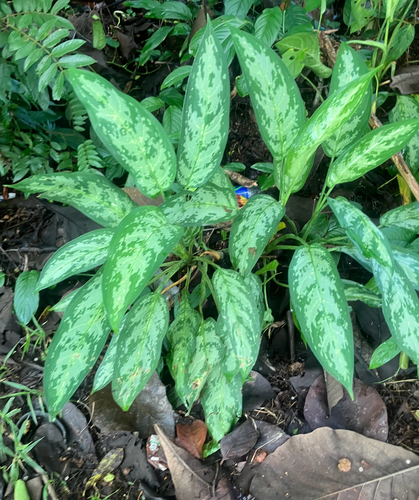
How to care for Philippine evergreen
Watering
Philippine evergreen (Aglaonema commutatum) likes its soil to dry out lightly between drinks. Water thoroughly until it runs out of the drainage holes, then empty the saucer. Keep the roots out of standing water, but never let the pot dry out completely for weeks. Use room-temperature water and a pot with drainage holes. In winter, when growth slows, water less often.
Does it need water today?
Push a finger about 2-3 cm into the soil. If it feels dry at that depth, water now. If it feels damp, wait a few days. Lift the pot too: a light pot means it is thirsty, a heavy pot means it can wait. The leaves also show thirst by drooping slightly and looking dull.
Water in the morning so the top of the soil can dry during the day. Leaves that stay wet overnight in a cool room can encourage rot.
Overwatering
Philippine evergreen has fleshy roots that rot quickly in soggy soil, and its dense, low-light-adapted growth holds moisture around the base. Constant wet soil starves the roots of oxygen, so the plant cannot take up water even when the pot is wet.
Symptoms: Yellowing lower leaves that feel soft, a mushy stem base, a sour or musty smell from the soil, and black or brown roots that come away easily. Growth stalls and new leaves may fail to unfurl.
Solutions: Stop watering and let the soil dry for several days. Slide the plant out, trim away soft or dark roots with clean scissors, and repot into fresh, well-draining mix in a pot just slightly larger than the root ball. Remove any rotting leaves and avoid watering again until the top few centimetres are dry.
Underwatering
Philippine evergreen is fairly forgiving, but its leaves rely on steady moisture to stay firm and glossy. When the root ball dries out fully, the plant pulls water from its leaves to survive, causing visible stress.
Symptoms: Limp, drooping leaves that perk up after watering, brown crispy leaf edges or tips, dull and wrinkled foliage, and soil that pulls away from the pot's sides.
Solutions: Soak the plant using bottom watering for 20-30 minutes until the soil is evenly moist. Then return to regular top watering. Trim off badly browned leaves at the base. Increase humidity by grouping plants or using a pebble tray, and check the soil more often during warm months.
Sunlight
Philippine evergreen grows naturally under the forest canopy in the Philippines, so it prefers bright light without harsh direct sun. Strong midday sun can scorch its leaves, while very dim corners slow growth and dull the patterned foliage. Good light keeps the silver and green variegation vivid. Rotate the pot every few weeks so the plant grows evenly.
- Ideal: Bright, indirect light · 6-8 hours of bright, filtered light per day
- Tolerates: Partial sun, Shade
- Best spot in a room: Near the window
- Artificial light: If natural light is weak, use a full-spectrum LED grow light placed 30-45 cm above the leaves for 10-12 hours a day. Standard ceiling bulbs are usually not enough to keep the plant compact and colourful.
Too little light
Philippine evergreen has large, thin leaves adapted to filtered forest light, so it stretches and loses colour when light is too low. Its patterned varieties are especially affected because they rely on light to maintain their silver markings.
Symptoms: Leggy stems with long gaps between leaves, smaller new leaves, leaves that fade to plain green, and a plant that leans toward the window.
Solutions: Move the plant closer to a bright window, ideally an east or north-facing one with bright indirect light. Add a full-spectrum LED grow light if needed. Rotate the pot weekly and reduce watering slightly, since slow growth in low light uses less water.
Too much sun
Direct sun, especially through south or west windows, is too intense for Philippine evergreen's thin leaves. The leaves can overheat and lose moisture faster than the roots can replace it.
Symptoms: Pale, bleached patches on leaves, brown or crispy scorch spots, curled edges, and faded variegation on the sun-facing side.
Solutions: Move the plant a metre or more back from the window or behind a sheer curtain. Scorched leaves will not recover, so cut them off at the base. Gradually reintroduce brighter light over a few weeks if you want more colour.
Temperature
Philippine evergreen (Aglaonema commutatum) is a tropical understory plant that grows best in warm, steady indoor conditions between about 18 and 27°C. Keep it away from cold drafts, radiators, and hot windows, since sudden swings stress its large soft leaves.
- Ideal: 18–27 °C
- Tolerates: 12–32 °C
- Hardiness zones: 10-12
Fertilizing
Philippine evergreen (Aglaonema commutatum) is a light feeder. It grows slowly and needs little food, especially in low winter light, so feed only during active growth and always after watering the soil.
- Slow-release fertilizer: Once a year in early spring, apply a light slow-release granular fertilizer, or skip it if you feed with liquid during the growing season.
- Balanced liquid houseplant fertilizer (such as 20-20-20) diluted to half strength, Slow-release granular houseplant fertilizer, Organic liquid fish or seaweed fertilizer diluted to half strength
Soil
Aglaonema commutatum needs a loose, airy mix that holds some moisture without staying waterlogged. Its roots rot quickly in dense garden soil or heavy clay, so drainage is the priority. Use fresh mix each time you repot.
- Aroid mix: Equal parts peat-free potting mix, coco coir or peat, perlite, and orchid bark or pumice.
- Chunky houseplant mix: Two parts all-purpose potting mix to one part perlite, with a handful of charcoal added for freshness.
- Lightly enriched mix: One part coco coir, one part compost, and one part perlite, suitable for dim rooms where drying is slower.
- pH 5.5–6.5
Repotting
Aglaonema commutatum has fleshy, fairly shallow roots that dislike being left in soggy soil. A pot only slightly larger than the root ball keeps moisture balanced. Repot in warm weather when the plant can recover quickly.
- How often: Every 2-3 years, or when roots fill the pot
- New pot: Move up only one size, about 2-5 cm wider in diameter, with drainage holes
- Repotting season: Spring, Summer
How to repot
- Slide the plant out by holding the base of the stems and gently tapping the pot sides.
- Loosen the outer roots with your fingers and trim any mushy, black, or foul-smelling roots with clean scissors.
- Place a layer of fresh mix in the new pot, set the plant at the same depth it grew before, and fill in around the root ball.
- Firm the mix gently with your hands, leaving a 2 cm gap below the rim for watering.
- Water thoroughly until it drains out the bottom, then let excess drain away.
Pruning
Prune Aglaonema commutatum lightly and only when needed. Remove leaves and stems with sharp, clean tools, cutting just above a node or at the soil line. Never remove more than about one third of the plant at once, because the plant needs leaves to make energy.
Pruning season: Spring, Summer
How to prune
- Cut away any fully yellow or brown leaves at the base of the stalk, close to the soil or stem.
- To shorten a tall, leggy stem, cut it about 2 to 3 cm above a node, where you can see new growth or a leaf joint.
- Remove crowded or crossing stems at the soil line to open up the centre of the plant.
- Remove any flowers or spathes as they fade, if you want to keep energy going into leaf growth.
- Wipe the blades with rubbing alcohol between plants to avoid spreading disease.
- Water lightly after pruning and keep the plant in bright, indirect light while it recovers. Avoid fertilising for a few weeks.
Propagation
Stem cutting in water · Spring, Summer
- Choose a healthy stem with at least one node, the small bump where a leaf meets the stem, and one or two leaves.
- Cut the stem cleanly with sharp, sterilised scissors, about 5 to 8 cm below the leaves.
- Place the cutting in a clear jar of room-temperature water so the node is submerged and the leaves stay above the surface.
- Set the jar in bright indirect light, away from direct sun, and keep it at about 20 to 25 °C.
- Change the water every 3 to 4 days. Roots usually appear within 3 to 6 weeks.
- When roots are 3 to 5 cm long, pot the cutting in a small container of well-draining aroid mix.
Division of the parent plant · Spring
- Wait until the plant is actively growing in spring, and water it lightly the day before.
- Slide the plant out of its pot and gently shake off loose soil so you can see the clumping stems and roots.
- Pull or cut the root mass into sections, making sure each section has several roots and at least two or three stems.
- Pot each section separately in fresh aroid mix, one size up from its old pot if needed.
- Keep the divisions in bright indirect light and water sparingly for the first two weeks while roots recover.
Air layering · Summer
- Pick a leggy stem and make a shallow upward cut, about one third of the way through, just below a node.
- Dust the cut with rooting hormone and wrap it in a handful of damp sphagnum moss.
- Cover the moss with clear plastic wrap and seal both ends with tape so moisture stays in.
- Check every few weeks, and add water if the moss dries out.
- When roots show through the moss, cut the stem below the new roots and pot the new plant.
Philippine evergreen roots most reliably from stem cuttings with a node, and water rooting is the simplest method for beginners. Cuttings taken in spring and summer, when the plant is growing fastest, root more quickly than those taken in cooler months.
About Philippine evergreen
Also known as: Chinese evergreen, Philippine evergreen, Poison dart plant
- Plant type: herb, perennial houseplant
- Lifespan: perennial
- Distribution: Native to the Philippines, Malay Peninsula and Sumatra, growing in shaded lowland tropical forest.
- Mature height: 30-60 cm indoors (up to 1 m in the wild)
- Bloom time: Mostly summer in the wild; rarely flowers indoors
Pets · People
Pets: Toxic · People: Toxic. Contains calcium oxalate crystals (raphides) in all parts; chewing causes intense oral irritation, drooling, swelling of lips and tongue, and difficulty swallowing. Non-fatal but seek veterinary or medical advice if ingested.
Common problems
- Brown leaf tips: Usually caused by dry air, low humidity or fluoride and salts in tap water; use filtered or rain water.
- Yellowing lower leaves: Normal aging when a few leaves drop, but many yellowing leaves usually indicate overwatering and root rot.
- Loss of leaf pattern: Caused by too little light; move the plant to a brighter indirect spot.
- Mealybugs: White cottony pests in leaf axils; wipe with alcohol on a cotton swab and treat with insecticidal soap.
- Stem rot: Soft, dark base caused by soggy soil and cold temperatures; avoid waterlogging and keep warm.
Uses
Grown worldwide as an ornamental houseplant and office plant prized for its tolerance of low light. In parts of Southeast Asia it is also used in traditional folk medicine, though it is not a mainstream remedy.
Is it edible?
not edible
History & legends
Aglaonema species were long collected in the Philippines and Malaysia and carried to Europe and North America in the nineteenth and twentieth centuries as curiosities. Their hardiness made them popular in Victorian and mid-century interiors, and they remain a staple of the houseplant trade.
Did you know?
Its leaves can be wiped clean and are so tough that the plant was once a popular ornamental in offices with little natural light.
Frequently asked questions
How often should I water Philippine evergreen?
every 10 days. Philippine evergreen (Aglaonema commutatum) likes its soil to dry out lightly between drinks. Water thoroughly until it runs out of the drainage holes, then empty the saucer. Keep the roots out of standing water, but never let the pot dry out completely for weeks. Use room-temperature water and a pot with drainage holes. In winter, when growth slows, water less often. Push a finger about 2-3 cm into the soil. If it feels dry at that depth, water now. If it feels damp, wait a few days. Lift the pot too: a light pot means it is thirsty, a heavy pot means it can wait. The leaves also show thirst by drooping slightly and looking dull.
How much light does Philippine evergreen need?
Bright, indirect light (6-8 hours of bright, filtered light per day). Philippine evergreen grows naturally under the forest canopy in the Philippines, so it prefers bright light without harsh direct sun. Strong midday sun can scorch its leaves, while very dim corners slow growth and dull the patterned foliage. Good light keeps the silver and green variegation vivid. Rotate the pot every few weeks so the plant grows evenly.
What temperature does Philippine evergreen like?
18–27 °C. Philippine evergreen (Aglaonema commutatum) is a tropical understory plant that grows best in warm, steady indoor conditions between about 18 and 27°C. Keep it away from cold drafts, radiators, and hot windows, since sudden swings stress its large soft leaves.
Is Philippine evergreen toxic to cats and dogs?
It is toxic to cats and dogs: keep it out of their reach. Contains calcium oxalate crystals (raphides) in all parts; chewing causes intense oral irritation, drooling, swelling of lips and tongue, and difficulty swallowing. Non-fatal but seek veterinary or medical advice if ingested.
What are the most common problems of Philippine evergreen?
Brown leaf tips: Usually caused by dry air, low humidity or fluoride and salts in tap water; use filtered or rain water. Yellowing lower leaves: Normal aging when a few leaves drop, but many yellowing leaves usually indicate overwatering and root rot. Loss of leaf pattern: Caused by too little light; move the plant to a brighter indirect spot. Mealybugs: White cottony pests in leaf axils; wipe with alcohol on a cotton swab and treat with insecticidal soap. Stem rot: Soft, dark base caused by soggy soil and cold temperatures; avoid waterlogging and keep warm.
When should I repot Philippine evergreen?
Every 2-3 years, or when roots fill the pot. Aglaonema commutatum has fleshy, fairly shallow roots that dislike being left in soggy soil. A pot only slightly larger than the root ball keeps moisture balanced. Repot in warm weather when the plant can recover quickly.
How do I propagate Philippine evergreen?
Stem cutting in water, Division of the parent plant, Air layering. Choose a healthy stem with at least one node, the small bump where a leaf meets the stem, and one or two leaves. Cut the stem cleanly with sharp, sterilised scissors, about 5 to 8 cm below the leaves. Place the cutting in a clear jar of room-temperature water so the node is submerged and the leaves stay above the surface. Set the jar in bright indirect light, away from direct sun, and keep it at about 20 to 25 °C. Change the water every 3 to 4 days. Roots usually appear within 3 to 6 weeks. When roots are 3 to 5 cm long, pot the cutting in a small container of well-draining aroid mix.
How this guide was written
Verdiss writes each guide with AI from botanical references and checks the species against iNaturalist and Plants of the World Online (Kew). Readers can rate every guide in the app.
Sources
Verdiss's information is for general guidance. Never eat or use a plant as medicine based on an app: ask a professional.