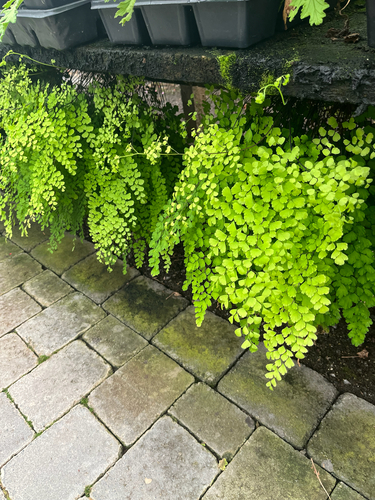
How to care for Delta Maidenhair Fern
Watering
Delta Maidenhair Fern (Adiantum raddianum) has very thin, delicate fronds and shallow roots, so it dries out fast and never likes to sit in wet soil. Keep the potting mix evenly moist, like a wrung-out sponge, and never let it dry to crumbling. Use room-temperature water, and always empty the saucer after watering so the roots can breathe. Humidity matters as much as water: this fern thrives in air above 50 percent humidity, and crisp brown fronds usually signal dry air or dry soil.
Does it need water today?
Gently push a finger about 1 cm (half an inch) into the soil. If it feels dry, water now. If it feels barely damp, wait a day and check again. You can also lift the pot: a dry pot feels noticeably lighter than one that was watered recently.
Water from the top until it drains freely, then wait until the top layer is just starting to dry before the next watering. Misting the fronds helps with humidity, but it does not replace watering the soil.
Overwatering
Delta Maidenhair Fern has fine, shallow roots that rot quickly in waterlogged soil, and it cannot take up water when the roots are suffocated. Its wiry black stems are especially prone to rot when the mix stays soggy.
Symptoms: Yellowing fronds, black or mushy stem bases, a sour smell from the soil, and fronds that wilt even though the soil is wet.
Solutions: Stop watering and let the top few centimetres dry out. Empty the saucer every time. If the stems are black and mushy, cut away the rotten parts, repot into fresh, well-draining mix in a pot with drainage holes, and water lightly until new growth starts.
Underwatering
Delta Maidenhair Fern grows in moist forest floors and streambanks in nature, so its fine fronds lose water quickly and dry, brittle foliage follows quickly when the soil dries out.
Symptoms: Crispy brown or papery fronds, drooping leaflets that do not perk up, and soil pulling away from the pot edges.
Solutions: Soak the whole pot in a tray of water for 20 to 30 minutes until bubbles stop rising. Then let it drain fully. Trim badly browned fronds at the base, raise humidity with a pebble tray or a humidifier, and water more often until the fern recovers.
Sunlight
In nature Delta Maidenhair Fern grows under the canopy of tropical forests, so it prefers bright light that is filtered or diffused. Direct midday sun scorches its delicate fronds within a few hours, turning them pale, crisp, or brown. Too little light makes the fronds stretch thin and sparse, and the plant stops producing new growth. Aim for a spot that is bright enough to read a book comfortably at midday without needing a lamp.
- Ideal: Bright, indirect light · 6-8 hours of bright, filtered light per day
- Tolerates: Partial sun, Shade
- Best spot in a room: At the window
- Artificial light: If your home is dim, use a full-spectrum LED grow light or a daylight bulb placed 30 to 45 cm (12 to 18 inches) above the fronds, running for 10 to 12 hours a day. Keep the light on a timer so the fern gets a steady, consistent schedule.
Too little light
Delta Maidenhair Fern needs enough light to fuel its very thin, fast-growing fronds. Without it, the plant produces weak, leggy growth and struggles to recover from watering mistakes.
Symptoms: Pale, sparse fronds, long leggy stems, slow or no new growth, and the plant leaning sharply toward the light source.
Solutions: Move the fern closer to a bright east or north window, or to a brighter room. Rotate the pot a quarter turn each week so growth stays even. Add a full-spectrum LED grow light if winter days are short.
Too much sun
Delta Maidenhair Fern has delicate, translucent fronds that are easily damaged by intense light. Direct sun dries the leaflets faster than the roots can replace water, which is why this species suffers quickly in a south or west window.
Symptoms: Bleached or yellowish fronds, crispy brown edges or spots, and wilting in the afternoon even when the soil is moist.
Solutions: Pull the fern back 1 to 2 metres (3 to 6 feet) from the window or add a sheer curtain to filter the light. Trim scorched fronds at the base, and increase humidity while the plant recovers.
Temperature
Delta Maidenhair Fern (Adiantum raddianum) is a tropical-subtropical fern from Central and South America that prefers warm, humid, steady conditions. Keep it between 16 and 24°C, away from drafts, heaters and cold windows. Its thin fronds decline quickly when temperatures swing, so consistency matters more than exact numbers.
- Ideal: 16–24 °C
- Tolerates: 7–32 °C
- Hardiness zones: 10-12
Fertilizing
Delta Maidenhair Fern is a light feeder with fine roots that are easily burned by strong fertilizer. Feed only while it is actively producing new fronds, usually from spring through early autumn. Always water the soil before feeding, and use half the strength recommended on the label.
- Slow-release fertilizer: Once a year in early spring, mix a small amount of slow-release granules into the top layer of compost. Skip this if you already repot into fresh potting mix that year.
- Balanced liquid houseplant fertilizer (roughly 10-10-10 or 20-20-20), Fish or seaweed-based organic liquid feed, Slow-release granular fertilizer for houseplants
Soil
Delta Maidenhair Fern needs a loose, humus-rich mix that stays evenly damp but drains freely. Its wiry roots rot in dense, waterlogged soil, so always use a pot with drainage holes and let the top layer dry slightly between waterings.
- Peat-free all-purpose potting mix with added perlite: About 60 percent peat-free organic compost or coir, 30 percent perlite, and 10 percent fine bark or pumice
- Humus-rich leaf mould mix: Two parts leaf mould, one part coarse sand, and one part perlite, which mimics the damp woodland floor where this fern grows naturally
- Orchid-style bark mix with added coco coir: Equal parts fine orchid bark and coco coir, with a handful of perlite to keep the mix open
- pH 5.5–6.5
Repotting
Repot in spring as new fronds start to grow. Use a well-draining, moisture-retaining mix and avoid burying the crown, the point where the fronds emerge.
- How often: Every 2-3 years, or when roots fill the pot
- New pot: Choose a pot only 2-5 cm wider than the root ball, with drainage holes. Delta Maidenhair Fern (Adiantum raddianum) prefers slightly snug pots, and oversized pots hold wet soil that can rot its fine roots.
- Repotting season: Spring
How to repot
- Lay the plant on its side and gently tap the pot until the root ball loosens, then ease it out by the base of the stems
- Tease the outer roots apart with your fingers and trim away any brown, mushy, or hollow roots with clean scissors
- Add a layer of fresh mix to the new pot so the top of the root ball will sit about 1 cm below the rim
- Set the fern in the centre, spreading the roots outward, and fill around it with mix, pressing gently to remove large air pockets
- Keep the crown level with the soil surface, then water thoroughly until water drains from the holes
- Place the pot in bright, indirect light and out of draughts while the plant settles
Pruning
Delta Maidenhair Fern does not need heavy pruning. Remove only damaged or dead fronds, cutting each stem at its base near the soil line. Avoid cutting into the green crown, because this fern regrows from its center and most of its new growth comes from there.
Pruning season: Spring, Summer
How to prune
- Look over the plant in good light and identify fronds that are fully brown, yellow, or shriveled.
- Hold the frond gently at its base and cut the black stem as close to the soil as possible with clean scissors.
- Remove any fallen leaflets from the soil surface to keep the pot clean and discourage mold.
- If only the tips of a frond are brown, trim just the affected leaflets, following the natural shape of the frond.
- Check the crown afterward and make sure no fronds are still tangled or pressed against the pot edge.
- Clean your scissors again before moving to another plant.
Propagation
Division of mature clumps · Spring
- In early spring, when the fern is actively putting out new fronds, slide the plant out of its pot and check the rhizome-like root mass for natural clumps.
- Gently tease the roots apart with your fingers, keeping at least three or four fronds and a healthy section of roots with each piece.
- Pot each division into a small container filled with a light, peat-based or coir mix that holds moisture but drains freely.
- Keep the new divisions in bright, indirect light at about 18 to 24 °C and water when the top layer begins to dry.
Spore sowing · Spring, Summer
- Collect spores from the undersides of mature fronds once the brown sori have darkened, placing a frond on white paper overnight so the spores drop.
- Sow the fine spores on the surface of a sterile, moist mix in a shallow tray and cover with a clear lid to keep humidity high.
- Keep the tray in bright, indirect light at about 20 to 24 °C; the spores may take several weeks to form green prothalli.
- Once tiny fern seedlings appear, mist them regularly and wait until they have several true fronds before transplanting.
Division is by far the easiest way to multiply this fern at home. Keep humidity high for new divisions, and avoid letting the wiry stems sit in soggy soil, which often causes rot.
About Delta Maidenhair Fern
Also known as: Delta Maidenhair Fern, Fan Maidenhair, Constant Maidenhair, Maidenhair Fern
- Plant type: fern, perennial herb
- Lifespan: perennial
- Distribution: Native to tropical and subtropical America from Mexico through Central America to southern Brazil and Argentina.
- Mature height: 20-45 cm
Pets · People
Pets: Safe · People: Safe. Adiantum raddianum is non-toxic to cats, dogs and children according to ASPCA listings for maidenhair ferns, though nibbling may cause mild stomach upset.
Common problems
- Brown frond tips: Usually caused by dry air or low humidity; raise humidity and water more evenly.
- Crispy fronds: Often from underwatering or hot dry drafts; keep soil consistently moist.
- Yellowing fronds: Commonly from waterlogged roots or overfeeding; check drainage and reduce fertilizer.
- Scale and mealybugs: Sap-sucking pests that hide on stalk bases; wipe with soapy water or use insecticidal soap.
- Fungus gnats: Tiny flies that breed in constantly wet soil; let the surface dry out between waterings.
Uses
Grown mainly as an ornamental houseplant and in shaded conservatories and terrariums; the fronds are also used by florists as a delicate filler in arrangements.
Is it edible?
not edible
History & legends
Adiantum, from the Greek adiantos meaning unwetted, refers to the way the fronds shed water. Maidenhair ferns were associated with fresh, youthful growth in old European herbals, and their delicate fronds were used in floral decoration for centuries.
Did you know?
The fronds are so delicate that the leaflets can be pressed flat in a book and keep their fan shape for years, which is why old herbarium specimens of this fern are so easy to recognise.
Frequently asked questions
How often should I water Delta Maidenhair Fern?
every 5 days. Delta Maidenhair Fern (Adiantum raddianum) has very thin, delicate fronds and shallow roots, so it dries out fast and never likes to sit in wet soil. Keep the potting mix evenly moist, like a wrung-out sponge, and never let it dry to crumbling. Use room-temperature water, and always empty the saucer after watering so the roots can breathe. Humidity matters as much as water: this fern thrives in air above 50 percent humidity, and crisp brown fronds usually signal dry air or dry soil. Gently push a finger about 1 cm (half an inch) into the soil. If it feels dry, water now. If it feels barely damp, wait a day and check again. You can also lift the pot: a dry pot feels noticeably lighter than one that was watered recently.
How much light does Delta Maidenhair Fern need?
Bright, indirect light (6-8 hours of bright, filtered light per day). In nature Delta Maidenhair Fern grows under the canopy of tropical forests, so it prefers bright light that is filtered or diffused. Direct midday sun scorches its delicate fronds within a few hours, turning them pale, crisp, or brown. Too little light makes the fronds stretch thin and sparse, and the plant stops producing new growth. Aim for a spot that is bright enough to read a book comfortably at midday without needing a lamp.
What temperature does Delta Maidenhair Fern like?
16–24 °C. Delta Maidenhair Fern (Adiantum raddianum) is a tropical-subtropical fern from Central and South America that prefers warm, humid, steady conditions. Keep it between 16 and 24°C, away from drafts, heaters and cold windows. Its thin fronds decline quickly when temperatures swing, so consistency matters more than exact numbers.
Is Delta Maidenhair Fern toxic to cats and dogs?
It is safe for cats and dogs. Adiantum raddianum is non-toxic to cats, dogs and children according to ASPCA listings for maidenhair ferns, though nibbling may cause mild stomach upset.
What are the most common problems of Delta Maidenhair Fern?
Brown frond tips: Usually caused by dry air or low humidity; raise humidity and water more evenly. Crispy fronds: Often from underwatering or hot dry drafts; keep soil consistently moist. Yellowing fronds: Commonly from waterlogged roots or overfeeding; check drainage and reduce fertilizer. Scale and mealybugs: Sap-sucking pests that hide on stalk bases; wipe with soapy water or use insecticidal soap. Fungus gnats: Tiny flies that breed in constantly wet soil; let the surface dry out between waterings.
When should I repot Delta Maidenhair Fern?
Every 2-3 years, or when roots fill the pot. Repot in spring as new fronds start to grow. Use a well-draining, moisture-retaining mix and avoid burying the crown, the point where the fronds emerge.
How do I propagate Delta Maidenhair Fern?
Division of mature clumps, Spore sowing. In early spring, when the fern is actively putting out new fronds, slide the plant out of its pot and check the rhizome-like root mass for natural clumps. Gently tease the roots apart with your fingers, keeping at least three or four fronds and a healthy section of roots with each piece. Pot each division into a small container filled with a light, peat-based or coir mix that holds moisture but drains freely. Keep the new divisions in bright, indirect light at about 18 to 24 °C and water when the top layer begins to dry.
How this guide was written
Verdiss writes each guide with AI from botanical references and checks the species against iNaturalist and Plants of the World Online (Kew). Readers can rate every guide in the app.
Sources
Verdiss's information is for general guidance. Never eat or use a plant as medicine based on an app: ask a professional.