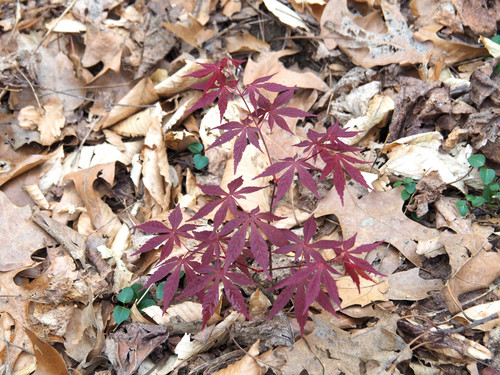
How to care for Japanese maple
Watering
Japanese maple (Acer palmatum) has fine, shallow roots that dry out quickly in pots and dislike both drought and soggy soil. Keep the root zone evenly moist during the growing season, water deeply when the top layer dries, and let the soil breathe between waterings. Container plants need more frequent watering than those in the ground, and newly planted trees need regular watering for their first two growing seasons.
Does it need water today?
Push a finger about 3-5 cm into the soil near the root ball. If it feels dry, water thoroughly until it drains from the bottom of the pot or soaks the root zone. If it still feels damp, wait a day or two. For potted plants, lift the pot: a light pot means it needs water. Leaves that are slightly limp in the afternoon can also signal thirst.
Mulch the soil surface with 5-7 cm of shredded bark or leaf mould, keeping it away from the trunk. This slows evaporation and keeps roots cooler, which Japanese maples greatly appreciate, especially in summer heat.
Overwatering
Japanese maple has fine feeder roots that suffocate in waterlogged soil, and root rot is one of the most common causes of decline in container and garden trees. Heavy clay soils that stay wet after rain make this problem worse. Saturated roots cannot take up water or oxygen, even though the soil looks wet.
Symptoms: Yellowing leaves that drop early, wilting even when the soil is wet, leaf scorch on new growth, a sour smell from the soil, and dieback of twigs. Mushy or brown roots and a dark, soft trunk base are late signs.
Solutions: Stop watering and check that the pot drains freely. For potted trees, repot into a fast-draining mix with added perlite or grit and a pot with drainage holes. For garden trees, improve drainage by planting on a slight mound and avoid adding more water until the top 5 cm of soil is dry. Prune out any rotten roots or dead branches with clean tools.
Underwatering
Japanese maple leaves are thin and lose water quickly, especially in full sun, wind, or hot, dry spells. Young trees and those in containers can dry out in a few days, and drought stress can weaken the tree's defences against pests such as aphids and borers.
Symptoms: Leaves that curl, crisp at the edges, or turn brown and papery, with premature leaf drop in summer. The soil pulls away from the pot edge, and the root ball feels light and dry to the touch.
Solutions: Water slowly and deeply until moisture reaches the full root ball. If the root ball has shrunk away from the pot, soak the whole pot in a basin of water for 30 minutes. Apply mulch, move the plant to a spot with afternoon shade, and water more frequently during heatwaves, especially for potted specimens.
Sunlight
Japanese maple grows naturally under the canopy of taller trees, so it prefers filtered light or morning sun with afternoon shade. Full sun can scorch leaves, especially in hot climates, though some cultivars with red foliage colour more intensely with more light. Dark-leaved cultivars tolerate more sun than green or variegated ones, which need more shade to avoid burning.
- Ideal: Partial sun · 3-6 hours of gentle morning sun or dappled light; avoid harsh afternoon sun
- Tolerates: Partial sun, Bright, indirect light, Shade
- Best spot in a room: At the window
- Artificial light: Indoors, Japanese maple is not a good long-term houseplant. If grown inside temporarily, a bright east or north window or a full-spectrum LED grow light set about 30 cm above the canopy for 12-14 hours a day can help maintain foliage.
Too little light
Japanese maple needs enough light to build energy for its leaves and branches. Too little light makes growth weak and leggy, and the leaves lose their colour and fail to hold their structure. Low light also reduces the tree's ability to recover from pruning and pests.
Symptoms: Long, spindly shoots reaching toward the light, small pale leaves, loss of red or purple colour, sparse foliage in the inner canopy, and slow growth.
Solutions: Move the plant to a brighter spot with morning sun or bright, filtered light. Thin dense branches in the crown to let light reach the inner leaves, and in shady gardens, prune nearby shrubs or limb up taller trees where possible.
Too much sun
Japanese maple has thin, delicate leaves that are easily damaged by intense sun, heat, and reflected light from walls or pavement. Prolonged strong light, especially in the afternoon, dries leaves faster than the roots can supply water, causing scorch.
Symptoms: Brown, crispy patches on leaf margins or between veins, bleached or faded colour, leaves curling inward, and early leaf drop during summer heat.
Solutions: Move the plant to a spot with afternoon shade, such as under a taller tree or on the east side of a building. Provide shade cloth during heatwaves, keep the root zone mulched and moist, and avoid planting in reflective locations like south-facing walls. Established trees in full sun may tolerate more light if well watered.
Temperature
Japanese maple thrives in cool, mild summers and cold winters with a real dormant period. Hardy in most of USDA zones 5 to 8. Container plants need protection from both freezing roots and scorching afternoon heat.
- Ideal: 5–25 °C
- Tolerates: -25–38 °C
- Hardiness zones: 5-8
Fertilizing
Japanese maples are light feeders with fine, shallow roots that burn easily. Feed sparingly, prioritize soil health with organic matter, and stop fertilizing by late summer so new growth can harden off before winter.
- Slow-release fertilizer: Apply once a year in early spring, just as buds begin to swell.
- Slow-release balanced granular fertilizer (e.g. 10-10-10 or 12-6-6), Acidic or azalea/rhododendron fertilizer for maples grown in slightly acidic soil, Well-rotted compost or leaf mold as an organic top dressing, Balanced liquid fish emulsion for container plants
Soil
Japanese maples grow best in slightly acidic, humus-rich, free-draining soil that stays evenly moist but never waterlogged. Their fine roots suffocate in dense clay or compacted mixes, and they dislike alkaline conditions that cause leaf yellowing.
- Gritty ericaceous-style mix: About 50% fine bark or peat-free coir, 30% pumice or horticultural grit, and 20% composted leaf mould or fine pine bark fines
- Garden loam for in-ground planting: Good loam amended with 30% compost and coarse sand or grit, with organic matter worked into the top 30 cm
- Acidic leaf mould blend: Mostly well-rotted leaf mould with added pine bark and a little grit to keep it open
- pH 5.5–6.5
Repotting
Japanese maples have fine, shallow, fibrous roots that are easily damaged and dry out quickly. Repot in early spring just before buds swell, and keep root disturbance minimal.
- How often: Every 2-3 years for young container-grown Japanese maples; every 3-4 years for mature specimens, with top-dressing in between
- New pot: Move up only one pot size (about 2-5 cm wider in diameter) each time, using a shallow, well-draining container with several drainage holes
- Repotting season: Spring
How to repot
- Tip the pot on its side and gently slide the root ball out, supporting the trunk base with one hand
- Tease away the outer 1-2 cm of compacted roots with your fingers or a chopstick; trim any dead, black, or mushy roots with clean shears
- Set the tree in the new pot so the root flare (where the trunk widens) sits about 2 cm above the rim
- Fill around the roots with fresh mix, tapping gently to remove large air pockets without compacting it
- Water thoroughly until it drains freely, then top up the soil so the surface is level with the rim
Pruning
Prune lightly and selectively. Japanese maple bleeds sap heavily when cut in late winter and early spring, but this is cosmetic and does not seriously harm the tree. Avoid removing more than about one quarter of the canopy in a single year, and never cut into bare wood on old branches without leaves to recover from.
Pruning season: Winter, Summer
How to prune
- In mid-winter, while the tree is dormant, remove all dead, broken, or diseased branches back to healthy wood or to the branch collar.
- Thin out crossing branches and any stems growing toward the center of the canopy so light and air can reach inside.
- Shorten long, whippy shoots by cutting just above a bud or a lateral branch to maintain a balanced shape.
- In summer, after the leaves have fully expanded, make light corrective cuts only, such as removing water sprouts from the trunk or branches. Avoid heavy summer pruning, which can scorch exposed inner bark in hot sun.
- Do not prune in late autumn or early winter when the weather is very cold, since fresh cuts may be damaged by frost.
Propagation
Seed stratification and sowing · Autumn, Winter
- Collect ripe samaras (winged seeds) from the tree in late summer or early autumn, when they turn brown and start to fall.
- Remove the wings and soak the seeds in water for 24 hours.
- Mix the seeds with moist sand or peat in a sealed bag and refrigerate them at about 4°C for 60 to 90 days to mimic winter.
- In early spring, sow the seeds 1 cm deep in a pot of gritty, well-draining potting mix and keep it lightly moist.
- Place the pot somewhere bright but out of harsh afternoon sun until seedlings appear, then gradually increase light.
Softwood cuttings · Spring, Summer
- In late spring or early summer, take 8 to 10 cm tip cuttings from current-season green growth that has just begun to firm up.
- Strip the lower leaves and dip the cut end in rooting hormone.
- Insert the cutting into a pot of moist perlite or a 1:1 mix of perlite and peat.
- Cover with a clear plastic bag or misting dome to hold humidity high, and keep out of direct sun.
- Check for roots after 6 to 8 weeks by gently tugging the cutting; resistance means roots have formed.
Grafting onto rootstock · Winter, Spring
- Use one-year-old seedlings of Acer palmatum or Acer palmatum rootstock as the base, since cultivated forms of Japanese maple are often grafted to keep their named leaf shapes and colors.
- In late winter, while the plants are dormant, make matching angled cuts on the scion (dormant shoot from the chosen cultivar) and the rootstock.
- Join the cambium layers tightly and wrap the union with grafting tape.
- Seal the cut ends with grafting wax and keep the plant in a cool, humid spot until new growth emerges.
Japanese maple seed is often slow to germinate and many seedlings will not match the parent. For a plant that keeps the exact leaf shape and color of a named cultivar, softwood cuttings or grafting are more reliable.
About Japanese maple
Also known as: Japanese maple, Smooth Japanese maple, Palmate maple, Kaede
- Plant type: tree, shrub
- Lifespan: perennial
- Distribution: Native to Japan, Korea, eastern China and parts of Taiwan.
- Mature height: 2 to 8 m in cultivation
- Bloom time: Spring, alongside the emerging leaves
Pets · People
Pets: Safe · People: Safe. Acer palmatum is not listed as toxic to dogs, cats or horses by the ASPCA; the seeds and leaves are considered non-toxic, though large quantities of plant matter may upset a pet's stomach.
Common problems
- Leaf scorch: Edges turn brown and crisp, usually from strong afternoon sun, drying wind or underwatering in containers.
- Verticillium wilt: A soil fungus causing wilting on one side of the crown and dieback of branches; no cure once established.
- Aphids: Clusters of sap-sucking insects on new shoots, which can leave sticky honeydew and distort young leaves.
- Waterlogged roots: Poor drainage causes yellowing leaves and root rot, especially in heavy clay soil.
- Sunscald on bark: Thin-barked young trees can crack on the sunny side of the trunk during hard winter frosts.
Uses
Primarily ornamental, grown as a specimen tree, in containers, in Japanese-style gardens and as a bonsai subject. Wood is occasionally used for small turned objects and carving, and the tree has long been valued in Japanese garden design.
Is it edible?
Not edible in any practical sense; leaves and seeds are not used as food, though young leaves are sometimes pickled or used as a garnish in Japanese cuisine.
History & legends
In Japan, maples have long been associated with autumn poetry and seasonal festivals, and the red-leaved forms have appeared in classical art and garden scrolls for centuries. Many old garden specimens are treasured as living heritage in temple and imperial gardens.
Did you know?
Japanese gardeners have cultivated maples for centuries, and some old cultivars are grafted specimens more than a hundred years old that are still trained into bonsai.
Frequently asked questions
How often should I water Japanese maple?
every 5 days. Japanese maple (Acer palmatum) has fine, shallow roots that dry out quickly in pots and dislike both drought and soggy soil. Keep the root zone evenly moist during the growing season, water deeply when the top layer dries, and let the soil breathe between waterings. Container plants need more frequent watering than those in the ground, and newly planted trees need regular watering for their first two growing seasons. Push a finger about 3-5 cm into the soil near the root ball. If it feels dry, water thoroughly until it drains from the bottom of the pot or soaks the root zone. If it still feels damp, wait a day or two. For potted plants, lift the pot: a light pot means it needs water. Leaves that are slightly limp in the afternoon can also signal thirst.
How much light does Japanese maple need?
Partial sun (3-6 hours of gentle morning sun or dappled light; avoid harsh afternoon sun). Japanese maple grows naturally under the canopy of taller trees, so it prefers filtered light or morning sun with afternoon shade. Full sun can scorch leaves, especially in hot climates, though some cultivars with red foliage colour more intensely with more light. Dark-leaved cultivars tolerate more sun than green or variegated ones, which need more shade to avoid burning.
What temperature does Japanese maple like?
5–25 °C. Japanese maple thrives in cool, mild summers and cold winters with a real dormant period. Hardy in most of USDA zones 5 to 8. Container plants need protection from both freezing roots and scorching afternoon heat.
Is Japanese maple toxic to cats and dogs?
It is safe for cats and dogs. Acer palmatum is not listed as toxic to dogs, cats or horses by the ASPCA; the seeds and leaves are considered non-toxic, though large quantities of plant matter may upset a pet's stomach.
What are the most common problems of Japanese maple?
Leaf scorch: Edges turn brown and crisp, usually from strong afternoon sun, drying wind or underwatering in containers. Verticillium wilt: A soil fungus causing wilting on one side of the crown and dieback of branches; no cure once established. Aphids: Clusters of sap-sucking insects on new shoots, which can leave sticky honeydew and distort young leaves. Waterlogged roots: Poor drainage causes yellowing leaves and root rot, especially in heavy clay soil. Sunscald on bark: Thin-barked young trees can crack on the sunny side of the trunk during hard winter frosts.
When should I repot Japanese maple?
Every 2-3 years for young container-grown Japanese maples; every 3-4 years for mature specimens, with top-dressing in between. Japanese maples have fine, shallow, fibrous roots that are easily damaged and dry out quickly. Repot in early spring just before buds swell, and keep root disturbance minimal.
How do I propagate Japanese maple?
Seed stratification and sowing, Softwood cuttings, Grafting onto rootstock. Collect ripe samaras (winged seeds) from the tree in late summer or early autumn, when they turn brown and start to fall. Remove the wings and soak the seeds in water for 24 hours. Mix the seeds with moist sand or peat in a sealed bag and refrigerate them at about 4°C for 60 to 90 days to mimic winter. In early spring, sow the seeds 1 cm deep in a pot of gritty, well-draining potting mix and keep it lightly moist. Place the pot somewhere bright but out of harsh afternoon sun until seedlings appear, then gradually increase light.
How this guide was written
Verdiss writes each guide with AI from botanical references and checks the species against iNaturalist and Plants of the World Online (Kew). Readers can rate every guide in the app.
Sources
Verdiss's information is for general guidance. Never eat or use a plant as medicine based on an app: ask a professional.